
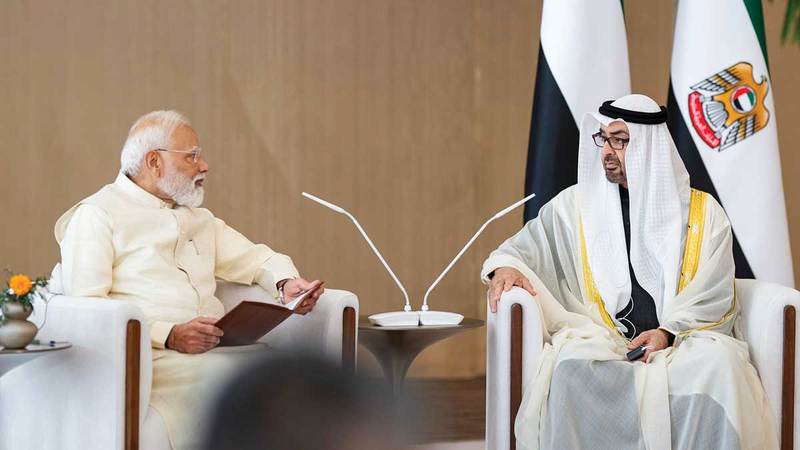
India and UAE Deepen Strategic Ties with Major Defense and Energy Pacts During PM Modi’s Abu Dhabi Visit
In a significant move to solidify bilateral relations amidst growing regional volatility, Indian Prime Minister Narendra Modi and UAE President Sheikh Mohamed bin Zayed Al Nahyan have finalized a series of high-level strategic agreements. The pacts, signed during the Prime Minister’s visit to Abu Dhabi, span critical sectors including defense, energy security, and large-scale infrastructure investment, marking a new chapter in the India-UAE strategic partnership.
The diplomatic engagement comes at a sensitive time for West Asia. Following recent missile and drone attacks targeting the Emirates, the meetings served as a platform to reaffirm mutual support and address the necessity of regional stability. Prime Minister Modi, characterizing his discussions with President Sheikh Mohamed bin Zayed Al Nahyan with personal warmth, emphasized that India stands “shoulder to shoulder” with the UAE in navigating current geopolitical challenges.
Strengthening Energy Security and Maritime Infrastructure
A cornerstone of the newly signed agreements is the enhancement of energy cooperation, a vital component of the economic relationship between the two nations. As part of a strategic move to bolster India’s energy resilience, the UAE has agreed to the storage of 30 million barrels of oil in Indian strategic petroleum reserves. This arrangement is expected to provide a critical buffer for India against global supply fluctuations and market volatility.

In addition to petroleum storage, the bilateral pacts include provisions for the supply of Liquefied Petroleum Gas (LPG), further integrating the energy markets of the two nations. This cooperation extends into the maritime sector, where a new ship repair cluster is set to be established in Vadinar, Gujarat. This development is expected to transform the region into a significant maritime hub, leveraging India’s coastal infrastructure to support growing commercial and strategic shipping needs.
The focus on Vadinar is particularly noteworthy for regional logistics. By developing a specialized cluster for ship repairs, both nations are investing in the long-term efficiency of trade routes that are essential to the global economy, particularly those traversing the Indian Ocean and the Arabian Sea.
Defense Cooperation and a $5 Billion Investment Pledge
Moving beyond commerce, the two leaders have established a formal framework for a strategic defense partnership. While the specific operational details of the framework remain subject to further bilateral implementation, the agreement signals a move toward deeper security cooperation, which may include intelligence sharing, maritime security, and potentially joint training or technological collaboration.
The economic dimension of the visit was equally robust, highlighted by a massive investment commitment from the UAE. The Emirates has pledged total investments of USD 5 billion toward various Indian sectors. This capital injection is earmarked for Indian infrastructure projects, as well as significant stakes in the financial sector, specifically targeting RBL Bank and Samman Capital.
This infusion of capital into Indian banking and infrastructure is expected to catalyze domestic growth and provide the necessary liquidity to support large-scale development projects. For the UAE, these investments represent a strategic diversification of its own wealth into one of the world’s fastest-growing major economies.
Navigating Geopolitical Volatility in West Asia
The summit was not merely about economic pacts; it was a high-stakes diplomatic response to the escalating tensions in the West Asian region. Prime Minister Modi addressed the recent attacks on the UAE, labeling such targeting as “unacceptable” and praising the UAE’s leadership for handling the situation with “restraint.”
A central theme of the discussions was the preservation of international maritime law and the freedom of navigation. Prime Minister Modi underscored that the Strait of Hormuz—a vital artery for global energy supplies—must remain “free, open and safe.” This stance reflects India’s growing role as a stabilizer in the region and its commitment to protecting the sea lanes essential to its own energy security and global trade interests.
Expressing India’s readiness to assist in regional stabilization, the Prime Minister noted that the impacts of the West Asian conflict are being felt on a global scale. The discussions between Modi and President Sheikh Mohamed bin Zayed Al Nahyan reinforced a shared vision for a stable, peaceful, and prosperous region, with India offering “all possible support” to restore equilibrium.
Key Takeaways: India-UAE Strategic Expansion
- Defense: Establishment of a new framework for a strategic defense partnership.
- Energy: Agreement to store 30 million barrels of oil in India’s strategic petroleum reserves and expanded LPG supply.
- Finance: A USD 5 billion investment pledge from the UAE into Indian infrastructure, RBL Bank, and Samman Capital.
- Maritime: Development of a major ship repair cluster in Vadinar, Gujarat.
- Geopolitics: Reaffirmation of the necessity for a “free, open and safe” Strait of Hormuz.
Frequently Asked Questions
What is the significance of the 30 million barrels agreement?
The agreement allows the UAE to store significant quantities of oil in India’s strategic reserves, which enhances energy security for both nations and provides a buffer against sudden disruptions in the global oil market.

How much is the UAE investing in India?
The UAE has pledged a total of USD 5 billion, which will be directed toward Indian infrastructure, RBL Bank, and Samman Capital.
Why is the Vadinar ship repair cluster important?
Located in Gujarat, the Vadinar cluster will enhance India’s maritime capabilities and support the growing needs of international shipping, strengthening the economic ties through maritime services.
What was the Prime Minister’s stance on regional conflict?
Prime Minister Modi expressed support for the UAE’s restraint during recent attacks and emphasized that India is ready to support efforts to bring peace and stability to West Asia.
The diplomatic momentum from this visit is expected to continue as Prime Minister Modi proceeds with his tour of four European nations. Further details regarding the implementation of the defense framework and the specific infrastructure projects receiving UAE funding are expected to be released in subsequent bilateral updates.
What are your thoughts on the deepening of these strategic ties? Do you believe this will significantly impact regional stability? Let us know in the comments below and share this report with your network.