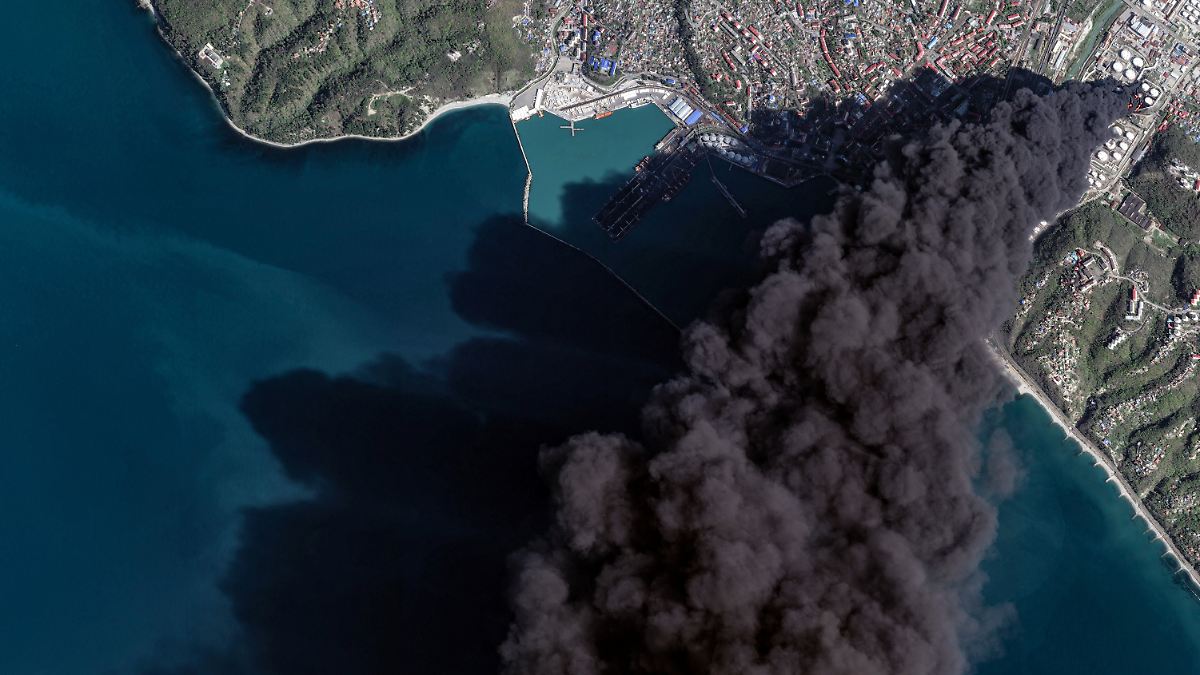
Fire Breaks Out Again at Russian Oil Terminal in Tuapse Amid Ongoing Ukraine Conflict
Flames erupted once more at the Tuapse oil terminal on Russia’s Black Sea coast, marking another incident in a series of attacks targeting energy infrastructure linked to Russia’s war in Ukraine. Local emergency services confirmed the blaze began in the early hours of May 23, 2024, at a fuel storage facility within the port complex. Thick plumes of black smoke were visible across the Krasnodar Krai region, prompting temporary evacuations and heightened alert levels among nearby residents. While no casualties were immediately reported, the fire reignited concerns over the vulnerability of critical energy assets amid escalating cross-border strikes.
The Tuapse refinery, operated by Rosneft, is one of Russia’s key export hubs for crude oil and refined products, handling millions of tons annually. Its repeated targeting underscores Ukraine’s strategy of degrading Russian military logistics by striking fuel supplies far from the front lines. Although Kyiv has not officially claimed responsibility for the latest incident, Ukrainian officials have previously acknowledged conducting long-range drone strikes against Russian energy infrastructure as part of broader efforts to weaken Moscow’s war capacity. The attack comes amid intensified Russian advances in eastern Ukraine, particularly around the cities of Sumy and Zaporizhzhia, where ground combat remains fierce.
Satellite imagery analyzed by independent observers showed signs of combustion at multiple tank farms within the terminal shortly after midnight local time. Emergency crews deployed foam retardants and cooling systems to prevent the fire from spreading to adjacent storage units containing gasoline and diesel. By midday, officials stated the blaze had been contained, though residual smoke continued to rise from the site. Environmental agencies warned of potential air quality risks due to particulate matter released during the burn, advising vulnerable populations to limit outdoor exposure until further notice.
Strategic Significance of Tuapse in Russia’s Energy Network
Located approximately 180 kilometers northwest of Sochi, the Tuapse port complex plays a vital role in Russia’s southern energy corridor. It processes crude oil shipped via pipeline from fields in Western Siberia and the Volga region, converting it into transport fuels, lubricants, and petrochemical feedstocks for domestic consumption and export. According to data from the Russian Ministry of Energy, the facility accounts for roughly 8% of the nation’s refining capacity, making it a strategically valuable node in both civilian and military supply chains.
Western intelligence assessments have noted that disruptions to Tuapse operations could impair Russia’s ability to sustain mechanized units operating in southern Ukraine, where fuel convoys are essential for maintaining offensive momentum. The terminal’s proximity to NATO-member Turkey also adds geopolitical weight, as any significant interruption raises questions about regional energy security and maritime traffic through the Bosphorus Strait. While Russia maintains alternative export routes through Novorossiysk and Primorsk, analysts argue that repeated strikes on southern hubs increase operational costs and complicate logistics planning.
In response to prior incidents, Rosneft has invested in upgraded air defense systems around the terminal, including short-range radar and electronic warfare suites designed to detect and neutralize incoming drones. Still, experts caution that no defense is foolproof against low-flying, slow-moving unmanned aerial vehicles, especially when launched in swarms from considerable distances. The use of modified commercial drones equipped with explosive payloads has become a hallmark of Ukraine’s asymmetric warfare approach, allowing precision strikes on high-value targets without risking pilot lives.
Broader Pattern of Attacks on Russian Energy Infrastructure
The Tuapse fire is part of a documented trend of Ukrainian strikes targeting oil refineries, depots, and pumping stations deep within Russian territory. Since early 2023, facilities in Bryansk, Kursk, Volgograd, and Tatarstan have experienced similar incidents, often attributed to drone attacks launched from Ukrainian-held territory or launched via proxy networks. A report by the Conflict Armament Research group confirmed that Ukrainian forces have increasingly relied on domestically produced UAVs such as the UJ-22 Airborne and PD-2 models for these missions, citing their range and adaptability.
Moscow has consistently condemned such actions as acts of terrorism, urging international bodies to designate specific Ukrainian units as terrorist organizations. Kyiv, in turn, frames these operations as legitimate military tactics under international law, arguing that energy infrastructure supporting Russia’s war effort qualifies as a lawful target. The United Nations has not issued a definitive ruling on the matter, though independent legal scholars note that the principle of distinction — requiring attackers to differentiate between civilian and military objectives — remains central to assessing legality.
Despite the attacks, Russian oil exports have remained relatively stable due to redirected shipments to India and China, which have increased purchases of discounted Urals crude following Western sanctions. However, downstream refining capacity constraints have led to periodic domestic fuel shortages in border regions, prompting Moscow to impose temporary export restrictions on gasoline and diesel to prioritize internal markets. Economists warn that sustained damage to refining infrastructure could eventually undermine Russia’s ability to balance wartime demands with civilian energy needs.
Humanitarian and Environmental Considerations
While industrial fires at oil terminals rarely result in direct civilian casualties when contained quickly, they pose secondary risks through air and water pollution. Burning hydrocarbons release volatile organic compounds, nitrogen oxides, and particulate matter, which can exacerbate respiratory conditions, particularly among children, the elderly, and those with pre-existing illnesses. Local health authorities in Tuapse deployed mobile monitoring units to assess airborne toxin levels, with initial readings showing elevated benzene concentrations near the fire perimeter.
Water contamination remains a concern given the terminal’s proximity to the Tuapse River, which flows into the Black Sea. Environmental NGOs have urged Russian authorities to deploy containment booms and conduct soil testing to prevent long-term ecological damage. Past incidents at similar facilities have shown that firefighting runoff containing oil residues can persist in sediments for months, affecting aquatic life and potentially entering the food chain. As of now, no official reports indicate significant marine impact, but monitoring continues.
The psychological toll on nearby communities should not be overlooked. Repeated explosions and fires, even without loss of life, contribute to chronic stress and anxiety, particularly in areas already affected by economic strain from sanctions and wartime mobilization. Human rights monitors have called for greater transparency from both Russian and Ukrainian authorities regarding the conduct of hostilities near populated zones, emphasizing the necessitate to minimize harm to non-combatants under international humanitarian law.
What Comes Next: Monitoring and Accountability
As of May 24, 2024, Russian officials have not released a full technical report on the cause of the Tuapse fire, though preliminary statements point to an external impact consistent with a drone strike. The Russian Investigative Committee has opened a case under Article 205 of the Criminal Code, which covers acts of terrorism, and is reportedly analyzing debris recovered from the site. Ukrainian military intelligence has neither confirmed nor denied involvement, maintaining its standard policy of operational secrecy regarding specific missions.
Independent verification remains challenging due to restricted access to the site and limited on-the-ground reporting from international journalists in the region. Satellite providers such as Maxar and Planet Labs continue to monitor the terminal for signs of renewed activity or repair efforts. Analysts at the Institute for the Study of War suggest that further attacks are likely as Ukraine seeks to maintain pressure on Russian rear-area logistics ahead of any potential summer counteroffensive.
For updates on the situation, readers are encouraged to consult official statements from the Russian Ministry of Emergency Situations and verified reports from reputable wire services such as Reuters and Agence France-Presse. Both agencies have correspondents stationed in the region and routinely cross-check claims from multiple sources before publication.
Stay informed, share responsibly, and join the conversation below. Your perspective helps foster a deeper understanding of complex global events.