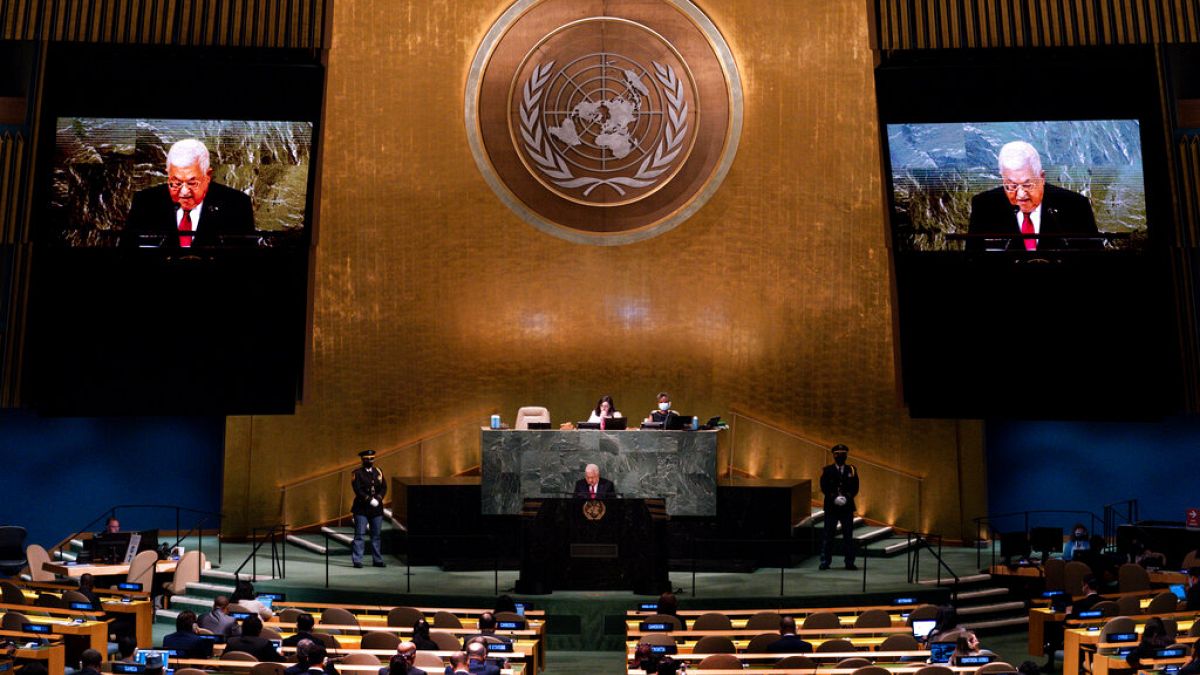
UN General Assembly backs Two-State solution Despite Israeli Rejection, Amidst Gaza Crisis
New York, NY – In a resounding display of international consensus, the United Nations general Assembly overwhelmingly approved a non-binding resolution Friday supporting a two-state solution for Israel and Palestine. The vote, 142 in favor, 10 against, and 12 abstentions, came just hours after Israeli Prime Minister Benjamin Netanyahu explicitly rejected the establishment of a Palestinian state, underscoring the deep chasm in perspectives surrounding the ongoing conflict. This declaration, known as the New York Declaration, represents a significant, though non-legally binding, signal of global intent amidst a devastating humanitarian crisis in Gaza.
A Framework for Transition & Security
The resolution, jointly presented by France and Saudi Arabia, outlines a phased approach to achieving a lasting peace.Crucially,it envisions the Palestinian Authority (PA) assuming governance over all Palestinian territories,with an immediate transitional administrative committee established following a ceasefire in Gaza. A key condition for this transition is the complete disarmament of Hamas and the unconditional release of all hostages currently held - approximately 50 individuals,with around 20 believed to be alive.
Beyond governance, the declaration calls for a UN-backed security mission to safeguard Palestinian civilians, provide security assurances for both Israelis and Palestinians, facilitate the peaceful transfer of authority to the PA, and monitor both the ceasefire and any future peace agreement. This proposed mission acknowledges the urgent need for a neutral,internationally recognized force to stabilize the region and build trust.
Acknowledging Suffering on both Sides
The New York declaration doesn’t shy away from acknowledging the immense suffering endured by both Israelis and Palestinians. It unequivocally condemns the October 7th Hamas-led attacks on southern Israel, which resulted in the deaths of roughly 1,200 people, predominantly civilians, and the abduction of 250 hostages.
However, the resolution also delivers a stark condemnation of Israel’s military response in Gaza, specifically its attacks on civilians and civilian infrastructure, and the imposition of a “siege and starvation” that has precipitated a catastrophic humanitarian crisis. Data from the Gaza Health Ministry, consistently cited by international bodies like the UN, indicates over 64,000 Palestinians have been killed as October 7th, a figure that includes a disproportionate number of women and children. While the precise breakdown between combatants and civilians remains contested, the scale of the loss of life is undeniable.
The declaration highlights the devastating impact of the conflict, noting that vast areas of Gaza have been reduced to rubble and over two million people – the vast majority of the population – have been displaced. The UN has officially declared famine is occurring in the Gaza governorate, with projections indicating its spread to Deir al Balah and Khan Younis within the month. This escalating humanitarian disaster demands immediate and sustained international attention.
The Push for Palestinian Statehood & International Recognition
A central tenet of the New York Declaration is the assertion that recognizing a Palestinian state is “essential and indispensable” for achieving a viable two-state solution. The resolution implicitly criticizes Israel’s unilateral actions, stating that they “pose an existential threat to the realization of the independent state of Palestine.”
This call for recognition comes amidst a growing international movement. Belgium recently joined the United Kingdom and France in recognizing Palestinian statehood, and Palestinian officials are optimistic that at least ten more countries will follow suit during the upcoming UN General Assembly annual gathering.Currently, over 145 countries already recognize Palestine.
Reactions & Opposition
Palestinian UN Ambassador Riyah Mansour hailed the resolution as a reflection of the “yearning of almost everyone,the international community,to open the door for the option of peace.” He directly appealed to those “pushing the option of war and destruction” to embrace peaceful dialog and heed the overwhelming message delivered by the General Assembly.
However, the resolution faced strong opposition. Israel rejected the declaration outright, dismissing it as a benefit solely to Hamas. Israeli UN Ambassador Danny Danon characterized it as a “hollow gesture” that undermines the assembly’s credibility. Prime Minister Netanyahu, during a visit to an Israeli settlement in the occupied West Bank, reiterated his opposition to a Palestinian state, asserting, ”this place belongs to us.”
The United States, israel’s closest ally, also voiced its disapproval, with US mission counselor Morgan Ortagus labeling the resolution a “misguided and ill-timed publicity stunt” that hinders genuine diplomatic efforts.
Analysis: A Symbolic Victory Amidst Deep-Rooted Challenges
While non-binding, the UN General Assembly’s vote represents a significant symbolic victory for proponents of a two-state solution. It underscores the growing international frustration with the stalled peace process and the escalating humanitarian crisis in Gaza.