
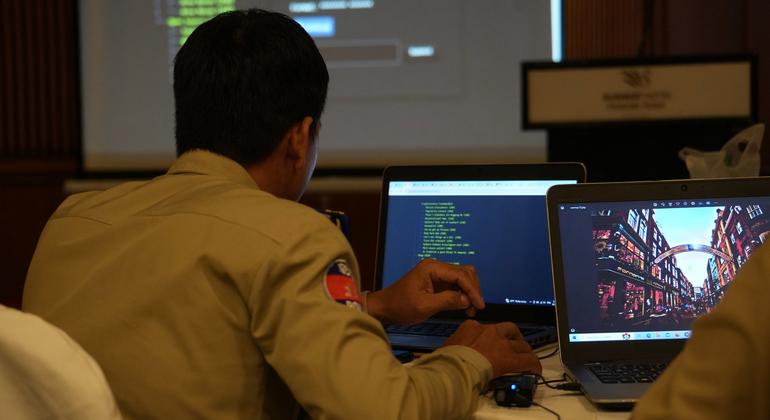
The Rising Tide of Cybercrime & A Landmark UN Response
The digital age has ushered in unprecedented connectivity and chance,but it’s also created fertile ground for a rapidly evolving threat: cybercrime. Today’s criminals leverage the speed and scale of the internet, and increasingly, the power of artificial intelligence, to operate with a sophistication and reach previously unimaginable.This isn’t just about individual attacks; it’s a global challenge demanding a coordinated, international response.
The nature of cybercrime is shifting. No longer confined to technically skilled hackers, malicious actors can now exploit readily available tools to launch devastating attacks. From autonomous cyberattacks that self-propagate to the creation of incredibly realistic “deepfake” content used for fraud, and the proliferation of AI-enhanced phishing campaigns, customary cybersecurity measures are constantly playing catch-up.
The Democratization of Cybercrime: Phishing & Credential Stuffing
Perhaps the most pervasive threat remains phishing - the deceptive practice of tricking individuals into revealing sensitive data like passwords and financial details. What’s particularly concerning is how accessible this crime has become. Inexperienced criminals can now purchase pre-packaged “phishing kits” that instantly generate convincing replicas of legitimate websites, making it harder than ever for users to discern what’s real and what’s not.
This vulnerability is compounded by the massive amounts of stolen credentials circulating on the dark web. Billions of username and password combinations, harvested from previous data breaches, are used in “credential stuffing” attacks - automated attempts to log into thousands of websites together, exploiting the common practice of password reuse. The consequences can be devastating, ranging from financial loss to identity theft.
A Turning Point: The UN convention Against Cybercrime
For years, the lack of a unified international legal framework has hampered efforts to effectively combat cybercrime. This is changing. In December 2024, the UN general Assembly adopted a historic agreement: the United nations convention against cybercrime. This marks the first international treaty on criminal justice in over two decades and represents a crucial step towards a safer online world.
The Convention is the culmination of five years of intensive negotiations involving UN Member States, alongside contributions from experts, civil society organizations, academic institutions, and the private sector. UN Secretary-General António guterres rightly hailed its adoption as “a decisive step” in the global fight against cybercrime.
[Image of mobile phone as evidence in cybercrime operation – as provided in original text]
A mobile phone, evidence in an anti-cybercrime operation in Southeast Asia, is set aside for analysis.
The treaty will be opened for signature on October 25th in Hanoi,Vietnam,and will come into force 90 days after ratification by 40 States. This timeline is critical; swift adoption is essential to maximize the Convention’s impact.
What Does the Convention Achieve?
The UN Convention against cybercrime establishes a common international framework for tackling this global threat. Key provisions include:
* Harmonized Definitions: A unified understanding of cybercrime offenses,eliminating ambiguity and facilitating cross-border cooperation.
* Standardized Investigation Procedures: Streamlined processes for investigating cybercrimes, including evidence collection and international assistance.
* Victim Support Mechanisms: Provisions for victim compensation, restitution, and the removal of illegal online content.
* international Cooperation: Enhanced collaboration between law enforcement agencies across borders, crucial for tracking down and prosecuting cybercriminals who frequently enough operate from multiple jurisdictions.
Importantly, the Convention respects national sovereignty. States will implement the measures outlined within the treaty in accordance with their own legal systems, but guided by agreed-upon international principles. the hope is that this treaty will usher in a new era of online safety, where a simple typo in a web address doesn’t lead to catastrophic consequences.
The UNODC: Leading the Charge
The United Nations office on Drugs and crime (UNODC) is at the forefront of the UN’s response to cybercrime. The agency provides vital training and support to countries worldwide, bolstering their capacity to prevent, detect, and prosecute cybercriminals.
The UNODC’s expertise extends to:
* Legislative Reform: Assisting countries in updating their laws to address emerging cyber threats.
* Law Enforcement capacity Building: Training law enforcement personnel in digital forensics, cyber investigation techniques, and international cooperation.
* Awareness-Raising: Educating the public about cybercrime risks and promoting safe online practices.
* Technical Assistance: Providing forensic support and data analysis to aid investigations.
* Research & Analysis: Monitoring cybercrime trends and developing strategies





