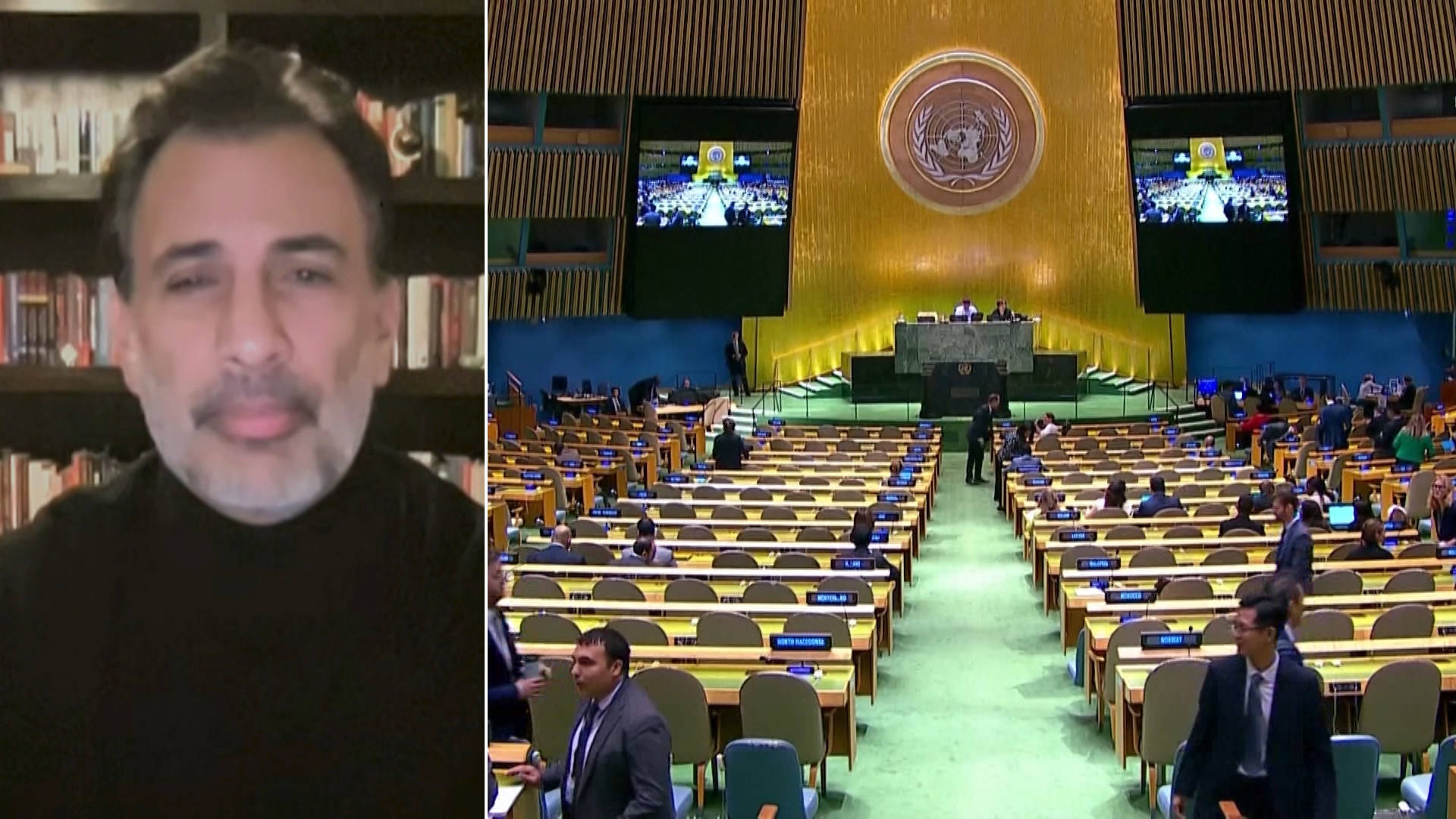
The Urgent Push for International Protection of Palestinians: A Former UN Official Explains the “Uniting for peace” Mechanism
The escalating violence in Gaza has ignited a renewed debate about international intervention and the protection of Palestinian civilians. While discussions around a two-state solution continue, a growing chorus of voices, including former UN officials, are advocating for a more immediate and robust response. This article delves into a potentially groundbreaking,yet often overlooked,mechanism within the United Nations – the “Uniting for Peace” resolution – and explores how it could offer a pathway to providing much-needed protection for Palestinians,even in the face of potential US opposition.
For over three decades, craig Mokhiber served within the United Nations human rights system, culminating in his recent resignation as the Director of the New York Office of the High Commissioner for Human Rights in protest of the organization’s response to the Gaza crisis. His insights,shared in a recent interview with Democracy Now!,offer a critical perspective on the limitations of current international efforts and the potential of the Uniting for Peace resolution.
Beyond Recognition: The Need for Active Protection
The international community has long acknowledged the plight of the Palestinian people, with many nations recognizing Palestinian statehood. Though, as Mokhiber emphasizes, recognition alone is insufficient in the face of ongoing atrocities. “recognition…in the middle of a genocide that is burning across the land, is not the kind of focus that we need,” he states. The immediate priority, he argues, is the protection of Palestinians undergoing what he unequivocally terms a “genocide.”
this is where the “Uniting for Peace” resolution (UN General Assembly Resolution 377A(V)) comes into play.Adopted in 1950 during the Korean War, this mechanism was designed to circumvent Security Council paralysis – often caused by vetoes from permanent members like the United States – and allow the General Assembly to take action in situations threatening international peace and security.
How ”Uniting for Peace” Could Work in Gaza
The resolution allows the General Assembly to recommend measures to maintain or restore international peace and security when the Security Council is unable to act due to a veto. Crucially,these measures can include authorizing a peacekeeping or protection force.
Mokhiber outlines a clear path forward: “There is an opportunity here now for that [protection force] to actually be created in September.” He highlights several key factors supporting this possibility:
No US Veto: Unlike Security Council resolutions, measures adopted under ”Uniting for Peace” cannot be vetoed by any single state, including the united States.
Two-Thirds Majority Achievable: Previous votes regarding Palestine within the General Assembly suggest a strong likelihood of securing the necessary two-thirds majority required for adoption.
Legal Standing: The International Court of Justice (ICJ) recently ruled that Israel has no sovereignty in Gaza or the West Bank,effectively stripping it of any legal right to consent to,or obstruct,the intervention of a protective force.Furthermore, the State of Palestine has formally requested such a force, and Palestinian civil society overwhelmingly supports it.
Israel Has No Legal Right to Refuse: The ICJ ruling establishes that Israel lacks the legal authority to prevent the deployment of a force aimed at protecting Palestinians.
The Obstacles and the Role of the US
While the “Uniting for Peace” mechanism offers a viable pathway, it’s not without potential roadblocks. Mokhiber cautions that the United States, acting on behalf of Israel, is likely to employ aggressive diplomatic tactics to derail the effort.
“The United States does not play fair in international diplomacy,” he warns. “One could expect that…it will use every carrot and stick – sticks, in particular – threats against delegations, not just allies, but delegations with developing economies that rely upon foreign aid.”
Though, Mokhiber remains hopeful that the world is ready to stand up and demand accountability. He believes that a public vote in the General Assembly will force nations to declare their position: “Under the glare of publicity, every state will have to say they either do or do not support protection for a people undergoing genocide.”
The Secretary-General’s Role – and Limitations
Addressing the question of UN Secretary-General António Guterres’ role, Mokhiber clarifies that the Secretary-General doesn’t possess the power to unilaterally initiate this process. Though, he criticizes Guterres for not leveraging the influence of his office more forcefully.
“He has no real power here, even though there’s much more he could have done in the past two
Related reading