
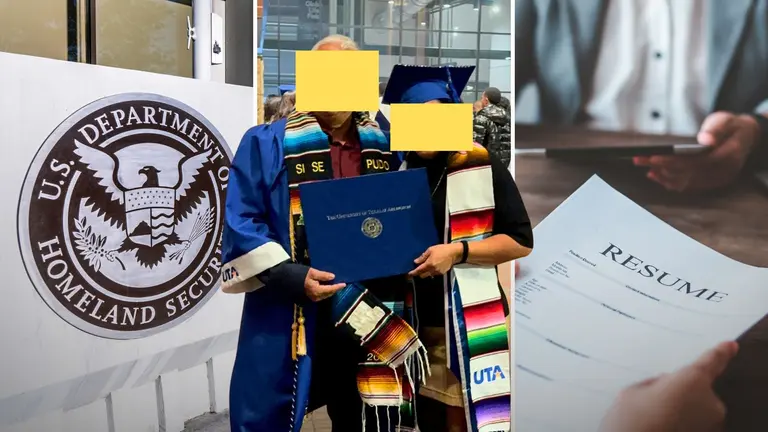
For many, the image of a university graduation—the tossing of the cap, the celebratory embrace of family, the walk across the stage—represents the ultimate threshold. It is the transition from the sheltered world of academia to the professional arena. But for a growing number of undocumented students in Texas, that threshold has become a wall.
In North Texas, a young woman named Alexia embodies this contradiction. Having arrived in the United States from El Salvador as a child, she navigated the complexities of a new language and a foreign culture, eventually discovering a profound passion for journalism. Through sheer determination and academic rigor, she achieved the milestone that millions strive for: a university degree. Yet, as the ink dried on her diploma, she encountered a systemic reality that rendered her professional training nearly obsolete.
Despite her qualifications and her degree, Alexia cannot legally work in the field she spent years studying. Her status as an undocumented immigrant means she lacks the legal authorization required to enter the professional workforce, leaving her in a state of professional limbo. Her story is not an isolated incident but a reflection of the precarious existence of “Dreamers” and other undocumented graduates who find that the state’s openness to their education does not extend to their employment.
This gap between educational access and professional utility creates a profound psychological and economic paradox. While Texas law provides a pathway for undocumented students to pursue higher education, federal immigration laws ensure that, for many, that education remains a trophy rather than a tool. The result is a wasted investment of human capital and a generation of highly skilled professionals who are legally barred from contributing to the economy.
The Paradox of the Texas Diploma
The struggle facing undocumented students in Texas is rooted in a clash between state-level educational policies and federal immigration mandates. Texas is one of several states that allow undocumented students to enroll in public universities and, under specific conditions, qualify for in-state tuition. This policy, codified through legislation such as Texas Senate Bill 1528, was designed to ensure that students who grew up in the state and graduated from Texas high schools had a chance to improve their lives through education.
However, the ability to attend college does not grant the ability to work. To be legally employed in the United States, an individual must provide proof of authorization to work, typically via a Social Security number and a document such as an Employment Authorization Document (EAD). For undocumented graduates, this is where the journey halts. Unless they have a specific legal status—such as those protected under the Deferred Action for Childhood Arrivals (DACA) program—they have no legal mechanism to obtain a work permit.
For Alexia, this meant that her degree in journalism, a field predicated on active reporting and professional employment, became a symbol of what could have been. The transition from student to professional, which should have been a moment of triumph, instead became a confrontation with the limitations of her legal status. She represents a demographic of students who were encouraged to strive for excellence in the classroom, only to find the exit doors locked upon graduation.
From El Salvador to the Newsroom: A Journey Interrupted
Alexia’s path to graduation was marked by the typical hurdles faced by immigrant children. Arriving from El Salvador, she faced an immediate language barrier and the jarring experience of cultural shock. The early years of her schooling were a struggle for dominance over the English language, a period she describes as difficult but necessary for her eventual success.
As she progressed through the education system, Alexia found her voice in journalism. The field offered a way to document the human experience and give voice to the marginalized—a drive likely fueled by her own experiences as an outsider. She navigated the university system without the benefit of government financial aid, which is generally unavailable to undocumented students, relying instead on personal sacrifice and limited community support.
The achievement of her degree was supposed to be the culmination of a long-term strategy for stability and integration. In the eyes of the university and the state of Texas, she had met the requirements for success. However, the “professional practice” required for a journalism career—internships, entry-level reporting jobs, and staff positions—all require the same legal documentation that remains out of her reach.
The Systematic Barriers to Professional Integration
The challenges for undocumented graduates extend beyond the simple lack of a work permit. In many professional fields, the barrier is even higher due to licensing requirements. For graduates in nursing, teaching, engineering, or law, a degree is only the first step; the second is professional licensure. In Texas, many of these licenses require proof of legal residency or citizenship, meaning that even if an undocumented graduate found an employer willing to overlook their status, they could not legally practice their profession.
This creates a phenomenon of “underemployment” or total unemployment among the most educated members of the undocumented community. Graduates with degrees in specialized fields often find themselves working in low-wage, “under-the-table” jobs in service or manual labor. This not only results in a loss of personal income but represents a significant loss for the state’s economy. When a trained journalist, nurse, or accountant is forced into unskilled labor, the return on the educational investment—both public and private—is effectively zero.
the instability of programs like DACA has added a layer of chronic anxiety to this struggle. For years, DACA provided a temporary reprieve, granting work authorization to eligible “Dreamers.” However, ongoing legal battles in federal courts have left the program’s future uncertain. For those who cannot qualify for DACA or those whose status is in jeopardy, the pursuit of a degree can feel like a gamble with no guaranteed payout.
The Human and Economic Cost of Legal Limbo
The psychological toll of being “overqualified and unauthorized” is immense. For students like Alexia, the experience of graduating only to be told they cannot work often leads to feelings of betrayal and hopelessness. The educational system encourages them to dream and achieve, but the legal system reminds them that they are unwelcome in the workforce.
From an economic perspective, this policy gap creates an artificial shortage of skilled labor. Texas continues to grow as a hub for technology, healthcare, and media, yet it ignores a pool of university-educated residents who are already integrated into the community and possess the necessary skills to fill these roles. The insistence on strict work authorization without a pathway to legal status ensures that these individuals remain in the shadows, unable to pay full taxes on their professional earnings or contribute to the professional growth of their cities.
The situation is further complicated by the lack of comprehensive immigration reform at the federal level. While state-level policies in Texas have opened the doors to the classroom, only federal action can open the doors to the office. Until a permanent legislative solution is reached, the “Texas Diploma” will continue to be a bittersweet achievement for thousands of students.
Key Challenges for Undocumented Graduates in Texas
| Phase | Status/Access | Primary Barrier |
|---|---|---|
| Higher Education | Permitted (SB 1528) | Lack of federal financial aid (FAFSA) |
| Graduation | Achievable | High personal/family financial cost |
| Employment | Legally Restricted | Lack of Work Authorization (EAD/SSN) |
| Professional Licensing | Highly Restricted | Residency/Citizenship requirements for licenses |
What Happens Next?
For students like Alexia, the immediate future remains uncertain. Many continue to seek alternative paths, such as pursuing further education in hopes that the legal landscape will shift, or seeking employers who are willing to navigate the complexities of unconventional hiring. However, these are precarious solutions that offer no long-term security.

The broader community of undocumented graduates continues to advocate for “professional pathways”—policies that would allow degree-holders to obtain limited work permits based on their educational achievements. Advocates argue that allowing graduates to work legally would not only benefit the individuals but would increase tax revenues and fill critical gaps in the labor market.
The next critical checkpoint for this community remains the federal judiciary and the U.S. Congress. Any ruling on the legality of DACA or any movement toward a comprehensive immigration bill that includes a pathway to residency for students would fundamentally change the trajectory for graduates across Texas. Until such a change occurs, the story of Alexia remains a cautionary tale of the gap between the American promise of education and the American reality of immigration law.
World Today Journal encourages readers to share this story and join the conversation on the intersection of education and immigration policy. How should states balance educational access with federal employment mandates? Let us grasp in the comments below.