
This advance could theoretically stretch quantum network connection distances from a few kilometers to 2,000 kilometers.
Connecting separate quantum computers over long distances has long posed a stubborn engineering wall. While classical data signals travel effortlessly across cities and oceans via amplification, quantum signals demand absolute fidelity. They cannot be copied or simply boosted without destroying their fragile states, meaning they must be handled by specialized architectures or direct entanglement.
Previously, the maximum distance two quantum computers could connect through a fiber cable spanned only a few kilometers. According to reporting from the University of Chicago, that limitation meant quantum machines stationed in downtown Chicago’s Willis Tower and the university’s campus on the South Side could not communicate. The new approach theoretically extends that maximum range to 2,000 kilometers, or roughly 1,243 miles, opening the door to intercity quantum communications between Chicago and Salt Lake City.
Molecular-Beam Epitaxy Rewrites Rare-Earth Crystal Production
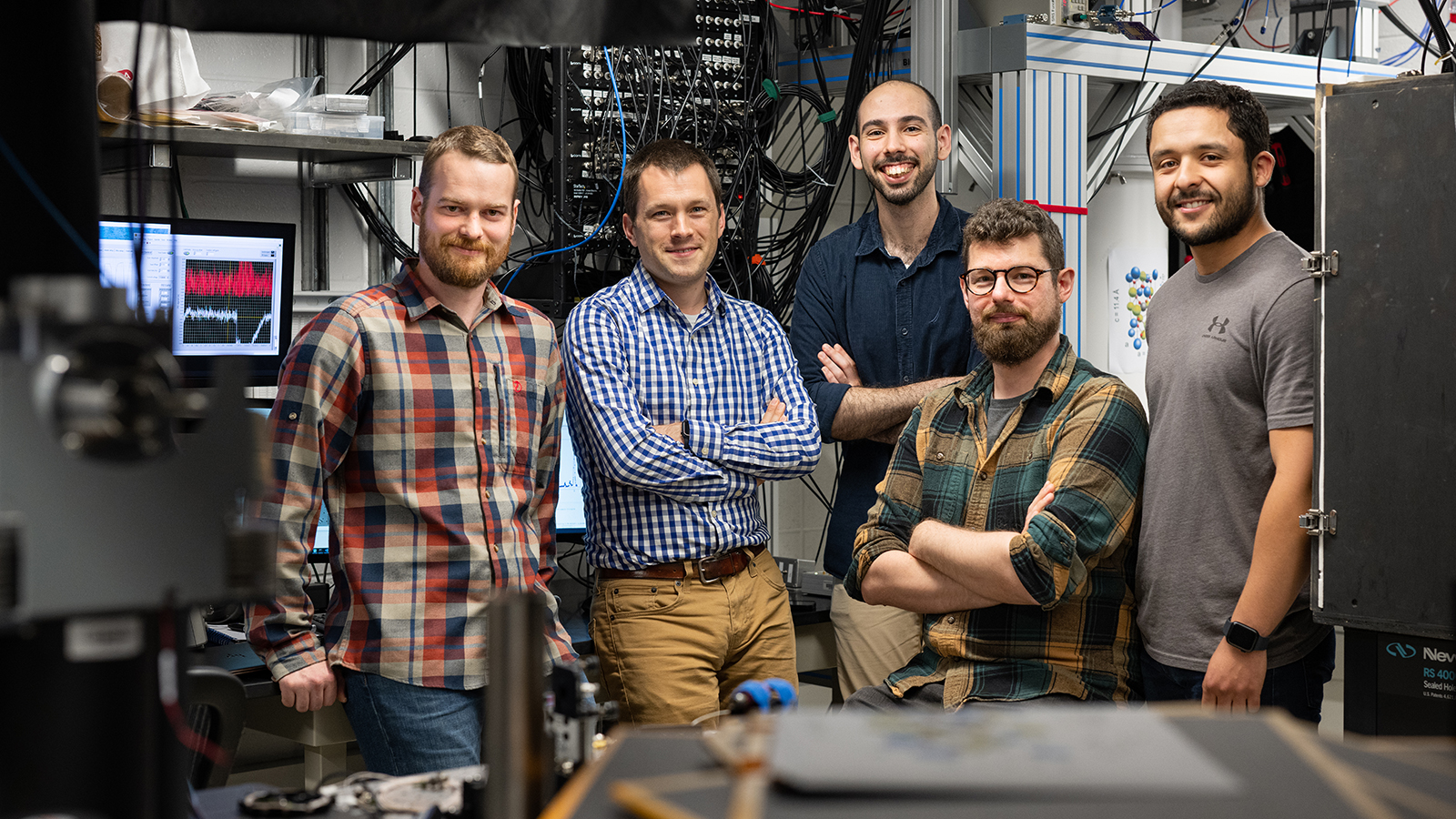
The core innovation arrived not through discovering an entirely new element, but by fundamentally changing how the materials are built. Led by assistant professor Tian Zhong, the research team at the University of Chicago Pritzker School of Molecular Engineering turned away from traditional manufacturing techniques.
Conventionally, researchers relied on the Czochralski method to produce rare-earth doped crystals. As Zhong explained in materials synthesis details provided by the university, that traditional process resembles a melting pot where ingredients are melted above 2,000 degrees Celsius and slowly cooled. Workers then chemically carve the resulting block into computer components.
Working alongside materials synthesis expert Shuolong Yang, Zhong’s team instead adopted molecular-beam epitaxy, or MBE. This technique operates more like 3D printing, spraying ultra-thin layers to build the crystal into its exact final form atom by atom.
“The quality or purity of this material is so high that the quantum coherence properties of these atoms become superb.”
Tian Zhong, Assistant Professor at UChicago PME, via Uchicago
Overcoming Spectral Diffusion with Calcium Tungstate
Material purity directly addresses an old obstacle in quantum photonics known as spectral diffusion. In earlier experiments using alternative host crystals, random noise caused the frequency of emitted photons to fluctuate unpredictably, ruining the delicate quantum interference required for network operations. Princeton University researchers studying similar erbium systems winnowed hundreds of thousands of candidate materials down to three before identifying calcium tungstate as the ideal host.
By pairing these advanced host materials with specialized nanoscopic silicon waveguides etched into J-shaped channels, researchers can capture and guide individual photons directly into fiber optic cables. Because erbium ions emit light at ideal infrared wavelengths, the system requires no signal conversion, preventing degradation over long distances.
To confirm the performance of these photons, Princeton teams constructed an interferometer incorporating a 22-mile spooled optical fiber. Observing up to an 80 percent suppression of individual photons at the output proved that the ions emit fundamentally indistinguishable photons well above the necessary fidelity threshold.
Next Milestones and the Path to a Global Quantum Internet
Independent experts have taken note of the architectural leap. Hugues de Riedmatten, a professor at the Institute of Photonic Sciences who was not involved in the study, called the development a significant advance that offers an interesting scalable avenue for producing networkable qubits.
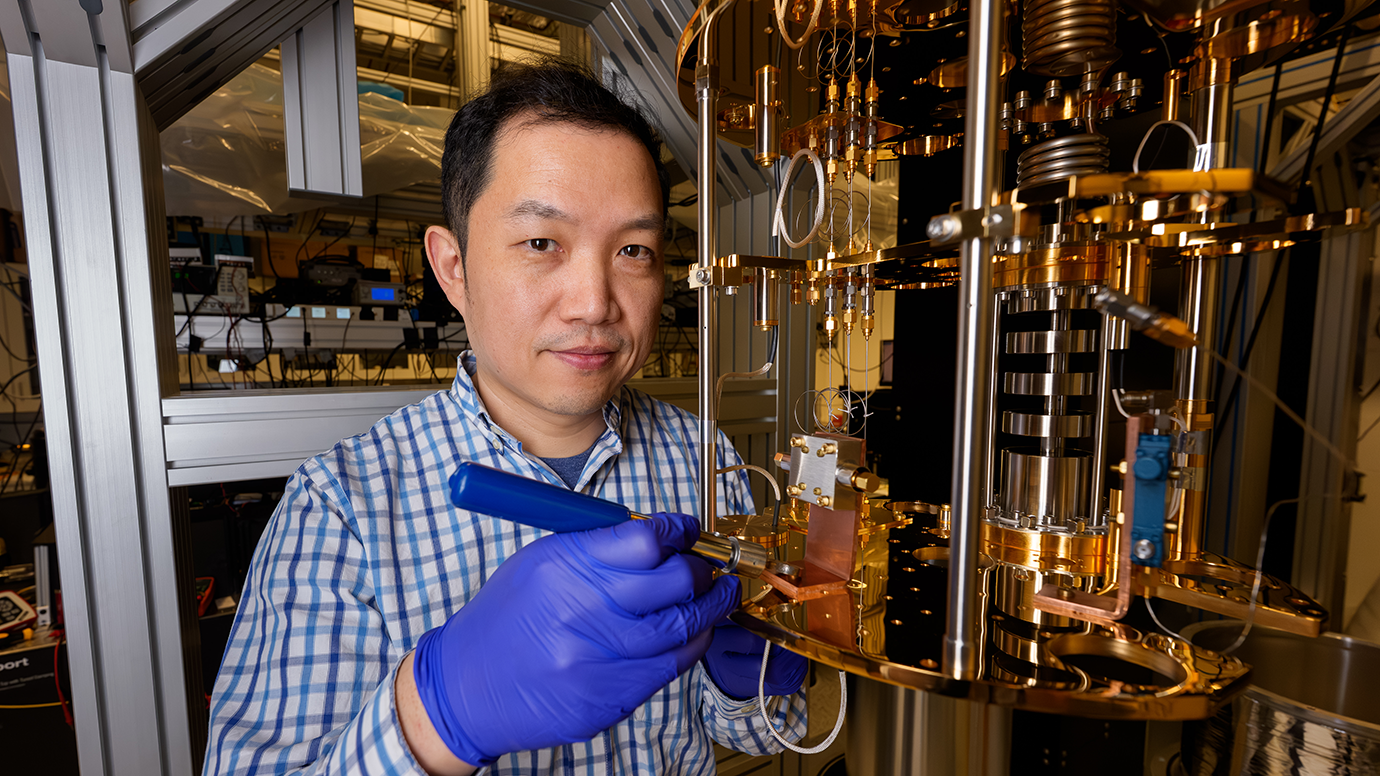
The research team is constructing a third dilution refrigerator inside the Chicago laboratory to link multiple isolated nodes. Before stringing physical fiber across state lines, researchers plan to test the technology through 1,000 kilometers of spooled cable entirely within the lab environment, simulating future long-distance network behavior.
“For the first time, the technology for building a global-scale quantum internet is within reach.”
Tian Zhong, Assistant Professor at UChicago PME, via Uchicago
Keep reading