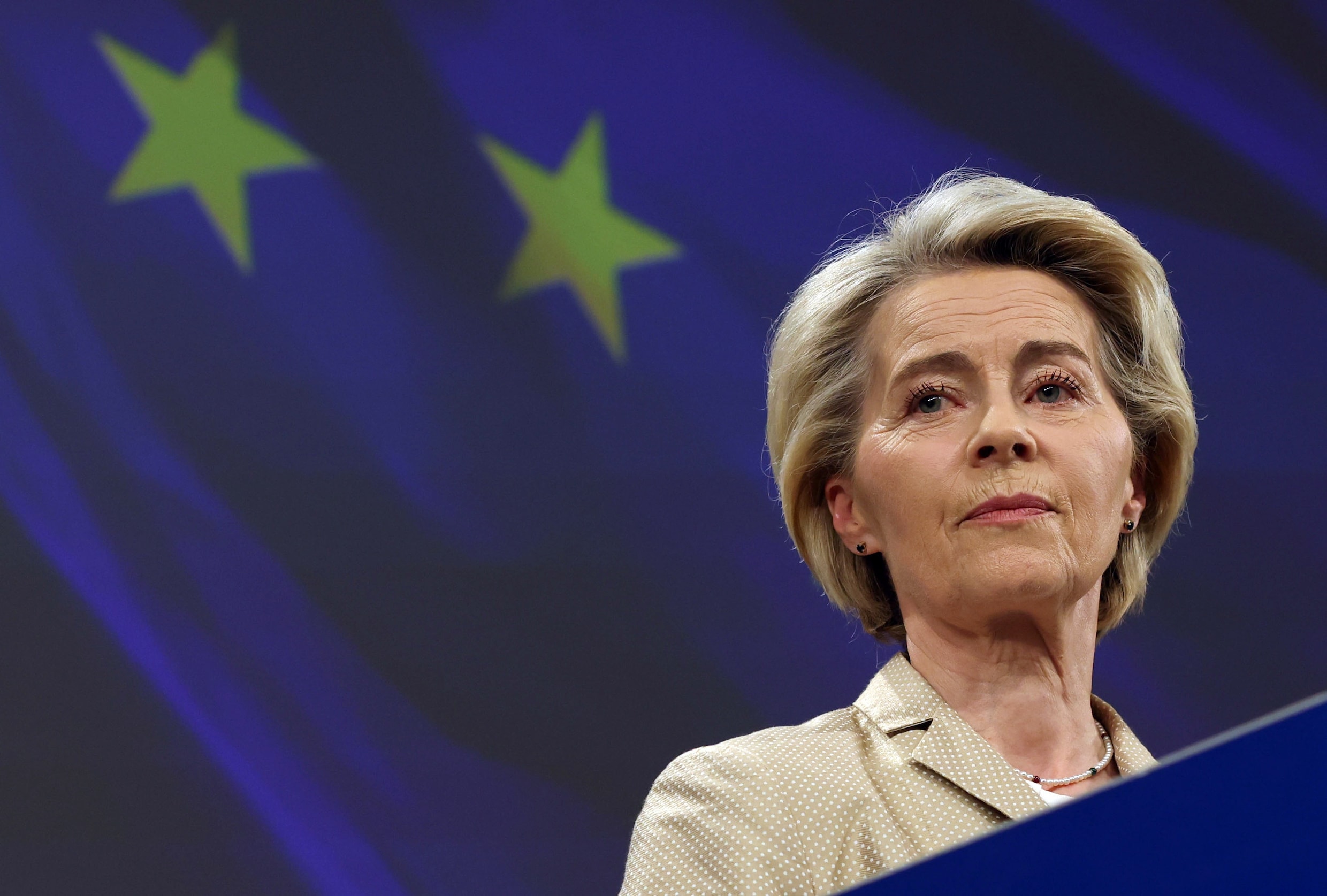
European Commission President Ursula von der Leyen has sparked diplomatic controversy after placing Turkey in the same category as China and Russia during a speech on EU expansion in Germany. The remarks, made on the eve of a visit by NATO Secretary-General Mark Rutte to Turkey, drew sharp criticism from Ankara and members of the European Parliament, who viewed the comparison as misleading and damaging to alliance cohesion.
Von der Leyen argued that the European continent must be completed to counter external influence, citing Turkey alongside strategic rivals China, and Russia. The comment immediately triggered reactions in Ankara and within the European Parliament, where lawmakers accused her of geopolitical inaccuracy and contradicting EU efforts to deepen security cooperation with Turkey.
The timing of the statement heightened tensions, coming just before Rutte’s preparatory visit to Ankara ahead of the NATO summit scheduled for July in Turkey. Turkish President Recep Tayyip Erdoğan is set to host the alliance summit, underscoring Ankara’s central role within NATO despite ongoing frictions with fellow alliance members Greece and Cyprus over territorial disputes and maritime boundaries.
Turkish officials responded swiftly, with the state-run Anadolu Agency quoting a European Commission spokesperson who clarified that von der Leyen’s reference to Turkey was intended to highlight its geopolitical influence in the Western Balkans, not to equate it with China or Russia. The spokesperson emphasized Turkey’s status as a key partner, particularly citing its financial support for mosque construction in Tirana, Albania, as evidence of its regional engagement.
European lawmakers were divided in their response. Nacho Sanchez Amor, a Spanish member of the European Parliament, criticized the analysis on social media as “geopolitically incorrect” and inconsistent with signals of strengthened security collaboration. Others noted that characterizing Turkey as a systemic rival undermines years of diplomatic engagement, including joint NATO exercises and EU-funded migration management projects.
The incident also complicates von der Leyen’s upcoming travel to Cyprus for an EU summit, where the long-standing division of the island remains a sensitive issue. Northern Cyprus has been under Turkish military control since 1974, while the Republic of Cyprus, an EU member state, continues to be partitioned by a UN buffer zone. The unresolved Cyprus dispute, coupled with Greco-Turkish tensions over Aegean Sea rights and energy exploration, has repeatedly strained EU-NATO coordination.
Analysts suggest the controversy reflects broader challenges in balancing EU enlargement ambitions with the need to maintain unity among NATO allies. While the EU seeks to deepen ties with Western Balkan countries, Ankara’s growing involvement in the region — through infrastructure investments and religious diplomacy — has raised concerns in Brussels about strategic competition, even as both sides cooperate on counterterrorism and refugee management.
The European Commission has sought to limit diplomatic fallout, reiterating its commitment to Turkey as a NATO ally and partner in regional stability. However, the episode underscores the delicate task facing EU leaders in navigating complex relationships with a country that is both a vital security partner and a source of recurring geopolitical friction.
As preparations continue for the NATO summit in Ankara, all eyes will be on how leaders like von der Leyen and Rutte manage the alliance’s internal dynamics amid rising external pressures. The incident serves as a reminder that even subtle rhetorical shifts can have significant repercussions in the intricate web of European and transatlantic relations.
For ongoing updates on EU foreign policy, NATO developments, and Turkey’s role in regional security, follow trusted sources such as the European Commission’s official website and NATO’s public communications channels.