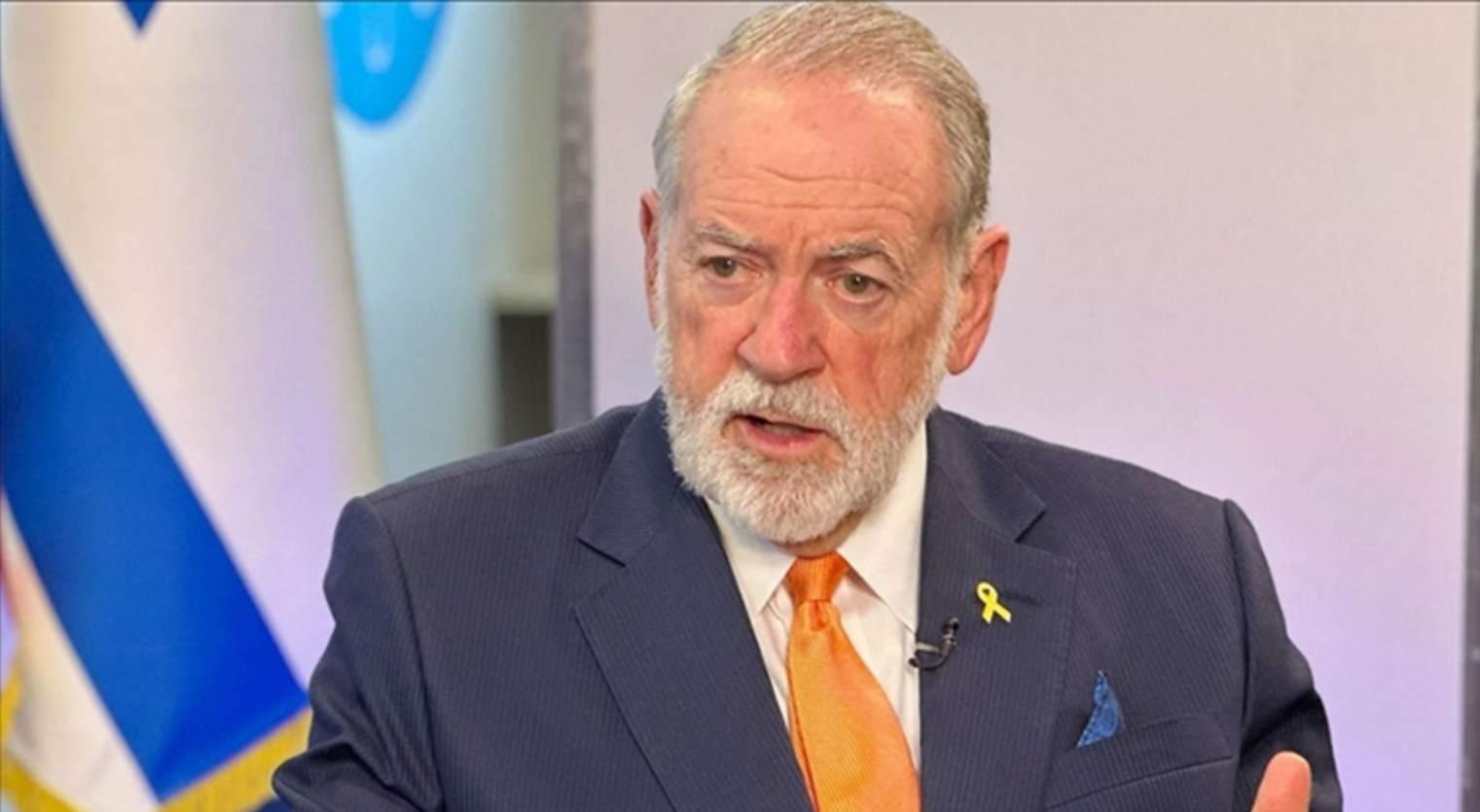
The international community is reacting with condemnation after remarks attributed to the U.S. Ambassador to Israel, Mike Huckabee, suggested a vision of expanded Israeli control stretching from the Nile to the Euphrates rivers. The comments, made during an interview with U.S. Journalist Tucker Carlson, have ignited a firestorm of criticism, particularly from Iran and across the Arab world, raising concerns about escalating regional tensions and the future of peace negotiations. The controversy underscores the deeply sensitive nature of territorial claims and historical narratives in the Middle East, and the potential for inflammatory rhetoric to exacerbate existing conflicts.
During the interview, Huckabee reportedly referenced the biblical concept of the “promised land” when discussing the geographical boundaries of Israel. When pressed by Carlson on the implications of this claim – encompassing territory within Egypt, Syria, Iraq, Jordan, Lebanon, and Saudi Arabia – Huckabee reportedly stated, “It would be good if Israel had all of it, given that God gave it to them.” This statement, quickly circulating online, prompted a swift and forceful response from Iranian officials, who characterized it as evidence of U.S. Complicity in what they termed a potential “genocide” against Palestinians. The remarks come at a particularly fraught moment, as Israel continues its military operations in Gaza and international efforts to secure a ceasefire remain stalled.
Iranian Condemnation and Regional Outcry
Iran’s Foreign Ministry Spokesperson, Ismail Bekayi, issued a strong condemnation of Huckabee’s remarks on February 22, 2026, via the social media platform X. According to reports from Hürriyet and Haberler, Bekayi asserted that Huckabee’s claim that Israel has a biblical right to the land between the Nile and Euphrates rivers proves the U.S. Is a partner in the “Israeli genocide.” He further stated that Iran condemns “such extremist ideological statements that will encourage the occupation regime’s crimes against Palestinians and its aggression against regional countries.”
The condemnation wasn’t limited to Iran. A joint statement released on February 22, 2026, by the foreign ministries of Turkey, Egypt, Jordan, Lebanon, Indonesia, Kuwait, Qatar, Oman, Pakistan, Bahrain, Saudi Arabia, Syria, Palestine, and the United Arab Emirates, along with the secretariats of the Organization of Islamic Cooperation (OIC), the Arab League, and the Gulf Cooperation Council (GCC), also denounced Huckabee’s comments. The statement, as reported by multiple sources including Hürriyet, characterized the remarks as a violation of international law and the UN Charter, posing a serious threat to regional security and stability. The collective statement emphasized that Israel has no sovereignty over occupied Palestinian territories or other Arab lands.
The “Promised Land” and Historical Context
The concept of the “promised land” is central to Jewish religious and historical narratives, originating in the Hebrew Bible (Old Testament). The biblical narrative describes a land promised by God to Abraham and his descendants. Interpretations of the geographical boundaries of this “promised land” vary, with some interpretations encompassing a significantly larger area than the modern State of Israel. The differing interpretations of this historical and religious claim are at the heart of the ongoing Israeli-Palestinian conflict and contribute to the sensitivity surrounding territorial disputes. The claim to a land extending from the Nile to the Euphrates is a maximalist interpretation, one that is not widely accepted internationally and is viewed by many as inherently expansionist and dismissive of the rights of other nations in the region.
Huckabee’s comments were made in response to a question from Tucker Carlson regarding the “promised lands” claim. Carlson followed up by pointing out that such a territory would encompass significant portions of multiple Arab nations, prompting Huckabee’s assertion that “it would be good if Israel had all of it because God gave it to them.” This exchange has been widely criticized as insensitive and provocative, particularly given the ongoing conflict in Gaza and the humanitarian crisis unfolding there. The timing of the remarks, amidst heightened tensions and international calls for a ceasefire, has further fueled the controversy.
U.S. Policy and Regional Implications
While the Biden administration has publicly reaffirmed its commitment to a two-state solution and has expressed concerns about civilian casualties in Gaza, Huckabee’s remarks raise questions about the extent to which such rhetoric aligns with official U.S. Policy. According to the Times of Israel, Ambassador Huckabee has previously taken a hard line on Iran, stating his hope for a diplomatic accord but expressing skepticism that military action can ultimately be avoided. This stance, coupled with his recent comments on territorial claims, suggests a potentially more assertive U.S. Approach to the region, one that could further complicate efforts to achieve a lasting peace.
The widespread condemnation of Huckabee’s remarks underscores the deep-seated resentment and mistrust that exists between Israel and many Arab nations. The statement has the potential to further radicalize public opinion in the region and could embolden extremist groups. It risks undermining ongoing diplomatic efforts to de-escalate tensions and find a peaceful resolution to the Israeli-Palestinian conflict. The implications extend beyond the immediate region, potentially impacting U.S. Relations with key allies in the Middle East and complicating efforts to address broader regional challenges, such as the threat of terrorism and the ongoing humanitarian crisis in Yemen.
International Law and Territorial Integrity
The assertion of a claim to territory based on religious or historical grounds is generally not recognized under international law. The principle of territorial integrity, enshrined in the UN Charter, holds that states have the right to govern their territory free from external interference. Israel’s occupation of Palestinian territories, including the West Bank and Gaza Strip, is widely considered a violation of international law by the international community. The expansion of Israeli settlements in these territories is also deemed illegal under international law. Huckabee’s comments, by appearing to endorse a broader claim to territory beyond the internationally recognized borders of Israel, are seen as a direct challenge to these established legal principles.
The joint statement from the Arab nations and international organizations explicitly condemned Huckabee’s remarks as a violation of international law and the UN Charter. The statement reaffirmed the rejection of any attempts to annex the West Bank or separate Gaza from the occupied Palestinian territories, and strongly opposed any expansion of settlement activities. It also reiterated the commitment to the sovereignty of Arab states and rejected any threats to their territorial integrity.
The situation remains highly volatile. The next significant development to watch will be the response from the U.S. State Department to the widespread criticism of Ambassador Huckabee’s remarks. As of February 22, 2026, no official statement has been released, but pressure is mounting on the Biden administration to clarify its position and distance itself from the ambassador’s controversial comments. We will continue to monitor the situation closely and provide updates as they become available. Share your thoughts on this developing story in the comments below.
Keep reading