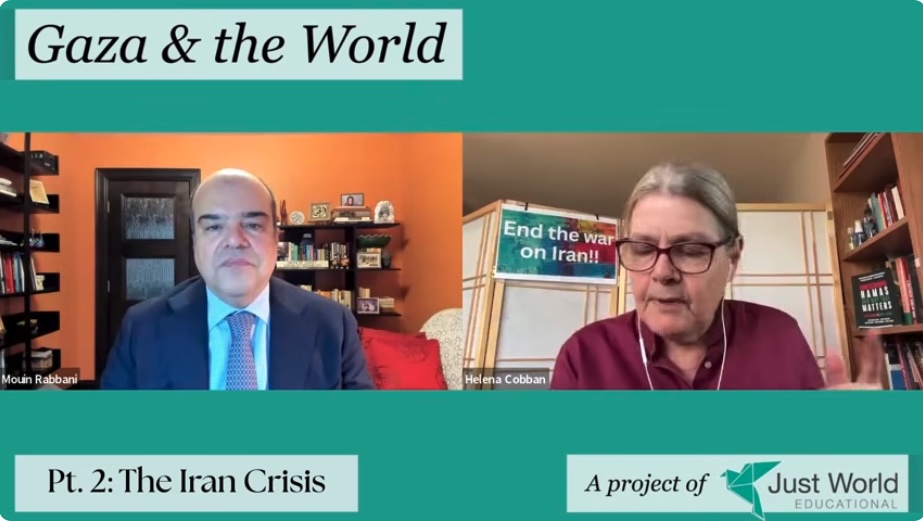
In a recent analysis that has drawn attention across international affairs circles, veteran Palestinian analyst Mouin Rabbani offered a stark assessment of U.S. Foreign policy in West Asia, suggesting that recent American military and diplomatic actions toward Iran may mark a turning point in global power dynamics. Speaking in mid-April 2024 as part of Just World Educational’s ongoing “Iran Crisis” series, Rabbani argued that the United States’ inability to achieve its stated objectives in confrontations with Iran and its allies has exposed fundamental limits to Washington’s regional influence.
His comments arrive amid heightened tensions following a series of U.S.-led strikes in early 2024 targeting Iranian-backed forces in Iraq and Syria, which Washington framed as retaliation for a drone attack that killed three U.S. Service members in Jordan. While the Biden administration has maintained it does not seek war with Iran, Rabbani contended that the pattern of escalation and subsequent de-escalation reveals a deeper strategic incoherence. He drew a parallel to the 1956 Suez Crisis, when British and French imperial overreach culminated in a humiliating withdrawal under U.S. Pressure, suggesting that similar limits are now constraining American action in the Middle East.
To understand the weight of Rabbani’s critique, it is necessary to examine both the factual backdrop of recent U.S.-Iran tensions and the analyst’s broader credentials. Mouin Rabbani is a longtime commentator on Palestinian affairs and West Asian geopolitics, frequently cited for his critical perspective on U.S. And Israeli policies. He has contributed to outlets such as Al Jazeera English, The Nation, and Jacobin, and is known for challenging mainstream narratives about conflict in the region. His April 17, 2024, discussion with Just World Educational’s president was the thirteenth episode in a series examining the multifaceted dimensions of U.S.-Iran tensions, available via YouTube, Apple Podcasts, and Spotify.
The immediate context for Rabbani’s remarks includes a February 2024 U.S. Military strike campaign that targeted facilities linked to Iran’s Islamic Revolutionary Guard Corps (IRGC) in Syria and Iraq. According to U.S. Central Command, the operations were conducted in response to the January 28 attack on Tower 22, a U.S. Outpost near the Jordan-Syria border that resulted in the deaths of three American soldiers and injuries to dozens more. The Pentagon stated that over 85 targets were hit using long-range bombers launched from the United States, marking one of the most significant direct U.S. Actions against Iran-aligned forces since the 2020 killing of Qasem Soleimani.
Iran denied direct involvement in the Jordan attack, though it acknowledged that some of the groups involved operate within its broader sphere of influence. Rabbani noted that despite the scale of the U.S. Response, Iran’s capacity to project power through its network of allied militias remained largely intact. He pointed to subsequent attacks on U.S. Bases in Iraq and Syria in the weeks following the strikes as evidence that deterrence had not been achieved. This, he argued, undermined the core premise of the Biden administration’s strategy: that overwhelming force could compel behavioral change without triggering broader war.
A key element of Rabbani’s analysis centers on what he describes as the mismatch between stated U.S. War aims and battlefield realities. In both public statements and private briefings, American officials have framed their actions as defensive and proportional, aimed at deterring further attacks on U.S. Personnel. However, Rabbani contended that the underlying logic mirrors past maximalist objectives seen during the Trump administration—such as efforts to curb Iran’s missile program, limit its regional influence, and pressure Tehran into renegotiating the JCPOA nuclear deal on stricter terms. He argued that these goals have repeatedly failed to materialize, even as U.S. Military actions have exacted a toll on civilian infrastructure and fueled anti-American sentiment across the region.
The analogy to the Suez Crisis is not merely rhetorical. In 1956, Britain, France, and Israel launched a joint invasion of Egypt after President Gamal Abdel Nasser nationalized the Suez Canal. Despite initial military success, the operation collapsed under intense U.S. Diplomatic and economic pressure, revealing that Washington no longer tolerated unilateral colonial adventures by its allies. Rabbani suggested that contemporary U.S. Actions in West Asia reflect a similar dynamic: while America retains formidable military capacity, its ability to translate that power into lasting political outcomes is increasingly constrained by regional resistance, global opinion, and the limits of its own strategic patience.
Rabbani also highlighted the implications for U.S. Allies in the Gulf, particularly smaller monarchies such as Bahrain, Qatar, and the United Arab Emirates, which have long relied on American security guarantees. He argued that the perceived ineffectiveness of recent U.S. Strikes—coupled with visible Israeli military operations in Gaza and Lebanon—has eroded confidence in Washington’s ability to protect its partners. This, he said, may push Gulf states toward greater strategic autonomy, including deeper engagement with non-Western powers like China, Russia, Turkey, and even Iran itself, despite historical rivalries.
On the Palestinian front, Rabbani warned that the absence of Gaza from recent ceasefire discussions involving Lebanon leaves the Strip vulnerable to renewed Israeli military action. He noted that Israeli officials have consistently treated any territory not explicitly named in agreements as fair game for future operations, a pattern observed after the 2012 and 2014 Gaza conflicts. Without binding commitments to halt hostilities in Gaza, he contended, the cycle of escalation and temporary calm is likely to persist, further isolating Israel diplomatically while exacting a devastating human toll on Palestinians.
Internationally, Rabbani observed a discernible shift in how Israel is perceived, particularly among younger generations and progressive constituencies in Europe and North America. He cited growing skepticism toward organizations like AIPAC and increasing willingness among political candidates to question unconditional support for Israel. While he stopped short of predicting a realignment in U.S.-Israel relations, he suggested that sustained criticism could eventually influence policy debates, especially as the humanitarian toll in Gaza continues to draw global scrutiny.
It is significant to clarify that Rabbani’s remarks do not reflect a consensus view among foreign policy experts. Many analysts maintain that U.S. Deterrence remains credible, pointing to the absence of direct Iranian attacks on American soil since 2020 and the continued degradation of Iran’s proxy networks through targeted sanctions and interdictions. Others argue that the Biden administration’s approach—combining calibrated military responses with diplomatic outreach—has avoided the pitfalls of both appeasement and overextension. Still, Rabbani’s critique resonates with a growing body of scholarship questioning the efficacy of militarized statecraft in an era of diffuse power networks and rising multipolarity.
As of mid-2024, the U.S.-Iran relationship remains in a state of managed hostility. Direct negotiations over reviving the JCPOA have stalled, though backchannel communications persist through intermediaries in Oman and Qatar. The IAEA continues to report that Iran’s uranium enrichment levels have exceeded the limits set by the 2015 deal, though Tehran insists its program remains peaceful. Meanwhile, regional flashpoints—from Red Sea shipping disruptions linked to Houthi attacks in Yemen to periodic clashes along the Israel-Lebanon border—keep the potential for escalation ever-present.
For readers seeking to follow developments, official updates from the U.S. Department of State, the Pentagon’s daily press briefings, and the International Atomic Energy Agency provide authoritative sources on policy shifts and military activity. Meanwhile, independent monitoring groups such as the Armed Conflict Location & Event Data Project (ACLED) and the Watson Institute for International and Public Affairs at Brown University offer regularly updated datasets on conflict trends in the Middle East.
The conversation with Mouin Rabbani remains accessible through Just World Educational’s website and major podcast platforms. While his views represent one perspective in a complex debate, they underscore a critical question facing U.S. Foreign policy: whether the era of unchallenged American dominance in West Asia is truly over—and if so, what a more multipolar regional order might look like.
As global powers recalibrate their strategies in response to shifting alliances and emerging threats, the insights of analysts like Rabbani serve as a vital reminder that military strength alone cannot secure enduring influence. Understanding the limits of power may be as important as wielding it—a lesson that, if heeded, could help prevent future missteps in one of the world’s most volatile regions.
We invite readers to share their thoughts in the comments below and to spread this article across social platforms to foster broader discussion on the evolving dynamics of U.S. Engagement in West Asia.
Keep reading