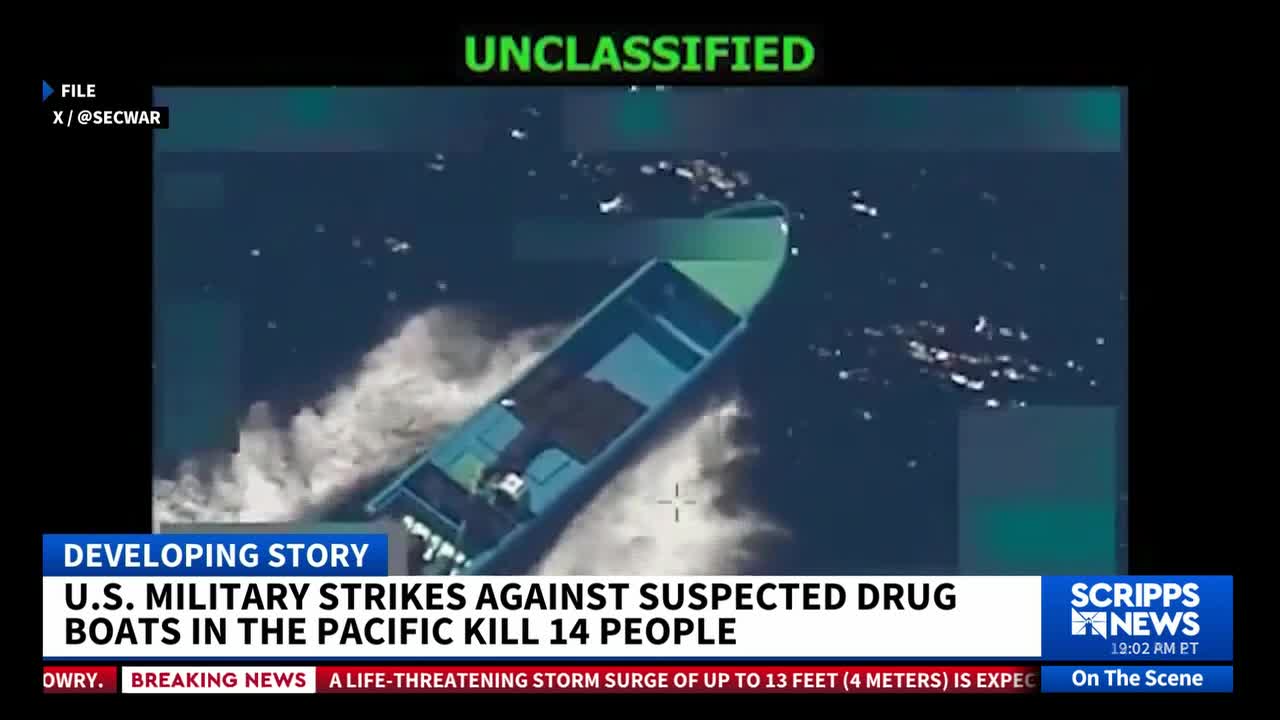
The United States military has intensified its maritime campaign against suspected drug smugglers, reporting a new strike in the eastern Pacific Ocean on Wednesday that resulted in three deaths. This latest action follows a series of rapid-fire engagements over the past week, highlighting a significant escalation in the Trump administration’s strategy to combat narcotics trafficking through direct kinetic force.
The strike, confirmed by the Pentagon, is part of a broader and increasingly controversial offensive targeting vessels the U.S. Government characterizes as being operated by “narcoterrorists.” According to official reports, the US military boat strikes in the Pacific are designed to disrupt the flow of illegal drugs into the United States by targeting vessels along established narco-trafficking routes.
The recent surge in activity underscores a shift in U.S. Security policy toward Latin American cartels. President Donald Trump has justified these operations by stating that the United States is in a state of “armed conflict” with these organizations, framing the attacks as a necessary measure to stem the tide of fatal drug overdoses claiming American lives via NPR.
A Week of Escalation: Timeline of Recent Strikes
The strike on Wednesday is the culmination of a violent week in the eastern Pacific. Between Saturday and Wednesday, the U.S. Military launched at least five separate attacks on vessels accused of smuggling drugs. The operational tempo suggests a concerted effort by U.S. Southern Command to saturate known smuggling corridors.
On Tuesday, a strike killed four people via CBS News. This followed an attack on Monday that left two men dead via CBS News. Earlier in the week, on Saturday, the military blew up two boats, killing five people and leaving one survivor via NPR.
U.S. Southern Command has utilized social media to share aerial footage of these operations, showing vessels being struck by projectiles, and exploding. While the military maintains that intelligence confirms these vessels are “operated by Designated Terrorist Organizations” and are engaged in drug trafficking, they have frequently declined to provide specific evidence for individual strikes, citing operational security via CBS News.
| Date | Vessels Struck | Reported Casualties | Status/Outcome |
|---|---|---|---|
| Wednesday, April 15 | 1 | 3 killed | Confirmed by Pentagon |
| Tuesday, April 14 | 1 | 4 killed | Aerial video released |
| Monday, April 13 | 1 | 2 killed | Operational security cited |
| Saturday, April 11 | 2 | 5 killed, 1 survivor | Search and rescue activated |
The ‘Narcoterrorist’ Campaign and Total Casualties
These recent events are part of a larger campaign that began in early September. Since the inception of these operations, the death toll has risen to at least 175 people via CBS News. The administration’s approach treats drug trafficking not merely as a criminal enterprise, but as a security threat warranting military intervention.
The strategy focuses on the eastern Pacific and the Caribbean Sea, targeting what the military calls “narcoterrorists.” However, the lack of transparency regarding the evidence used to justify these strikes has drawn significant scrutiny. Critics argue that the military is operating in a legal gray zone, essentially conducting extrajudicial killings on the high seas without trial or definitive proof of the cargo being carried.
some analysts question the effectiveness of the US military boat strikes in the Pacific. A primary point of contention is that much of the fentanyl—the drug responsible for the majority of fatal overdoses in the U.S.—is typically trafficked through different channels than the large-scale maritime shipments targeted by these strikes via CBS News.
Legal Controversies and Human Rights Concerns
The campaign has been marred by accusations of human rights violations and potential war crimes. One of the most cited incidents occurred during the first boat strike of the campaign on September 2. In that instance, two people survived an initial attack but were subsequently killed in a follow-on strike, leading to allegations that the second attack may have constituted a war crime via CBS News.
The U.S. Coast Guard is typically notified to activate search-and-rescue systems for survivors. While some have been rescued—including two individuals in October who were repatriated to Ecuador and Colombia—several other searches have been called off via CBS News. The suspension of these searches has further fueled criticism regarding the proportionality and legality of the strikes.
Key Takeaways of the Current Maritime Strategy
- Kinetic Escalation: The U.S. Has shifted from interception and seizure to direct military strikes on suspected drug vessels.
- Casualty Toll: At least 175 people have been killed since the campaign began in early September via CBS News.
- Legal Justification: The administration defines the situation as an “armed conflict” with cartels, allowing for military action.
- Operational Secrecy: U.S. Southern Command frequently cites operational security to avoid releasing specific evidence of drug trafficking prior to strikes.
- Contested Efficacy: Experts suggest the strikes may not significantly impact fentanyl flow, which often uses different trafficking routes.
What This Means for International Relations
The aggressive posture in the eastern Pacific has implications beyond drug control. By designating cartels as terrorist organizations and engaging in “armed conflict,” the U.S. Is effectively expanding its theater of operations into international and territorial waters near Latin American nations. This approach risks straining diplomatic ties with regional partners who may view these strikes as a violation of sovereignty or international maritime law.
The broader geopolitical context similarly includes the Trump administration’s preparations for a naval blockade of Iranian ports, suggesting a wider trend of using naval power to enforce economic and security mandates globally via NPR.
As the death toll climbs and the frequency of attacks increases, the international community is likely to demand more transparency. The central question remains whether the destruction of these vessels provides a measurable reduction in drug availability or if it serves primarily as a political signal of “toughness” on the drug war.
The next official update on these operations is expected from U.S. Southern Command as they continue to monitor narco-trafficking routes in the Eastern Pacific. We will continue to track the legal challenges and official casualty reports as they emerge.
Do you believe military strikes are an effective tool against drug trafficking, or do they pose too great a risk of human rights abuses? Share your thoughts in the comments below.
Worth a look