
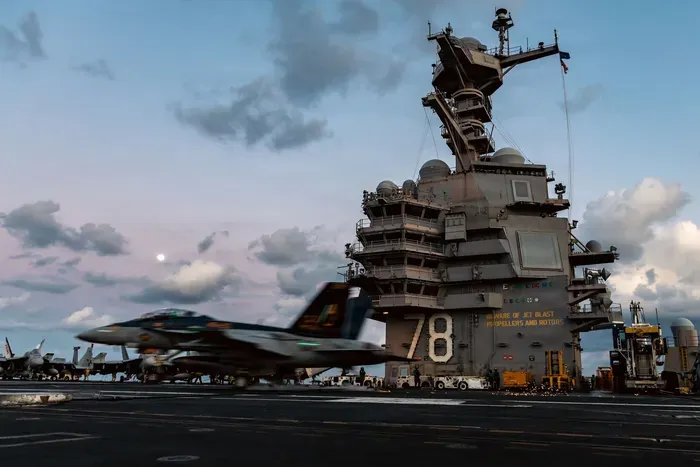
U.S. Navy destroyers successfully repelled a series of missiles, drones, and boat-borne attacks launched by Iranian forces in the Strait of Hormuz on May 7. The engagement, which took place in one of the world’s most volatile maritime chokepoints, triggered a series of precision self-defense strikes by U.S. Forces against Iranian military infrastructure.
The U.S. Central Command (CentCom) confirmed the incident in a statement released early Friday, May 8, 2026. According to CentCom, the engagement occurred as three guided-missile destroyers were transiting the international sea passage toward the Gulf of Oman. Despite the intensity of the inbound threats, military officials reported that no U.S. Assets were struck during the exchange.
The ships involved in the encounter were the USS Truxtun (DDG 103), the USS Rafael Peralta (DDG 115), and the USS Mason (DDG 87). These vessels are equipped with advanced Aegis Combat Systems designed specifically to detect and neutralize the types of asymmetric threats—such as swarming fast-attack boats and cruise missiles—that characterize the current security environment in the region.
Precision Counter-Strikes and Target Neutralization
Following the interception of the inbound threats, which CentCom described as “unprovoked Iranian attacks,” U.S. Forces launched targeted strikes to eliminate the source of the aggression. The U.S. Military focused its response on the specific Iranian military facilities responsible for the assault.
The strikes targeted three primary categories of military infrastructure:
- Launch Sites: Facilities used for the deployment of missiles and drones.
- Command and Control: Locations responsible for coordinating the attack and directing forces.
- ISR Nodes: Intelligence, surveillance, and reconnaissance nodes used to track U.S. Naval movements.
By neutralizing these nodes, the U.S. Navy aimed to degrade Iran’s ability to conduct further coordinated strikes against naval assets in the immediate vicinity. This tactical response underscores the U.S. Military’s current posture of “active defense,” where the interception of threats is immediately followed by the elimination of the launch capability.
The Strategic Crisis: The ‘Dual Blockade’ of Hormuz
This latest clash occurs against a backdrop of escalating maritime tension that has evolved into what is being described as a “dual blockade” of the Strait of Hormuz. This complex geopolitical situation has created a high-risk environment for both military vessels and commercial shipping.
According to reports, the Iranian regime imposed a blockade on the Strait following an original truce, making attempts to seize ships and denying passage to commercial vessels it deems “unauthorised.” Simultaneously, the U.S. Navy has imposed its own maritime blockade on Iran. This overlapping set of restrictions effectively turns the Strait of Hormuz—a critical artery for global energy supplies—into a zone of competing military mandates.
The Strait of Hormuz is the only sea passage from the Persian Gulf to the open ocean, making it one of the most strategically significant waterways on earth. Any disruption to the flow of traffic, whether through official blockades or military skirmishes, has immediate implications for global oil prices and international trade security.
Current Posture and Escalation Risks
While the May 7 engagement was significant in scale, CentCom has indicated that it is not seeking a wider conflict. In its official communication, the command stated that “CentCom does not seek escalation but remains positioned and ready to protect American forces.”

The readiness of the USS Truxtun, USS Rafael Peralta, and USS Mason to neutralize multiple vectors of attack—missiles, drones, and boats—simultaneously demonstrates the current operational capability of U.S. Naval forces in the region. However, the continued existence of the “dual blockade” suggests that the risk of further miscalculations remains high.
As the situation evolves, the international community remains focused on whether these self-defense strikes will lead to further Iranian reprisals or if both sides will seek a way to resolve the competing blockades currently strangling the Strait.
World Today Journal will continue to monitor official updates from CentCom and regional maritime authorities. We encourage our readers to share this report and leave their perspectives on the current security situation in the Persian Gulf in the comments below.