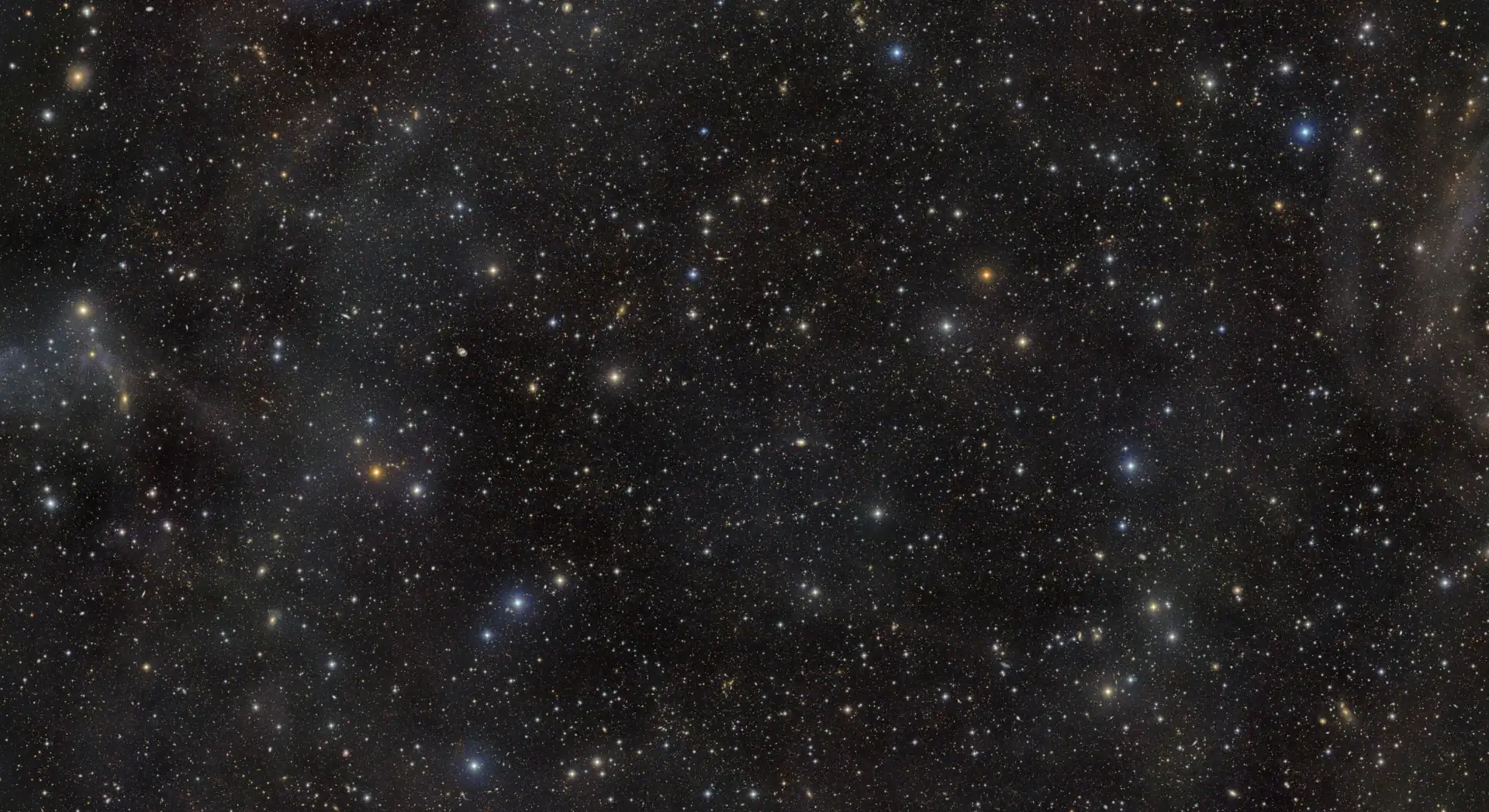
The Vera C. Rubin Observatory released its first science data preview on July 31, 2026, revealing an image of the COSMOS field containing more than 500,000 galaxies and 50,000 stars. Captured by the 3.2-gigapixel LSST Camera in Chile, the composite view charts a well-studied patch of the southern sky.
An unprecedented view of the southern sky has been released by the NSF–DOE Vera C. Rubin Observatory, showcasing more than 500,000 galaxies in a single stacked image. The release, made public on July 31, 2026, marks the observatory’s Early Data Preview 2, providing researchers with their first formal look at science validation observations collected between April 2025 and January 2026.
Inside the 3.2-Gigapixel LSST Camera and Site
At the center of the facility sits the Simonyi Survey Telescope, an 8.4-meter instrument equipped with the LSST Camera. Weighing roughly 6,600 pounds and scaling to the size of a small car, the device stands as the largest digital camera ever built for astronomy.

The camera’s focal plane packs 189 science CCD microchips arranged across 21 rafts, chilled to approximately -100 degrees Celsius to minimize thermal noise. Each exposure covers 9.6 square degrees of the sky, matching the area of roughly 45 full Moons. The newly published view covers roughly one-sixth of the entire Southern Hemisphere sky.
Targeting the Unobstructed COSMOS Field in Sextans
The composite image centers on the COSMOS field, located within the constellation Sextans. Astronomers selected this specific coordinate region because it lies far from the crowded plane of the Milky Way. With fewer foreground stars and minimal galactic dust blocking the path, the telescope gains a remarkably clear window into the distant universe.
Behind the local dust wisps lie galaxies spanning vast cosmological distances, including ancient structures whose light traveled for roughly 12 billion years before reaching Earth. The resulting stacked frame reveals more than 50,000 foreground stars.
Building on Two Decades of Multiwavelength Reference Data
The COSMOS field is hardly unfamiliar to astronomers. Exploration of the patch began in 2002 with initial planning, followed by targeted observations from the Hubble Space Telescope in October 2003. Over the subsequent two decades, international observatories examined the region across the electromagnetic spectrum, utilizing the James Webb Space Telescope, XMM-Newton, Chandra, Spitzer, Subaru, and the Very Large Array.

That multiwavelength library established the region as a premier testing ground for modern astrophysics. Rubin’s new contribution layers high-sensitivity wide-field imaging on top of that historical archive.
Transitioning From a Static Atlas to Dynamic Alerts
While the initial data preview offers a deep, stacked portrait, the observatory’s true design centers on motion and change. By subtracting a reference baseline from newer exposures, the system will isolate transient phenomena.
“The COSMOS deep image is just the beginning for Rubin in this region, repeated visits to the field over the next few years will demonstrate the power of our survey design for discovery by providing our science community with a huge number of transient and variable objects like supernovae and other explosive transients for follow-up and detailed study.”
Bob Blum, Director of Rubin Observatory at NSF NOIRLab
These automated notices will direct researchers toward shifting targets like exploding supernovae, flaring black holes, pulsing variable stars, and foreground asteroids crossing the southern sky.
Worth a look