
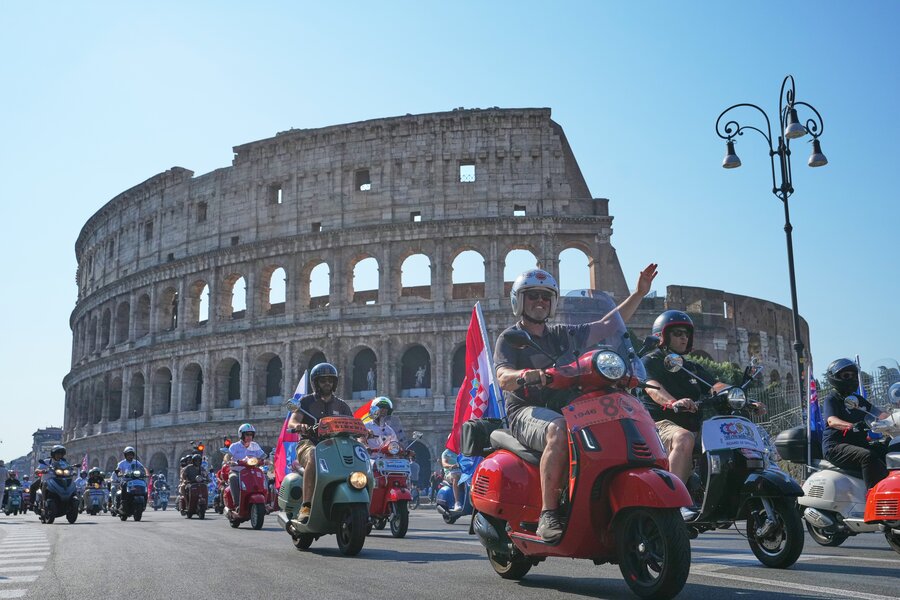
Thousands of riders descended upon Rome this weekend to celebrate the 80th anniversary of the Vespa, the iconic motor scooter that transformed Italian mobility and became a global symbol of design. The gathering, which brought together enthusiasts from across the globe, honored the legacy of the vehicle first patented by Corradino D’Ascanio in 1946. According to Piaggio Group records, the scooter was engineered to provide affordable transportation in a nation struggling to rebuild its infrastructure following the devastation of the Second World War.
A Legacy of Post-War Mobility
The Vespa’s origin story is deeply intertwined with Italy’s industrial recovery. Following the conflict, the country faced severe fuel shortages and damaged road networks that made traditional automobiles impractical for the average citizen. Enrico Piaggio, the head of the company that had previously manufactured aircraft, sought to create a low-cost, mass-produced vehicle to get Italy moving again. The result was the MP6 prototype, which featured a step-through frame and a shielded engine that protected the rider’s clothing from grease and road debris.

Historical accounts from the Piaggio Museum indicate that the name “Vespa”—Italian for “wasp”—was coined by Enrico Piaggio himself upon seeing the prototype’s narrow waist and the buzzing sound of the engine. Unlike the heavy motorcycles of the era, the Vespa was designed for accessibility, allowing people to ride in business attire or casual wear, which helped bridge the gap between social classes in a rapidly modernizing society.
The Global Cultural Impact of the Scooter
While the Vespa was initially a utilitarian tool for economic survival, it quickly evolved into a cultural phenomenon. By the 1950s, the brand had gained international recognition, fueled in part by its appearance in cinema, most notably in the 1953 film Roman Holiday starring Audrey Hepburn and Gregory Peck. This cinematic association cemented the scooter’s status as a quintessential element of the “Dolce Vita” lifestyle, representing freedom, elegance, and the Italian aesthetic.

Today, the Vespa remains a significant asset for the Piaggio Group, which continues to manufacture the scooters in Pontedera, Italy. Financial reports from the Piaggio Group’s latest fiscal statements show that the brand remains a core component of the company’s revenue stream, with millions of units sold worldwide over the past eight decades. The scooter has evolved from a simple steel-bodied frame into a line that includes high-performance electric models, demonstrating a capacity to adapt to contemporary environmental and regulatory standards.
Why Rome Remains the Spiritual Home of Vespa
Rome has long served as the backdrop for major milestones in the brand’s history, due to its winding, narrow streets that are uniquely suited for compact motorbikes. The city’s historic center, characterized by cobblestone roads and dense traffic, provides a practical environment where the Vespa’s maneuverability is most evident. Enthusiast clubs from countries as diverse as Japan, Brazil, and the United States frequently coordinate pilgrimages to the Italian capital to participate in events sanctioned by the Vespa World Club.

These gatherings are more than just displays of vintage machinery; they serve as a networking hub for collectors who specialize in restoring models dating back to the late 1940s. The preservation of these early scooters is supported by a robust secondary market for original parts and a community of specialized mechanics who maintain the integrity of the original two-stroke engine designs. For many participants, the 80th-anniversary celebration represents a commitment to keeping the craftsmanship of the mid-20th century alive in the age of digital transportation.
Looking Toward the Future
As the brand enters its ninth decade, the focus has shifted toward sustainability. European Union regulations regarding urban emissions have prompted manufacturers to pivot toward electrification. The introduction of the Vespa Elettrica, as noted in official product documentation, marks the company’s attempt to reconcile its traditional design language with the necessity of reducing the carbon footprint of urban commuters.
The next major milestone for the brand will be the upcoming Vespa World Days, an annual international event that attracts thousands of members from hundreds of national clubs. As the company continues to navigate the complexities of global supply chains and shifting consumer preferences, the Vespa remains a rare example of a product that has maintained its core identity while serving successive generations of riders. Readers interested in the history of the brand can find archives and virtual exhibition tours via the official Piaggio Museum website.
Have you ever ridden a vintage Vespa? Share your experiences and photos in the comments section below.