
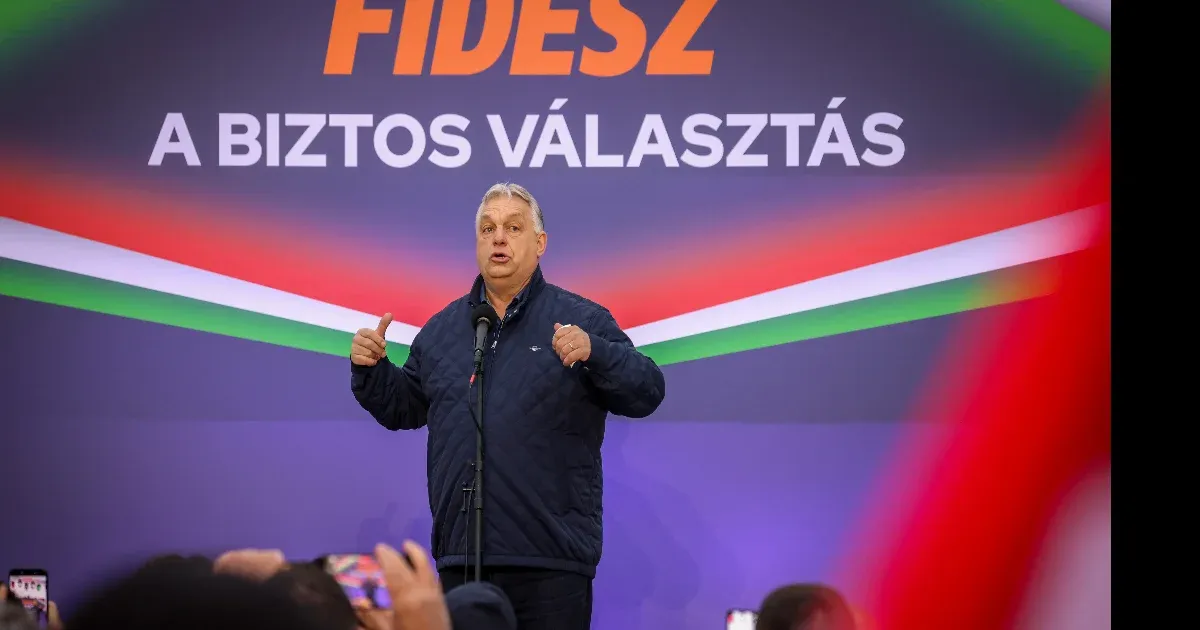
Hungary is entering the final, high-stakes stretch of its political cycle as Prime Minister Viktor Orbán and his most formidable challenger, Péter Magyar, prepare to close their campaigns in Budapest. Reports indicate a strategic clash in timing for the final events this Saturday, with Orbán reportedly scheduled to conclude his campaign an hour after Magyar, a move that underscores the intensifying battle for the narrative in the capital.
The timing of these closing events comes as Hungary’s April 12 elections loom, representing a potential turning point for a nation that has been under Orbán’s leadership for 16 years. For the global community, the outcome is not merely a domestic concern but a signal of Hungary’s future relationship with the European Union and its stance on the conflict in Ukraine.
The contest has evolved into a personal and ideological showdown. On one side is Orbán, the veteran strategist of the Fidesz party and on the other is Péter Magyar, a 45-year-old former Fidesz insider who has rapidly ascended to lead the opposition Tisza party. This internal rupture within the right-wing establishment has created a political dynamic unseen in Hungary since 2010.
The Rise of the ‘Insider’ Challenger
Péter Magyar’s campaign has been defined by a sense of urgent necessity. Utilizing the slogan “Now”—a shortened version of a 19th-century revolutionary cry “Now or never”—Magyar has spent over two years touring the country to build a grassroots base. His strategy has been exhaustive, visiting all 106 of Hungary’s constituencies and delivering up to six speeches a day to reach voters in traditionally Fidesz-dominated small towns and villages .
Magyar’s appeal stems partly from his deep knowledge of the system he now seeks to dismantle. A former member of the Fidesz family who joined the party during his university years, he was once closely aligned with the administration. This insider status allows him to frame his campaign not as an external attack, but as a necessary correction from within. His platform focuses on three primary pillars: tackling systemic corruption, improving the national economy, and wooing the disadvantaged Roma community .
Beyond domestic policy, Magyar has positioned himself as the key to unlocking billions of euros in EU funds that have been frozen due to European concerns over Hungary’s rule of law. By presenting himself as a viable alternative who can repair relations with Brussels, he has attracted voters weary of the ongoing diplomatic friction between Budapest and the EU.
The March 15 Showdown: A Battle of Numbers
The intensity of the rivalry was on full display during the national day celebrations on March 15, 2026. Both candidates used the anniversary of the 1848-1849 revolution and war of independence to hold massive, rival marches through the streets of Budapest .
The event quickly turned into a competition over perceived strength, with both sides disputing the size of their respective crowds. The government-controlled Hungarian Tourism Agency reported that Orbán’s “peace march” at Kossuth Square drew 180,000 people, although Magyar’s rally attracted 150,000 . These estimates were based on cell phone connections to nearby antennas.
However, sources close to the Tisza party contested these figures, estimating that Magyar had actually mobilized 350,000 attendees . This discrepancy highlights the polarized nature of the current political environment, where even the measurement of public support is a point of contention.
Orbán’s Strategy: The ‘Party of Peace’
Prime Minister Viktor Orbán has responded to the challenge by doubling down on his image as a protector of Hungarian sovereignty. While Magyar emphasizes the need for EU integration and rule-of-law reforms, Orbán has framed his opponent as a “puppet” of the European Union and Ukraine .
Orbán’s campaign has leaned heavily into a “peace” narrative, promising voters that Fidesz is the “real party of peace.” By positioning himself against the perceived pressures of Brussels and Kyiv, Orbán aims to maintain his grip on the rural electorate and those who fear that a change in leadership would lead to increased foreign interference in Hungarian affairs.
Despite the surge in support for the opposition, Orbán remains a formidable force. Having won four consecutive victories since 2010, his machinery is well-entrenched, and his ability to dominate the national discourse through aligned media outlets remains a critical advantage in the final days of the campaign.
Political Stakes and Global Implications
The upcoming vote is more than a choice between two men. We see a referendum on the direction of the Hungarian state. The primary points of friction that will likely decide the election include:
- EU Funds: The potential release of billions in frozen EU funds remains a central campaign issue, with Magyar arguing that only a change in government can satisfy the rule-of-law requirements imposed by Brussels .
- Economic Stability: While Orbán emphasizes sovereignty and peace, Magyar has promised a comprehensive overhaul to improve the economy and reduce corruption.
- International Alliances: The election will determine if Hungary continues its distinctive, often confrontational approach toward the EU and NATO or shifts toward a more collaborative alignment.
Current polling suggests a tightening race. At one point during the campaign, the Tisza party was polling approximately 10 points ahead of Fidesz . While these numbers indicate that Magyar represents the most significant threat to Orbán’s rule in over a decade, the final result will depend on voter turnout in both the urban centers of Budapest and the rural heartlands.
Comparative Campaign Approaches
| Feature | Viktor Orbán (Fidesz) | Péter Magyar (Tisza) |
|---|---|---|
| Core Narrative | Sovereignty and the “Party of Peace” | Urgency (“Now”) and systemic reform |
| Key Target | Rural voters and traditional nationalists | Urban professionals, disillusioned Fidesz voters, Roma community |
| EU Stance | Resistant to Brussels’ “interference” | Collaborative; goal to unlock frozen funds |
| Campaign Style | Institutional strength and mass rallies | High-frequency touring and grassroots outreach |
What Happens Next
As the campaign closes this Saturday in Budapest, all eyes move toward the polling stations. The next definitive checkpoint is April 12, the date of the general election . The results will determine whether Hungary continues its path under the long-term leadership of Viktor Orbán or pivots toward the vision proposed by Péter Magyar.

We will continue to monitor the final rallies and the official vote tallies as they emerge. Do you believe a change in leadership in Budapest will shift the broader political landscape of the European Union? Share your thoughts in the comments below.