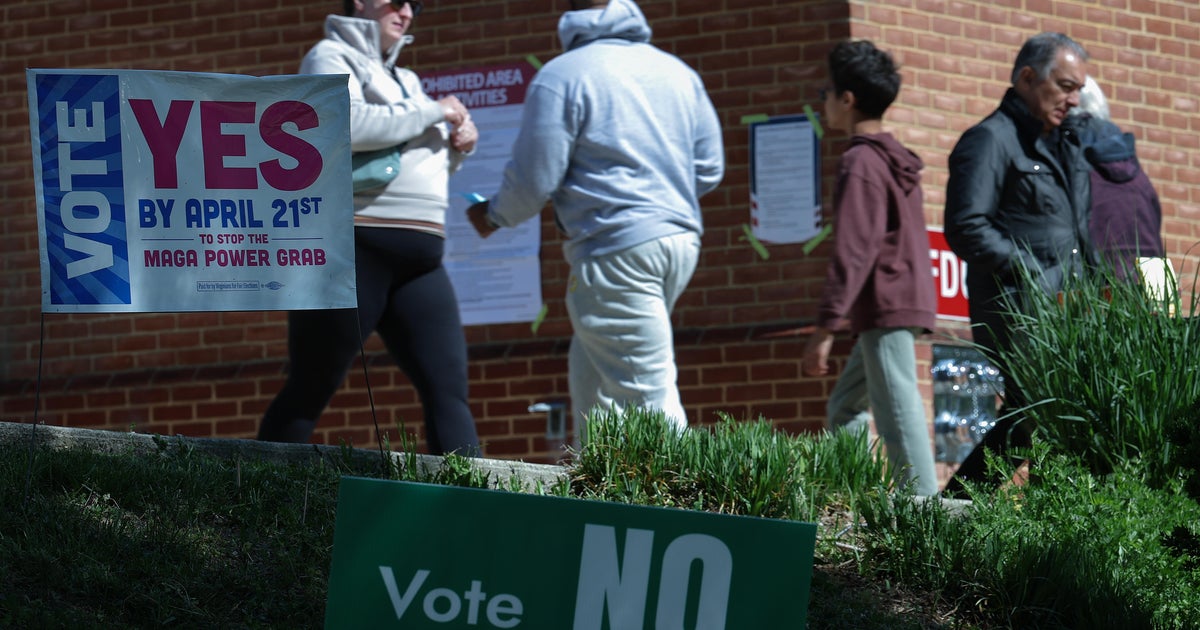
Virginia voters on Tuesday approved a new congressional map that would give Democrats an advantage in 10 of the state’s 11 House districts, according to projections by CBS News. The referendum, held on April 21, 2026, passed with majority support, marking a significant shift in the state’s political landscape ahead of the 2026 midterm elections. The newly adopted map, drawn by Democratic state legislators, is expected to dramatically reshape representation in Virginia’s U.S. House delegation, which currently stands at a 6-5 Republican advantage.
The approval of the constitutional amendment allows the Virginia General Assembly to redraw congressional districts outside the normal 10-year redistricting cycle. This move comes amid a broader national trend of mid-decade redistricting efforts, with both parties seeking to gain electoral advantages ahead of the 2026 midterms. In Virginia, Democrats argue the new map is necessary to counter Republican-led redistricting in states like Texas, where maps were redrawn to favor GOP candidates. The referendum drew intense attention and heavy spending from both parties, with polling showing a tight race in the days leading up to the vote.
According to the Virginia Public Access Project (VPAP), the proposed map was passed by the General Assembly and signed by Governor Abigail Spanberger before being submitted to voters in a statewide referendum. The Supreme Court of Virginia had previously allowed the referendum to proceed despite legal challenges, stating that any final rulings in those cases would be issued after April 21. Voters were asked to decide whether the constitutional amendment would permit the legislature to redraw congressional maps outside the standard decennial process.
CNN reported that the new map dramatically reworks sections of the state, slicing up deeply Democratic areas in the Washington, D.C. Suburbs and around Richmond, while creating a new district along the Blue Ridge Mountains that connects liberal-leaning cities. The current map, drawn by court-appointed experts in 2021, consists of six Democratic-leaning districts, four Republican-leaning districts, and one highly competitive seat. Under the proposed Democratic map, analysts project that as many as 10 of Virginia’s 11 congressional districts could favor Democrats, leaving only one safe Republican seat.
The vote reflects broader national tensions over redistricting, with President Donald Trump having criticized the Virginia proposal ahead of the referendum, claiming it would “silence Virginia conservatives.” Democrats, however, pointed to similar mid-decade redistricting efforts in other states as justification, arguing that the map is necessary to ensure fair representation following Republican-led map changes elsewhere. Gov. Spanberger and former President Barack Obama have previously supported nonpartisan redistricting but now argue that the current political climate requires a more aggressive approach to counter GOP advantages in other states.
Following the approval, election officials will begin implementing the new district boundaries for the 2026 congressional elections. Candidates will file to run under the new map in the coming months, with primary elections scheduled for June 2026 and the general election set for November 3, 2026. The Virginia Department of Elections will provide updated district information and voter resources on its official website as the maps are finalized.
The outcome in Virginia could have major national implications, as shifts in the state’s congressional delegation may influence the balance of power in the U.S. House of Representatives. With both parties continuing to battle over district maps nationwide, the Virginia referendum adds to a growing list of states that have pursued redistricting ahead of the 2026 midterms, including Texas, Florida, and North Carolina.
For ongoing updates on the implementation of the new congressional map and related election procedures, voters are encouraged to consult the Virginia Department of Elections website and the Virginia Public Access Project’s redistricting tracker, which provides detailed analyses of how the proposed changes affect individual districts and communities.
What are your thoughts on Virginia’s new congressional map and its potential impact on the 2026 elections? Share your perspective in the comments below and help inform the conversation by sharing this article with others interested in voting rights and political representation.