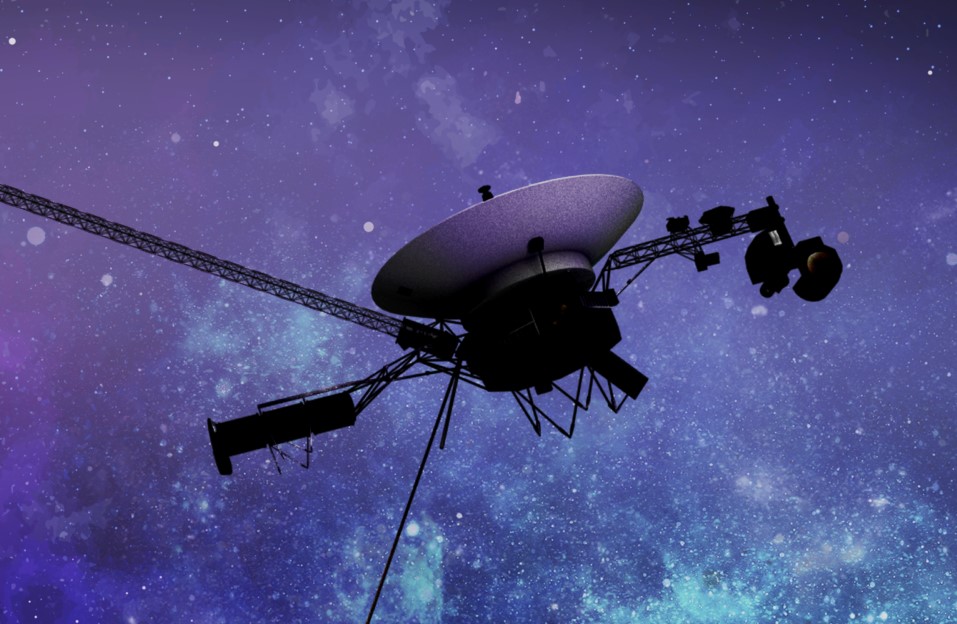
San Francisco, CA – In a remarkable feat of engineering and resourcefulness, NASA has powered down another instrument aboard Voyager 1, the farthest human-made object from Earth, in a bid to extend the mission’s lifespan. The move, announced on April 17, 2026, is the latest in a series of carefully planned shutdowns designed to conserve energy as the spacecraft continues its journey through interstellar space. This latest adjustment underscores the incredible longevity of the Voyager program and the dedication of the team working to keep this pioneering probe operational nearly five decades after its launch.
Voyager 1, launched on September 5, 1977, from Cape Canaveral, Florida, initially set out to explore Jupiter and Saturn. However, its mission dramatically expanded when it became the first spacecraft to cross the heliosphere – the boundary where the sun’s influence wanes and interstellar space begins – in August 2012. The probe continues to transmit data back to Earth, providing invaluable insights into the conditions beyond our solar system. Maintaining communication across such vast distances, currently over 15 billion miles, requires meticulous power management.
Conserving Power for Continued Exploration
The instrument deactivated was not identified by name in NASA’s announcement, but officials confirmed it was a strategic decision to prioritize the spacecraft’s remaining capabilities. Voyager 1 currently has two science instruments still functioning, a testament to the robust design and careful management of the mission. Engineers at NASA’s Jet Propulsion Laboratory (JPL) in Southern California have long anticipated the need to gradually shut down systems to preserve power, a plan put in place years ago to maximize the mission’s duration. This proactive approach is crucial given the diminishing output of Voyager 1’s radioisotope thermoelectric generator (RTG), which converts the heat from decaying plutonium into electricity.
The RTG, which powered Voyager 1 at launch with 470 watts, has steadily declined in output over the decades. Although the exact current power level wasn’t specified in the recent announcement, the need for conservation measures highlights the challenges of operating a spacecraft designed for a five-year mission for nearly 49 years. The decision to switch off the instrument wasn’t a sign of failure, but rather a calculated step to ensure the continued operation of the remaining instruments and the maintenance of communication with Earth.
A Legacy of Discovery
Voyager 1’s contributions to our understanding of the solar system and interstellar space are profound. During its flybys of Jupiter in March 1979 and Saturn in November 1980, the probe discovered a thin ring around Jupiter and two new Jovian moons, Thebe and Metis. At Saturn, Voyager 1 identified five new moons and a new ring, dubbed the G-ring. These discoveries significantly expanded our knowledge of the outer planets and their complex systems.

However, Voyager 1’s most significant achievement arguably came with its entry into interstellar space. By crossing the heliosphere, the probe provided the first direct measurements of the interstellar medium – the matter and radiation that exists between star systems. These measurements have been crucial in understanding the environment beyond the sun’s influence and the interaction between our solar system and the rest of the galaxy. The data collected continues to be analyzed by scientists worldwide, offering insights into the fundamental nature of the universe.
Challenges of Deep Space Communication
Maintaining contact with Voyager 1 presents unique challenges. The vast distance means that signals take over 22 hours to travel one way. This delay necessitates a high degree of autonomy in the spacecraft’s operations and careful planning of communication sequences. The 12-foot-wide dish antenna on Voyager 1 is critical for maintaining a stable link with Earth, constantly pointed towards our planet to send and receive signals.
The spacecraft communicates through the NASA Deep Space Network (DSN), a global network of large radio antennas strategically located to provide continuous coverage. Even with the DSN’s capabilities, the signal from Voyager 1 is incredibly weak by the time it reaches Earth, requiring sensitive receivers and sophisticated signal processing techniques. The ongoing power conservation efforts are essential not only for operating the instruments but also for maintaining the strength of the communication signal.
What’s Next for Voyager 1?
Despite the challenges, NASA remains committed to continuing the Voyager 1 mission for as long as possible. The remaining two operational science instruments will continue to collect data on the interstellar medium, providing valuable insights into this largely unexplored region of space. Engineers will continue to monitor the spacecraft’s systems and make adjustments as needed to optimize power usage and maintain communication.

The future of the mission is uncertain, as the RTG’s power output will inevitably continue to decline. However, the team at JPL is exploring innovative strategies to extend the spacecraft’s lifespan, including optimizing software and reducing the frequency of certain operations. The ultimate fate of Voyager 1 remains unknown, but its legacy as a pioneering explorer of the cosmos is already secure.
The next major update from NASA regarding Voyager 1 is expected in late 2026, when engineers will assess the impact of the latest power conservation measures and provide an outlook for the mission’s future. Readers interested in following the mission’s progress can find the latest information on the NASA Voyager website: https://science.nasa.gov/mission/voyager/. Share your thoughts on this incredible mission in the comments below!
Keep reading