
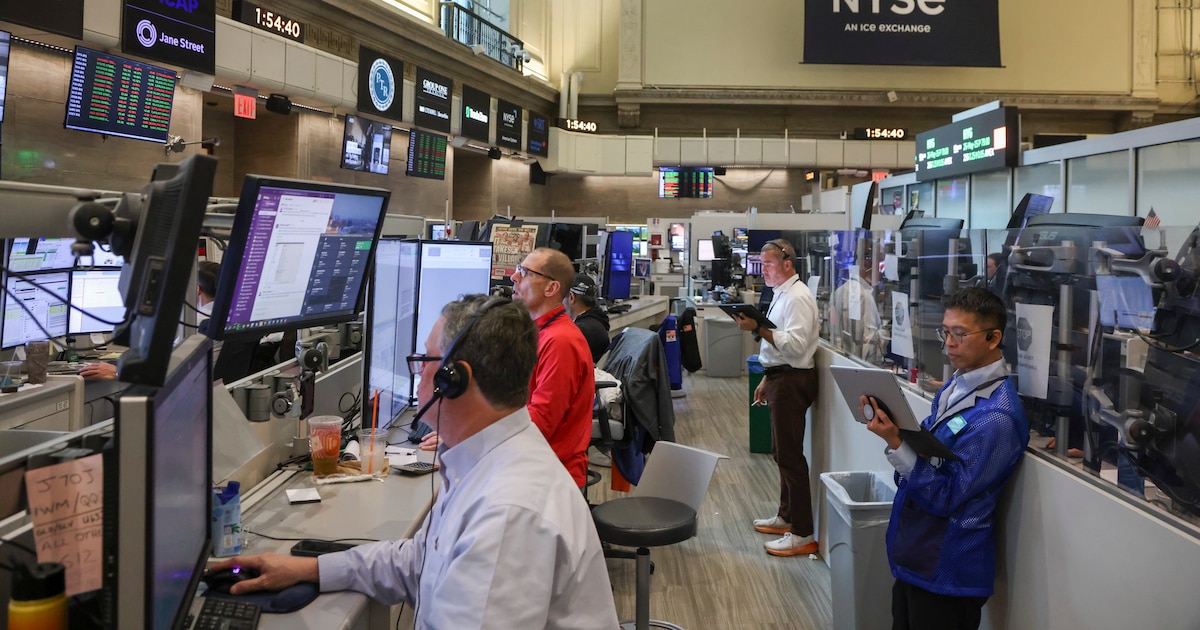
Wall Street demonstrated remarkable resilience on Friday, pushing several major indices to record levels despite escalating geopolitical volatility in the Middle East. The market rally was primarily fueled by employment data that surpassed economist expectations, signaling a robust domestic labor market that continues to anchor investor confidence even as global tensions threaten energy stability.
The S&P 500 climbed 0.8% to reach an all-time high, marking the index’s sixth consecutive winning week—its longest such streak since 2024. Similarly, the Nasdaq composite rallied 1.7% to hit its own record, while the Dow Jones Industrial Average saw a more modest increase, edging up by 12 points, or less than 0.1% according to reporting by the Associated Press.
This surge toward Wall Street record highs comes at a complex crossroads. Investors are currently balancing a strong internal economic narrative against a precarious external environment characterized by military flare-ups in the Strait of Hormuz and rising fuel costs. The divergence between market performance and geopolitical risk suggests a high degree of optimism that the current conflict will not result in a worst-case scenario for the global economy.
Employment Data Drives Market Momentum
The primary catalyst for Friday’s gains was a new report indicating that the U.S. Job market remains stronger than many analysts had predicted. While the pace of hiring slowed compared to March, the figures were still nearly double the expectations of economists. Specifically, the report revealed that U.S. Employers added 115,000 more jobs than they cut last month as detailed by the Associated Press.
For global markets, this data is critical because it suggests that the U.S. Economy can maintain growth and consumer spending power despite inflationary pressures and international instability. When the labor market holds up, it reduces the immediate fear of a sharp domestic recession, allowing investors to focus on growth sectors—particularly in technology, which is reflected in the significant rally of the Nasdaq composite.
Geopolitical Friction in the Strait of Hormuz
Despite the bullish trend in equities, the operational environment in the Persian Gulf has deteriorated. On Friday, U.S. Forces fired upon and disabled two Iranian oil tankers. This action followed an overnight exchange of fire between U.S. And Iranian forces in the Strait of Hormuz per AP News.

The Strait of Hormuz is one of the world’s most vital maritime chokepoints, essential for the transport of crude oil from the Persian Gulf to global markets. The latest military engagement has raised serious doubts regarding the stability of a month-old ceasefire. While the United States has insisted that the ceasefire remains in effect, the actual fighting on the water suggests a tenuous peace at best.
The economic stakes of this conflict are centered on energy security. The ongoing war with Iran has already contributed to rising fuel costs, which typically act as a drag on economic growth by increasing transportation and production expenses for businesses worldwide. Market participants are currently operating on the hope that the Strait of Hormuz will reopen fully to allow oil tankers to deliver crude without interference, though it remains unclear if these hopes are grounded in reality or are simply “wishful” thinking.
Analyzing the Market’s “Worst-Case” Calculation
From an economic perspective, the current behavior of Wall Street reflects a calculated gamble. Typically, military conflict in oil-rich regions triggers a “flight to safety,” where investors move money out of stocks and into gold or government bonds. However, the current trajectory suggests that investors are pricing in a “containment” scenario rather than a global escalation.
The factors maintaining this optimism include:
- Labor Market Strength: The net addition of 115,000 jobs provides a cushion, suggesting that the U.S. Economy has the fundamental strength to absorb some level of energy price shocks.
- Sector Diversification: The Nasdaq’s record-breaking rally indicates that investors are doubling down on technology and innovation, sectors that are less directly tied to the immediate flow of crude oil than industrial or transport sectors.
- Hope for Diplomacy: The market is betting that the U.S. Insistence on the ceasefire will eventually lead to a stabilization of the Strait of Hormuz.
However, the risk remains asymmetric. If the Strait of Hormuz were to be closed or if the conflict were to expand significantly, the resulting spike in oil prices could trigger a rapid reversal of these gains, leading to stagflation—a period of stagnant economic growth coupled with high inflation.
What In other words for Global Investors
For the global audience, the current state of the U.S. Markets serves as a barometer for global risk appetite. When Wall Street hits record highs amidst a war, it signals that the professional investment community believes the domestic economic engine is powerful enough to override geopolitical headwinds.

However, the volatility in fuel costs is a reminder that no market is truly insulated from geopolitical shocks. Businesses relying on global supply chains and energy-intensive manufacturing will continue to face uncertainty as long as the military situation in the Persian Gulf remains unresolved.
Investors are now closely watching for two primary signals: further official statements regarding the status of the ceasefire and any tangible change in the volume of oil tankers successfully navigating the Strait of Hormuz. These developments will determine whether the current winning streak is a sustainable trend or a temporary disconnect from global realities.
The next critical checkpoint for market observers will be the continued monitoring of the ceasefire’s viability and the subsequent impact on global oil prices as the conflict in the Strait of Hormuz evolves. We will continue to provide updates as official reports on the diplomatic and military situation emerge.
Do you believe the current market rally is ignoring the risks in the Middle East, or is the U.S. Economy truly resilient enough to withstand the volatility? Share your thoughts in the comments below.