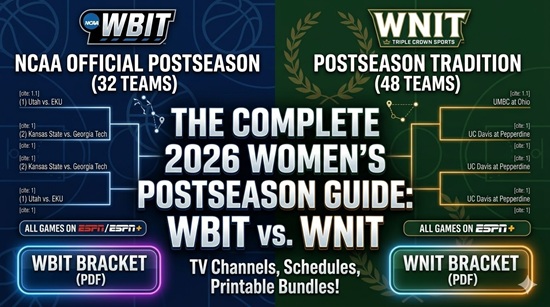
For college women’s basketball teams whose NCAA Tournament dreams fell short, the season isn’t necessarily over. A pair of postseason tournaments – the Women’s Basketball Invitation Tournament (WBIT) and the Women’s National Invitation Tournament (WNIT) – offer continued opportunities for competition. Though, the evolving landscape of women’s postseason basketball can be confusing for fans. This guide clarifies the differences between the WBIT and WNIT, and provides a look at the first-round schedules kicking off this Thursday, March 19th.
The introduction of the WBIT in recent years has reshaped the postseason picture, creating a tiered system that aims to provide more teams with a chance to extend their seasons. Understanding the distinctions between these two tournaments – their selection criteria, broadcast arrangements, and overall prestige – is key to following the action as it unfolds.
What is the Difference Between the WBIT and WNIT?
The core difference lies in their organizational structure and perceived standing within the broader women’s basketball ecosystem. The WBIT, established as the official NCAA secondary tournament, is designed to mirror the men’s National Invitation Tournament (NIT) in its function. According to the official WNIT website, the tournament features 48 teams and offers a pathway for programs that didn’t secure a bid to the NCAA Tournament or the Women’s Basketball Invitation Tournament (WBIT). The WNIT, conversely, is an independent tournament operated by Triple Crown Sports, positioning it as a third-tier postseason event.
The WBIT boasts a 32-team bracket, with automatic berths awarded to one team from each of the nation’s 31 conferences, provided they meet specific criteria. A team is eligible for an automatic berth if it is the highest-finishing team in its conference’s regular-season standings and was not selected for either the NCAA Tournament or the WBIT. Should a conference’s automatic qualifier decline the invitation, the spot is then offered to the next highest-finishing team or reallocated at the discretion of the WNIT committee. The WNIT, with its 48-team field, often includes a larger number of mid-major automatic qualifiers.
WBIT First Round Schedule: Thursday, March 19
The WBIT first round tips off on Thursday, March 19th, with games broadcast primarily on ESPN+. The tournament’s progression will see the quarterfinals on ESPN+, the semifinals on ESPNU, and the championship game culminating on ESPN2 on April 4th. The WNIT website details the full schedule, providing fans with ample opportunity to follow their teams’ journeys.
| Time (ET) | Matchup | Seed | Location |
| 6:30 PM | Georgia Tech vs. (2) Kansas State | 2 | Manhattan, KS |
| 6:30 PM | Utah vs. Eastern Kentucky | 1 | Richmond, KY |
| 7:00 PM | Santa Clara vs. (3) California | 3 | Berkeley, CA |
| 9:00 PM | LMU vs. (2) Stanford | 2 | Stanford, CA |
| TBD | Wisconsin vs. Oregon State | 3 | Corvallis, OR |
WNIT First Round Schedule: Thursday, March 19
The WNIT also launches its first round on Thursday, March 19th, with a substantial 12-game slate. This tournament provides another avenue for teams to continue their seasons and compete for a postseason title. While the WNIT doesn’t enjoy the same level of NCAA affiliation as the WBIT, it still offers valuable playing experience and exposure for participating programs.
| Time (ET) | Matchup | Location |
| 6:00 PM | Bradley at George Washington | Washington, D.C. |
| 6:00 PM | Binghamton at Mercyhurst | Erie, PA |
| 6:00 PM | Lehigh at Monmouth | West Long Branch, NJ |
| 7:00 PM | UMBC at Ohio | Athens, OH |
| 9:00 PM | UC Davis at Pepperdine | Malibu, CA |
| 9:00 PM | Sam Houston at Portland | Portland, OR |
The WNIT’s broader field and inclusion of more mid-major programs contribute to a diverse and competitive tournament bracket. Fans can follow the action throughout the tournament, with games taking place across various campus locations.
Understanding the Shift in Postseason Landscape
The emergence of the WBIT as a prominent secondary tournament reflects a broader trend in college basketball – a desire to provide more postseason opportunities for deserving teams. As reported by the Courier & Press, the WNIT has seen its stature diminish somewhat with the creation of the WBIT, which has taken on the role of the second-tier tournament for college women’s basketball. This shift underscores the evolving dynamics of the postseason and the increasing emphasis on providing competitive opportunities for a wider range of programs.
The WBIT’s connection to the NCAA provides a level of legitimacy and visibility that the WNIT, as an independent tournament, currently lacks. This distinction is important for programs seeking to enhance their national profile and attract recruits. The WBIT’s broadcast partnership with ESPN further amplifies its reach and appeal.
For teams navigating this postseason landscape, the choice between the WBIT and WNIT often comes down to a combination of factors, including their overall record, conference standing, and perceived potential for success. The WBIT, with its NCAA affiliation and ESPN coverage, generally attracts teams with stronger resumes and higher aspirations. The WNIT, meanwhile, provides a valuable opportunity for mid-major programs to showcase their talent and compete for a postseason title.
The 2026 WBIT Championship will be hosted by Wichita State at Charles Koch Arena in Wichita, Kansas, providing a central location for the tournament’s culminating event. This decision aims to create a vibrant atmosphere and attract fans from across the country.
As both the WBIT and WNIT progress, fans can expect a series of exciting matchups and compelling storylines. The tournaments offer a chance to witness the talent and dedication of college women’s basketball players as they compete for postseason glory.
The next key date for both tournaments is March 22nd, with the second round of games scheduled to take place. Fans are encouraged to check the official websites of the WBIT and WNIT for updated schedules, scores, and bracket information.
What are your thoughts on the evolving landscape of women’s college basketball postseason tournaments? Share your opinions and predictions in the comments below, and be sure to share this article with fellow fans!
Keep reading