For more than two centuries, physicists have struggled to pin down one of nature’s most fundamental numbers with greater precision: the gravitational constant, universally known as “Large G.” Despite its critical role in describing the force that governs planetary motion and the structure of the cosmos, its measured value remains frustratingly elusive, with results varying by about one part in 10,000 across experiments.
This persistent uncertainty stands in stark contrast to other fundamental constants, such as the speed of light or the charge of an electron, which are known to extraordinary precision. The gravitational constant’s weakness relative to the other three fundamental forces — electromagnetism, the strong nuclear force, and the weak nuclear force — makes it exceptionally difficult to isolate in laboratory settings, where Earth’s own gravitational field introduces significant background noise.
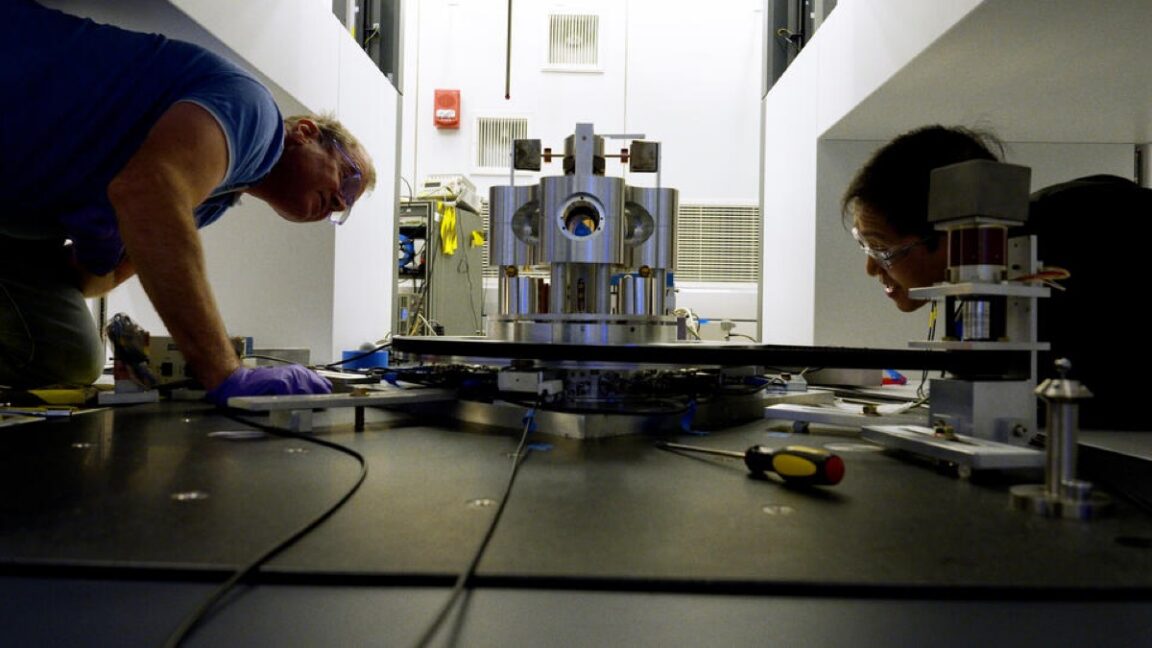
In a recent effort to contribute to this longstanding scientific challenge, researchers at the National Institute of Standards and Technology (NIST) replicated one of the most divergent experimental measurements of Big G from recent years. Their work, conducted over approximately a decade, aimed not to resolve the discrepancy but to add a reliable data point to the global effort to refine the constant’s value. The team published their findings in the peer-reviewed journal Metrologia, where the paper details their methodology and results.
The gravitational constant, denoted by the symbol G, appears in Isaac Newton’s law of universal gravitation and Albert Einstein’s general theory of relativity. It quantifies the attractive force between two masses: the force equals G multiplied by the product of the masses, divided by the square of the distance between them. In Einstein’s framework, G helps determine how much spacetime curves in response to mass and energy.
Since gravity is approximately 1038 times weaker than the strong nuclear force, even the most sensitive instruments struggle to detect its influence without interference. Seismic vibrations, magnetic fields, and fluctuations in local gravity due to underground water movement or tectonic activity can all mask the tiny signals experiments seek to measure. This environmental sensitivity is why measurements of Big G often require extraordinary isolation techniques, such as conducting experiments underground or using shielded vacuum chambers.
Over time, various experimental approaches have been employed, including torsion balance experiments (first used by Henry Cavendish in 1798), atom interferometry, pendulum measurements, and beam balance techniques. Each method has yielded values clustering around 6.674 × 10⁻¹¹ m3 kg−1 s−2, but the spread between the highest and lowest reliable results remains larger than what would be expected from stated uncertainties alone.
The NIST team focused on replicating a particular result that had stood out as an outlier in recent meta-analyses of G measurements. By carefully reconstructing the original experimental setup and applying modern metrological practices, they sought to determine whether the divergence stemmed from unaccounted systematic errors or represented a genuine variation requiring modern physics to explain.
Their published work did not close the gap between conflicting measurements. Instead, it added another data point whose value fell within the existing range but did not favor one faction of results over another. As noted in the Metrologia paper, such outcomes are valuable not for resolving discrepancies immediately, but for gradually building a more robust picture of measurement reliability across different laboratories and techniques.
This ongoing effort underscores a broader theme in metrology: the pursuit of ever-greater precision often reveals hidden complexities in experimental design. Unlike constants that can be measured through electromagnetic phenomena — which allow for quantum-based definitions — Big G must still be determined through direct mechanical measurement of mass and distance, limiting the pathways to improvement.
Scientists involved in the NIST project emphasized that their goal was not to claim superiority over prior work but to contribute transparency and reproducibility to the process. By documenting their procedures in detail and making their data available for scrutiny, they aimed to support the collective advancement of gravitational physics.
The lack of consensus on Big G’s value has practical implications beyond theoretical physics. Accurate knowledge of G is essential for modeling planetary interiors, calculating the masses of celestial bodies from orbital dynamics, and testing alternative theories of gravity that seek to explain phenomena like dark matter or cosmic acceleration.
While some researchers have speculated that the discrepancies might point to new physics — such as undiscovered fields or extra dimensions — most experts attribute the variations to subtle experimental challenges rather than flaws in gravitational theory itself. Until a measurement emerges with significantly reduced uncertainty and broad replication, the true value of Big G will remain one of metrology’s enduring puzzles.
As of now, the Committee on Data for Science and Technology (CODATA) periodically reviews global measurements of fundamental constants and issues recommended values. The most recent CODATA adjustment, based on data available through 2018, lists the gravitational constant as 6.67430(15) × 10−11 m3 kg−1 s−2, where the digits in parentheses represent the uncertainty in the last two digits of the mean value.
Future experiments, including those involving quantum sensors, space-based measurements, and novel cryogenic apparatuses, may eventually provide the breakthrough needed to reduce uncertainty in Big G. For now, the scientific community continues to refine its techniques, recognizing that even a stubborn constant can yield its secrets to persistent, careful inquiry.
To stay informed about developments in fundamental physics and metrology, readers can follow updates from organizations such as NIST, the International Bureau of Weights and Measures (BIPM), and peer-reviewed journals like Metrologia and Physical Review Letters.
Keep reading