
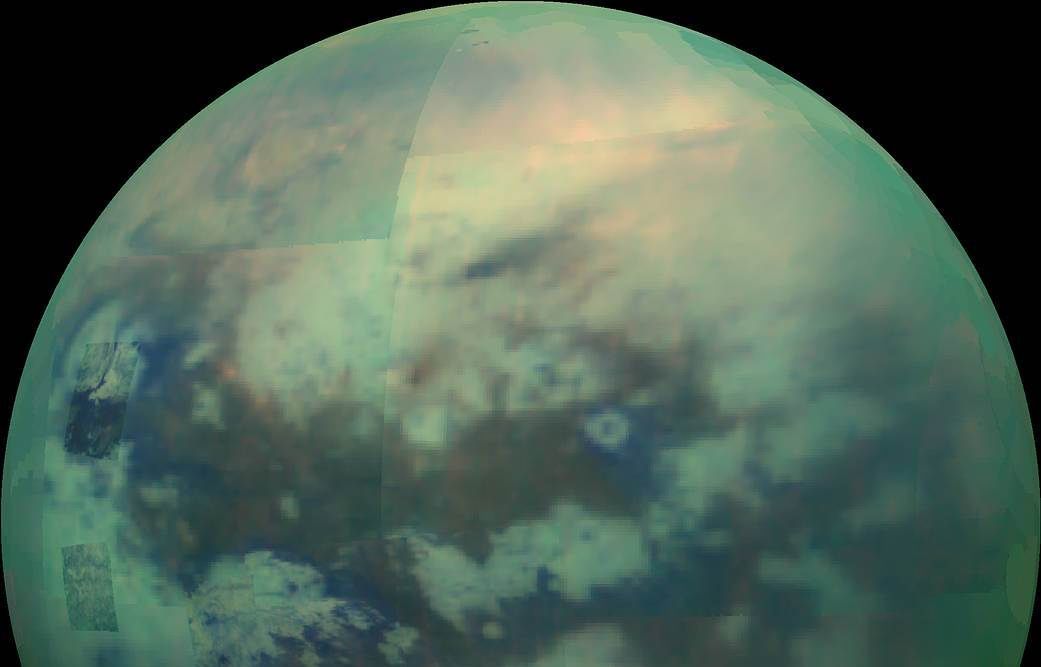
Scientists at the Massachusetts Institute of Technology (MIT) have developed a groundbreaking model that reveals how even the gentlest breeze on Saturn’s moon Titan could generate waves as tall as three meters on its hydrocarbon lakes. This discovery, based on the new “PlanetWaves” model, fundamentally changes our understanding of wave formation beyond Earth and has significant implications for future space exploration missions to Titan.
The research, published in the Journal of Geophysical Research: Planets, demonstrates that Titan’s unique environmental conditions—low gravity, dense nitrogen-rich atmosphere, and liquid methane-ethane seas—create ideal conditions for massive wave formation under minimal wind stress. Unlike Earth, where substantial wind is required to produce noticeable waves, Titan’s combination of factors means a light breeze could produce dramatic surface disturbances.
According to Una Schneck, a researcher at MIT involved in the study, understanding these wave dynamics is critical for designing future probes destined for Titan’s surface. “We need to know how to build something that can withstand wave energy,” Schneck stated, highlighting the practical engineering challenges posed by these findings.
How Titan’s Environment Creates Giant Waves
The PlanetWaves model developed by MIT researchers represents a significant advancement in planetary science because it comprehensively accounts for multiple physical variables that influence wave formation. Previous models primarily focused on gravity alone, but this new approach incorporates liquid density, viscosity, surface tension, and atmospheric pressure alongside gravitational forces.
When applied to Titan’s conditions, the model shows that the moon’s low surface gravity (approximately 14% of Earth’s) combined with the low density and viscosity of liquid methane and ethane creates an environment where minimal wind energy transfers efficiently into wave motion. The atmospheric pressure on Titan, about 1.5 times that of Earth, further influences how wind couples with the liquid surface.
Researchers validated their model using empirical data from Lake Superior on Earth, where they demonstrated accurate prediction of wave growth under various wind conditions. After confirming the model’s reliability for terrestrial conditions, they extrapolated its application to Titan, Mars, and several exoplanets with known surface liquid compositions.
Implications for Space Exploration
The discovery has direct implications for NASA’s Dragonfly mission, which is scheduled to launch in July 2028 and arrive at Titan in 2034. Dragonfly, a rotorcraft lander designed to explore multiple locations across Titan’s surface, will need to account for potential wave activity when operating near the moon’s seas, and lakes.

Beyond mission engineering, the findings contribute to solving longstanding mysteries about Titan’s surface features. Scientists have observed river channels and coastlines on Titan but have noted the absence of typical river deltas where these channels meet seas. The PlanetWaves model suggests that persistent wave action, even from light winds, could continuously redistribute sediments and prevent the stable delta formations commonly seen on Earth.
The research also provides comparative insights into other celestial bodies. Model simulations indicate that on ancient Mars, which once had a thicker atmosphere and surface liquid water, wave formation would have required progressively stronger winds as the atmosphere thinned over time. Conversely, on hot rocky exoplanets like 55 Cancri e, where surface materials exist as molten lava, even hurricane-force winds would produce only minimal waves measuring just a few centimeters in height.
Understanding the PlanetWaves Model
The PlanetWaves framework represents a versatile tool for studying liquid surface dynamics across diverse planetary environments. By integrating fundamental fluid physics with specific planetary parameters, the model enables scientists to predict wave behavior without requiring direct observations from every celestial body of interest.
This approach is particularly valuable for studying distant exoplanets where direct imaging of surface features remains beyond current technological capabilities. Researchers can input known or hypothesized planetary characteristics—such as estimated gravity, atmospheric composition, and likely surface liquids—to generate predictions about potential wave activity.
The model’s developers emphasize that while it provides robust predictions based on established physics, actual wave heights on Titan would depend on numerous variables including wind duration, fetch (the distance over which wind blows across the liquid), and local topography. The three-meter figure represents a plausible maximum under favorable conditions rather than a guaranteed constant wave height.
As preparations continue for the Dragonfly mission and future concepts for Titan lake landers or submarines, understanding surface wave dynamics becomes increasingly important for ensuring mission success and maximizing scientific return from this intriguing ocean world in our outer solar system.
For ongoing updates on Titan research and planetary science developments, readers can follow official announcements from NASA’s planetary science division and peer-reviewed publications in journals such as the Journal of Geophysical Research: Planets.
What aspects of extraterrestrial oceanography intrigue you most? Share your thoughts in the comments below and help spread awareness of these fascinating discoveries by sharing this article with others interested in space exploration and planetary science.