
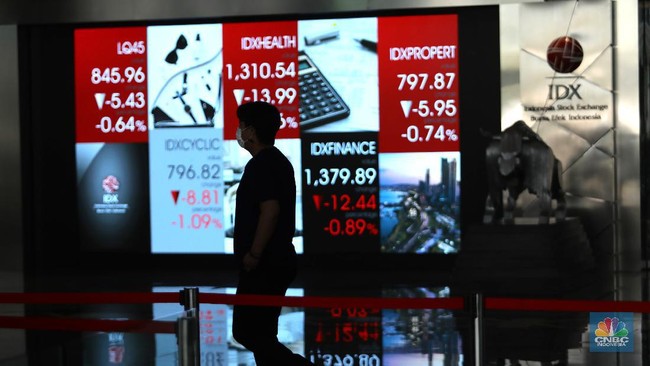
Indonesia’s benchmark Jakarta Composite Index (IHSG) opened today with a sharp 1.4% decline, extending losses seen across regional equity markets as investors grappled with mounting concerns over commodity prices, currency stability, and domestic policy risks. The sell-off—one of the steepest in recent weeks—reflects growing unease about the health of Indonesia’s economic fundamentals, particularly in sectors heavily exposed to global commodity cycles and foreign investor sentiment.
While the rupiah’s depreciation against the US dollar and weaker-than-expected mining sector earnings dominated headlines, analysts warn the downturn may signal deeper structural challenges. With regional peers like Singapore and Malaysia also experiencing volatility, today’s market action underscores how tightly Indonesia’s economic performance is now tied to both commodity markets and broader Asian risk appetites.
Here’s what’s driving the sell-off—and why today’s drop could be just the beginning of a more prolonged correction.
Key Takeaways: Why Indonesia’s Stock Market Is Under Pressure
- Mining sector underperformance: Stocks in coal and nickel—Indonesia’s two largest export commodities—fell sharply amid concerns over falling global demand and potential royalty hikes.
- Currency weakness: The rupiah’s slide to Rp 17,386 per USD (its weakest level in six months) triggered profit-taking by foreign investors holding dollar-denominated assets.
- Regional contagion: Declines in Singapore’s Straits Times Index and Hong Kong’s Hang Seng Index pulled Indonesian equities lower as Asian markets reacted to US Federal Reserve signals on interest rate cuts.
- Policy uncertainty: Upcoming elections and potential changes to mining regulations have investors questioning long-term stability in key export sectors.
- Valuation concerns: Many Indonesian stocks now trade at premiums to their regional peers, making them particularly vulnerable to profit-taking in a risk-off environment.
Why Did the IHSG Plunge 1.4% Today?
Three interconnected factors are driving today’s market downturn, according to trading analysts and economists:
1. Mining Stocks Bleed as Commodity Prices Wobble
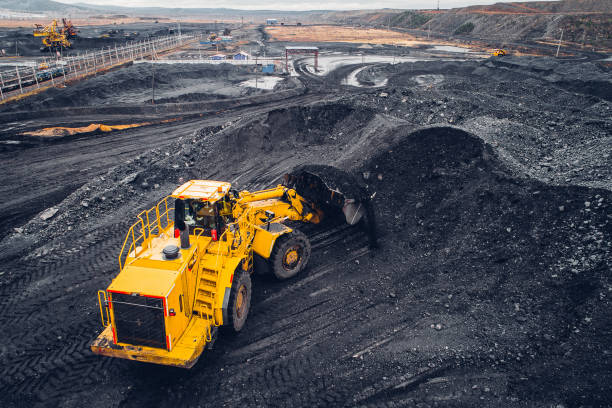
The IHSG’s decline was heavily concentrated in mining and materials stocks, which accounted for nearly 40% of today’s total losses. Coal and nickel—Indonesia’s top two exports—have both faced downward pressure in recent weeks due to:
- Coal demand softening: China’s appetite for Indonesian thermal coal has weakened as domestic production ramps up, reducing the need for imports. Benchmark prices for Indonesian coal have fallen by nearly 8% in the past month.
- Nickel supply glut: Indonesia’s rapid expansion of nickel processing capacity—now the world’s largest producer—has led to oversupply concerns, with London Metal Exchange nickel prices down 5% year-to-date.
- Royalty fears: Speculation about potential increases in mining royalties has spooked investors, with some analysts warning of a 15–20% hit to sector profitability if new regulations are enacted.
What it means: Mining stocks make up roughly 25% of the IHSG by market capitalization. Their underperformance today is not just a sectoral issue—it’s dragging down the broader index as investors reassess Indonesia’s economic growth outlook.
2. The Rupiah’s Freefall Triggers Foreign Outflows
The Indonesian rupiah hit Rp 17,386 per USD in early trading—its weakest level since November 2023—amplifying losses in the stock market. The currency’s decline stems from:

- US dollar strength: A resurgent greenback, fueled by expectations of delayed Federal Reserve rate cuts, has put pressure on emerging-market currencies, including the rupiah.
- Capital flight: Foreign investors have pulled $3.2 billion from Indonesian equities and bonds in the past three months, according to central bank data, as yields in developed markets rise.
- Trade deficit concerns: Indonesia’s trade deficit widened to $8.1 billion in the first quarter, fueled by higher fuel imports and weaker commodity revenues, further weakening the rupiah.
Why this matters: Many Indonesian stocks are held by foreign investors, who are now facing losses in both local currency and USD terms. The rupiah’s weakness also makes Indonesian assets less attractive to global fund managers, who prefer higher-yielding currencies like the Brazilian real or South African rand.
3. Regional Market Contagion and Policy Risks
Indonesia is not trading in isolation. Declines in neighboring markets—including a 2.1% drop in Singapore’s Straits Times Index and a 1.8% fall in Hong Kong’s Hang Seng—have dragged Jakarta’s market lower. Additionally:
- Federal Reserve signals: Recent comments from Fed officials suggesting rate cuts may be delayed have sent shockwaves through Asian markets, where liquidity-sensitive economies like Indonesia are particularly vulnerable.
- Election uncertainty: With Indonesia’s next presidential election just 12 months away, investors are growing wary of potential policy shifts, particularly in the mining and energy sectors.
- Valuation gaps: Indonesian stocks now trade at a 12% premium to their regional peers on a price-to-earnings basis, making them prime targets for profit-taking in a risk-off environment.
The bigger picture: Today’s sell-off is less about a single trigger and more about a confluence of risks. “The market is pricing in a more cautious outlook for Indonesia’s economy,” said BIS economist Daniel Lee. “Investors are asking: Is this a correction, or the start of a longer-term adjustment?”
Bloomberg’s live market tracker shows Indonesia’s IHSG among the worst performers in Asia today, alongside Thailand’s SET Index and the Philippines’ PSEi.
Who Is Most Affected?
The IHSG’s decline today will have uneven impacts across stakeholders:
- Retail investors: Many Indonesians hold stocks through mutual funds or brokerage accounts, and today’s losses could dampen consumer confidence. The Jakarta Stock Exchange (IDX) has seen retail participation grow by 30% year-over-year, making this group particularly vulnerable.
- Foreign institutional investors: Funds managing assets in USD terms will face losses as the rupiah weakens, potentially leading to further outflows if the trend continues.
- Mining companies: Firms like PT Adaro Energy and PT Vale Indonesia—heavily exposed to coal and nickel—will see their market caps shrink, reducing their ability to fund expansion projects.
- Government revenue: Lower stock prices could reduce capital gains taxes and corporate profits, straining public finances at a time when the government is already grappling with slower growth.
What Happens Next?
Market analysts are divided on whether today’s drop signals a broader correction or a temporary pullback. Key factors to watch in the coming days:
- Central Bank intervention: Bank Indonesia has $130 billion in foreign reserves and could step in to support the rupiah if the currency’s decline accelerates. However, direct market intervention is unlikely without clearer signs of a crisis.
- Commodity price trends: If coal and nickel prices stabilize—or rebound—mining stocks could recover quickly. Conversely, further declines would deepen the sell-off.
- Federal Reserve decisions: The next Fed meeting on June 12 will be critical. Any hints of prolonged high rates could keep emerging-market currencies under pressure.
- Domestic policy signals: Clarity on mining royalties and election-related economic plans could either reassure or spook investors.
Next checkpoint: The Indonesian Stock Exchange (IDX) will release its official trading volume and value data by 4:00 PM local time today, followed by a Bank Indonesia press conference tomorrow at 10:00 AM. Investors will also be watching for updates from the Ministry of Energy and Mineral Resources on mining sector regulations.
FAQ: Your Questions About Indonesia’s Stock Market
Q: Is this the start of a bear market?
A: Not necessarily. While today’s 1.4% drop is significant, a bear market typically requires a 20% decline from recent highs. Analysts suggest this is more of a correction driven by specific risks rather than a systemic collapse.
Q: Should I sell my Indonesian stocks?
A: That depends on your investment horizon and risk tolerance. Short-term traders may see this as an opportunity to take profits, while long-term investors could view it as a buying opportunity if they believe in Indonesia’s fundamentals. Always consult a financial advisor.
Q: How does this affect the Indonesian economy?
A: A prolonged stock market downturn could reduce corporate investment, slow hiring, and lower government revenue from capital gains taxes. However, Indonesia’s economy remains resilient, with GDP growth still expected at 5.1% this year.
Q: Will the rupiah keep falling?
A: The currency’s trajectory depends on global liquidity conditions and domestic data. If the US Fed signals more rate cuts, the rupiah could stabilize. But if risk aversion persists, further depreciation is possible.
Q: Are there safe sectors to invest in?
A: Consumer staples and healthcare stocks have historically performed well during market downturns. Companies like Unilever Indonesia and Kalbe Farma have shown resilience in volatile conditions.
What do you think is driving Indonesia’s market turbulence? Share your insights in the comments below—or let us know if you’re looking for deeper analysis on mining stocks, currency trends, or regional market comparisons.
For real-time updates, follow Jakarta Stock Exchange and Bank Indonesia for official statements.