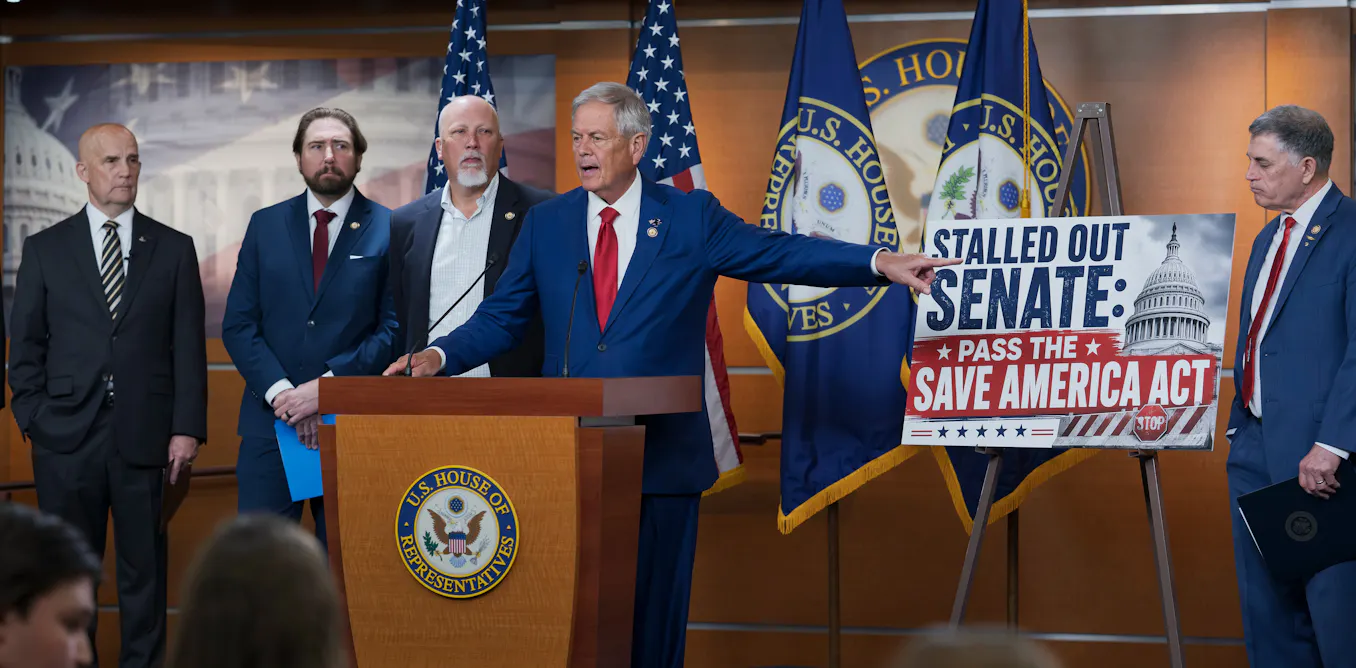
The Safeguard American Voter Eligibility Act, known as the SAVE America Act, remains stalled in the U.S. Senate despite Republican control of both chambers of Congress. According to legislative reports, the bill faces a blockade due to the 60-vote filibuster threshold and concerns among Republican lawmakers regarding the logistical costs and legal feasibility of federalizing election administration.
President Donald Trump has made the legislation a focus of his administration in recent months, featuring the act prominently in a primetime speech on July 16, 2026. The proposed law seeks to implement stringent voting changes, including the requirement of additional documentation to vote and a significant curtailment of mail-in registration and ballots across all states.
While House Speaker Mike Johnson has brought the legislation to the floor for at least three votes, Senate Majority Leader John Thune told Fox News in June 2026 that the necessary votes to move the act through the Senate currently do not exist. This deadlock has disrupted the summer legislative calendar and strained the relationship between the White House and congressional Republicans.
The Senate Filibuster and House Tactical Maneuvers
The primary procedural hurdle for the SAVE America Act is the Senate filibuster, which requires 60 votes to reach a final floor vote. House Republicans have attributed the bill’s stagnation to this threshold. In an effort to force the Senate’s hand, Speaker Mike Johnson attempted to include portions of the SAVE America Act in a House-passed bill intended to fund the State Department in July 2026.

These maneuvers are described by some observers as theatrical, given the lack of support in the upper chamber. While President Trump has requested that Senate Republicans vote to remove the filibuster to expedite the act, they have not done so. The slim margins of Republican control in the House also complicate Speaker Johnson’s ability to maintain party unity on the issue, raising the risk of government shutdowns when the act is tied to essential funding legislation.
The friction over the bill has extended to other policy areas. Reports indicate that President Trump refused to sign a bipartisan housing bill passed by Congress due to his preoccupation with the SAVE America Act. Although the housing bill eventually became law without his signature, the incident denied congressional Republicans an opportunity to tout a bipartisan, popular policy win.
Logistical Costs and Constitutional Challenges
The SAVE America Act proposes a shift toward federalized election processes, a move that critics and some lawmakers argue is legally murky. Under Article 1, Section 4 of the U.S. Constitution, while Congress can establish general parameters for elections, the states maintain the primary responsibility for election administration.
Republican Senator Thom Tillis has questioned the feasibility of implementing the act across 50 different states without a dedicated funding stream or specific implementation instructions. Tillis stated to reporters that it is disingenuous to suggest the system could be operational by the next election, adding that such a move could undermine the integrity of the elections.
The act would require federal possession of voter rolls, a departure from the precedent set by the National Voter Registration Act of 1993. While that earlier law reinforced citizenship as a requirement for voting, it left the creation of forms and the enrollment process to individual states.
Impact on Rural Voters and Election Security
Analysis of the bill’s requirements suggests it could create significant barriers for eligible voters, particularly in rural areas. Because the act would restrict mail-in registration and ballots, an estimated 5 million Americans might be required to drive an hour or more to register to vote, with some facing trips as long as eight hours.
Additional documentation requirements would also affect specific demographics. Women who changed their names after marriage would likely need to present marriage certificates in addition to birth certificates. First-time voters and students on college campuses would also face hurdles in presenting the required documentation in person.
Concerns regarding election security have intensified following the president’s decision to fire the remaining members of the bipartisan, Senate-confirmed Election Assistance Commission in June 2026. This action followed the Supreme Court ruling in Trump v. Slaughter, which allowed the president to remove executive branch officials without cause. The Election Assistance Commission serves as the point of contact for states regarding election administration processes; its vacancy leaves a gap in the expertise needed to implement the SAVE America Act fairly and unbiasedly across all 50 states.
Political Risks and the Republican Divide
The hesitation among congressional Republicans reflects a tension between loyalty to the president and the risk of disenfranchising their own constituents. While the act’s goals are popular among MAGA-aligned voters in deep-red districts, the practical effects on rural voters could jeopardize the reelection efforts of members representing those areas.
For many Republican lawmakers, public support for the act allows them to signal alignment with President Trump, while the Senate’s procedural blockade serves as a convenient “doorstop” to prevent the law from actually taking effect mere months before an election. This strategy allows members to avoid the political fallout of implementing restrictive voting laws while remaining in the president’s good graces for primary endorsements.
The next critical checkpoint for the legislation will be the upcoming budget negotiations, where House leadership may again attempt to link the SAVE America Act to must-pass spending bills.
Do you believe federalizing voter rolls is a necessary security measure or a logistical impossibility? Share your thoughts in the comments below.