
For centuries, historians and literary enthusiasts have chased the ghost of William Shakespeare’s urban presence. Whereas his roots in Stratford-upon-Avon are well-documented, his footprint in the capital remained a puzzle of “near this site” plaques and vague archival references. Now, a breakthrough in archival research has finally pinpointed the exact location of Shakespeare’s long-lost London home.
The discovery centers on the Blackfriars precinct in east London, an area historically significant for its 13th-century Dominican friary and its proximity to the Millennium Bridge. While a commemorative plaque at 5 St. Andrew’s Hill has long noted that the playwright purchased lodgings in the Blackfriars Gatehouse on March 10, 1613, the specific coordinates of that residence remained elusive until now.
The mystery persisted largely given that the property was destroyed during the Great Fire of London in 1666, which claimed approximately 15 percent of the city’s housing. For over 360 years, the exact plot of land where the Bard once resided was a matter of academic debate rather than mapped fact.
This gap in the historical record has been closed by Lucy Munro, a Shakespeare expert at King’s College London. Through the discovery of three newly located documents, Munro has been able to map the residence with precision, providing a rare glimpse into the domestic life of the world’s most famous playwright during his final years.
Unlocking the Archives: The 1668 Floorplan
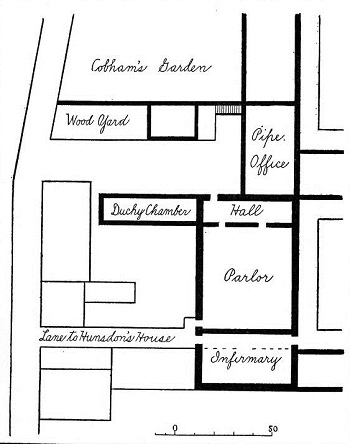
The key to the discovery lay within the London Archives. Munro identified a rendering of the Blackfriars precinct drawn in 1668, just two years after the Great Fire. This document contained a floorplan that allowed researchers to visualize the physical dimensions of the property.

According to the archival rendering, the section of the property with a foundation measured 45 feet wide from east to west, with widths of 13 to 15 feet on either complete. A portion of the property that spanned the gate itself was absent from the map because it lacked a foundation. While the documents do not provide internal layouts, the overall scale suggests the structure was large enough to be divided into two separate homes.
This structural detail offers new insight into Shakespeare’s financial and personal habits. Historians believe the size of the property indicates it may have served a dual purpose: a private residence for the playwright and a rental property to generate additional income. This challenges the previous assumption that the Blackfriars property was strictly an investment vehicle.
Proximity to the Blackfriars Theatre
The location of the house provides a logical link to Shakespeare’s professional life. The residence was situated close to the Blackfriars theatre, his workplace. Munro notes that while Shakespeare could have purchased an investment property anywhere in the city, the choice of this specific location suggests a desire for proximity to his theatrical endeavors.
The timing of the purchase also aligns with his professional output. In 1613, the same year he acquired the lodgings, Shakespeare co-authored Two Noble Kinsmen with fellow playwright John Fletcher. Records indicate that Shakespeare visited London again in November 1614, leading Munro to suggest it is highly probable that he stayed in his own home during that visit.
A Century of Change on a Historic Plot
Since the reconstruction of London following the Great Fire, the site of Shakespeare’s home has seen a rotating door of commercial tenants. Over the last 100 years, the plot has hosted a variety of businesses, including an architecture firm, a printing company, and a carpet wholesaler.
In a fitting turn of historical irony, the site has more recently been occupied by the National Book Association, returning the land to a purpose aligned with the literary legacy of its original 17th-century owner.
Timeline of the Blackfriars Property
| Date | Event |
|---|---|
| March 10, 1613 | William Shakespeare purchases lodgings in the Blackfriars Gatehouse. |
| 1665 | The property is sold by Shakespeare’s granddaughter, Elizabeth Hall Nash Barnard. |
| 1666 | The home is destroyed during the Great Fire of London. |
| 1668 | A rendering of the Blackfriars precinct is drawn, preserving the floorplan. |
| Modern Era | The site is identified via archival documents and later occupied by the National Book Association. |
The identification of this site provides a tangible link to the playwright’s later years, bridging the gap between his rural life in Stratford-upon-Avon and his celebrity status in the heart of London. For those interested in the intersection of history and urban geography, this discovery transforms a vague commemorative plaque into a precise historical landmark.
Further archival research into the Blackfriars precinct may continue to reveal details about the surrounding neighborhood and the other figures of the Elizabethan and Jacobean eras who frequented the area.
Do you believe the location of a writer’s home changes how we interpret their function? Share your thoughts in the comments below and share this discovery with fellow history buffs.
Worth a look