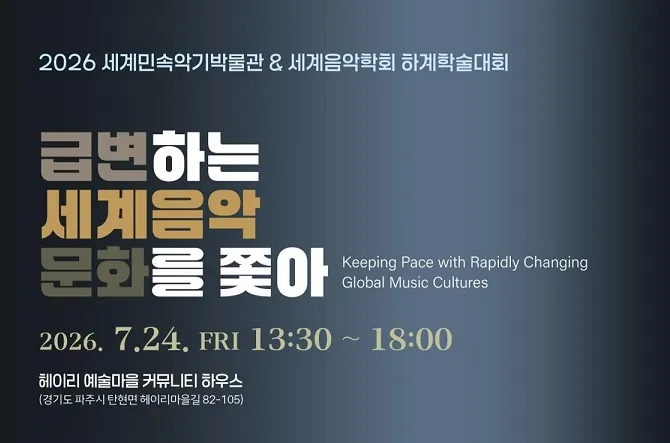
The World Folk Instrument Museum, located in the Paju Heyri Art Village, is set to host an event. In partnership with the Society for World Music, the museum will hold an event, bringing together scholars, musicians, and curators to examine the evolving role of ethnic instruments in global musical heritage.
Academic Collaboration in Paju
This event represents a formal collaboration between the World Folk Instrument Museum, directed by Lee Young-jin, and the Society for World Music, led by Park Mi-kyung. The conference is designed to serve as a platform for interdisciplinary research, focusing on the preservation of traditional musical practices and the systematic study of folk instruments from around the globe. By hosting the event within the Heyri Art Village—a prominent cultural hub in Gyeonggi Province—the organizers aim to emphasize the connection between artistic creation and historical documentation.
The academic program is scheduled to feature presentations that address the technical aspects of instrument construction, the cultural significance of traditional repertoires, and the challenges of maintaining authentic soundscapes in an increasingly digitized musical environment. According to the stated objectives of the participating organizations, the conference seeks to provide a rigorous framework for musicologists to exchange findings on the migration of instruments and the evolution of performance techniques across different cultures.
The Role of the World Folk Instrument Museum
The World Folk Instrument Museum has long functioned as a repository for rare and historically significant musical artifacts. Its mission involves not only the physical preservation of instruments but also the education of the public regarding the diverse origins of sound. By initiating this joint academic conference, the museum is expanding its mandate to include active scholarly discourse, moving beyond exhibition-based engagement to direct participation in academic research.

The Society for World Music, a professional organization dedicated to the study of global musical traditions, brings a complementary focus to the partnership. With Park Mi-kyung at the helm, the society has historically focused on the analysis of musical structures and the socio-cultural contexts of performance. The collaboration is expected to highlight the importance of “living” archives, where instruments are studied not merely as static museum pieces, but as active participants in the ongoing development of world music.
Why Musicological Research Matters
For students, professional musicians, and cultural historians, this conference offers a rare opportunity to engage with primary research on ethnic instrumentology. The intersection of material culture—the physical instruments—and performance practice—the music itself—remains a core interest for the international musicology community. By facilitating this dialogue in Paju, the organizers are contributing to a broader understanding of how cultural heritage is transmitted through sound.
The event is expected to draw attendance from various academic institutions and cultural organizations. For those interested in the preservation of intangible cultural heritage, the insights shared during this conference will provide a clearer picture of how traditional instruments are being adapted for modern audiences while maintaining their historical integrity. The organizers have emphasized that the findings from this conference may influence future curation strategies at the museum, ensuring that the collection remains relevant to contemporary scholarly needs.
Future Directions and Participation
As the date for this conference approaches, the World Folk Instrument Museum and the Society for World Music have indicated that this event is intended to be a series of collaborative efforts. The focus remains on establishing a sustainable model for academic inquiry that can support both the needs of the museum’s archival staff and the broader goals of the musicological community in South Korea and abroad.

Participants and interested observers are encouraged to monitor the official channels of the World Folk Instrument Museum for updates regarding registration procedures and the final schedule of presentations. By fostering these professional connections, the organizers hope to cement the Paju region’s reputation as a center for serious study of global musical traditions. Further announcements regarding follow-up publications or subsequent symposia are expected to be released by the host organizations following the conclusion of the event.
We invite our readers to share their thoughts on the importance of preserving traditional musical instruments in the comments section below. Have you visited the World Folk Instrument Museum in Heyri? Join the conversation on our social media platforms to let us know your perspective on the intersection of music and history.
Worth a look