
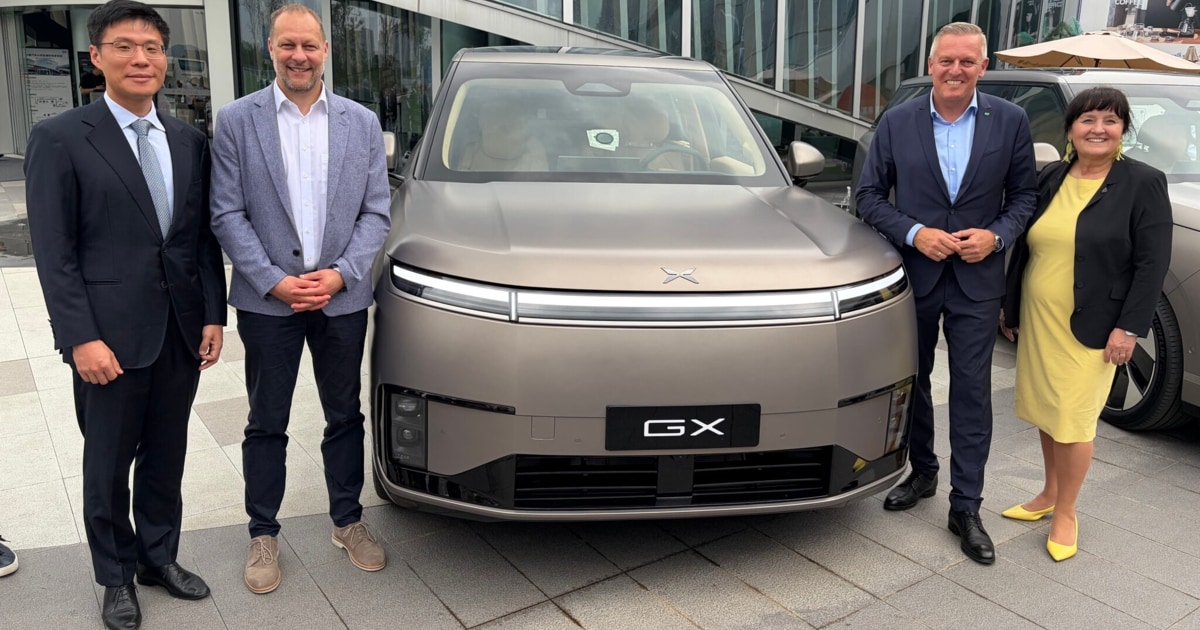
Chinese electric vehicle manufacturer Xpeng will begin production of a fourth model at Magna Steyr’s facility in Graz, Austria, later this year, according to announcements made during a Styrian economic delegation’s visit to China. The expansion of the existing partnership between Xpeng and Magna marks a significant deepening of industrial ties between Austria and China in the electric vehicle sector.
The announcement was made on April 22, 2026, during the final day of a Styrian government delegation’s trip to China, where officials including Styrian Governor Mario Kunasek and Deputy Governor Manuela Khom met with Xpeng representatives at the company’s headquarters in Guangzhou. Magna’s Kurt Bachmaier confirmed the development, stating that production of the modern model would commence before the end of 2026.
This development builds on an existing collaboration that began in September 2025, when Magna announced it had been selected by Xpeng to assemble two electric vehicle models for the European market at its Graz facility. Serial production of those initial models was scheduled to begin in the third quarter of 2025, marking Magna’s first complete vehicle assembly contract with a Chinese original equipment manufacturer in Europe.
Currently, Magna’s Graz plant produces three Xpeng models for the European market: the G6, G9, and P7 Plus. Production of the P7 Plus commenced in early April 2026, joining the already-established manufacturing of the G6 and G9 models. The addition of a fourth model will further increase the volume of Xpeng vehicles assembled at the Styrian facility.
According to Magna officials, Xpeng sold over 20,000 vehicles in Europe during the previous year, with the majority of those vehicles manufactured at the Graz plant. The company expressed confidence that sales would continue to grow, which would positively impact Magna’s operations through increased production volume.
The expansion of production capacity is expected to lead to an increase in employment at the Graz-Thondorf facility, although specific hiring numbers have not yet been disclosed. Magna managers emphasized that the continued growth of the Xpeng partnership reflects the success of Austria’s strategy to attract high-value industrial investment through its skilled workforce and established manufacturing expertise.
Styrian officials characterized the development as validation of the region’s economic strategy. Governor Kunasek described the continued expansion of the Xpeng-Magna partnership as “a remarkably positive sign” and evidence of Styria’s strength through companies like Magna that offer “reliability and years of experience in vehicle manufacturing.” Deputy Governor Khom highlighted the reciprocal nature of the relationship, noting that “the bridges we have built are being crossed from both sides” as technical know-how flows between the regions.
Beyond Xpeng, Magna’s Graz facility also produces vehicles for other Chinese manufacturers, including two models for GAC Group, whose headquarters are located in Guangzhou, not far from Xpeng’s base. The plant continues to manufacture the Mercedes-Benz G-Class alongside these Asian-made vehicles, demonstrating the facility’s flexibility in handling diverse automotive platforms.
The ongoing collaboration between Magna and Chinese EV manufacturers represents a significant aspect of Austria’s industrial policy, particularly in Styria, where efforts to attract and retain advanced manufacturing have been a priority. As European automakers face increasing competition from Chinese electric vehicle entrants, partnerships like the one between Magna and Xpeng illustrate how traditional automotive suppliers are adapting to serve new market entrants while maintaining local production capabilities.
Industry analysts note that such arrangements allow Chinese manufacturers to establish a local presence in Europe more quickly while avoiding some of the tariffs and trade barriers associated with direct imports. For European suppliers like Magna, the partnerships provide valuable volume and technical experience with emerging electric vehicle architectures.
The next phase of the Xpeng-Magna collaboration will involve the ramp-up of production for the fourth model, with specific details about the vehicle’s specifications and expected annual volume yet to be disclosed by either company. Styrian economic development officials have indicated they will continue to monitor the partnership’s progress as part of broader efforts to assess the impact of foreign direct investment on regional employment and technological development.