
The landscape of global healthcare is currently undergoing a fundamental shift. For years, the promise of artificial intelligence in medicine has often felt confined to high-budget pilot programs or theoretical white papers. However, we are now seeing the emergence of platforms designed specifically for real-world deployment, focusing on accessibility for underserved populations and the integration of scalable technology.
One such development is the launch of XRPH AI, a mobile-first healthcare platform built on the XRP Ledger. By combining AI-driven guidance with a decentralized infrastructure, the platform aims to bridge the gap between complex medical resources and the individuals who need them most, regardless of their geographic location or socioeconomic status.
As a physician and journalist, I have observed that the primary barriers to healthcare are rarely just a lack of information, but rather a lack of accessible, actionable tools. XRPH AI is attempting to address this by creating a unified ecosystem that operates with HIPAA-grade standard privacy, ensuring that sensitive patient data is handled with the necessary rigor required for medical applications XRPH Healthcare.
The platform’s strategy is centered on “real-world usability,” moving beyond the conceptual phase to provide tools that can be utilized daily on a smartphone. This approach is particularly critical for emerging markets where physical healthcare infrastructure may be sparse, but mobile connectivity is widespread.
The Mobile-First Architecture of XRPH AI
The design philosophy of XRPH AI is rooted in mobile-first accessibility. By leveraging the devices that users already own, the platform provides a streamlined interface to navigate digital guidance and connected care tools. This is not merely a convenience; in many parts of the world, a smartphone is the only point of entry for professional health information.

Current capabilities within the platform include a variety of specialized tools designed to support a broad spectrum of health needs. These include AI-powered healthcare guidance and multilingual communication support, which allows the platform to function across major languages and dialects, removing one of the most significant barriers to global health equity XRPH AI Platform.
From a clinical perspective, the inclusion of image upload capabilities for visible health concerns—such as skin or throat issues—is a noteworthy addition. Whereas not a replacement for a physical examination, such tools can facilitate better triage and symptom awareness. The platform incorporates FemCare support experiences and wellness features via CalmXRPH, providing a more holistic approach to health that includes mental clarity and women’s health insights.
To further integrate the digital experience with physical care, the platform includes local doctor search and connection tools, as well as health education resources. This ensures that the AI guidance serves as a bridge to professional medical intervention rather than a siloed information source.
Addressing Medication Affordability and Safety
One of the most tangible applications of the XRPH AI ecosystem is its focus on the affordability and authenticity of medication. In the United States, the platform has integrated a Prescription Savings Card that is accepted at more than 68,000 pharmacies, including major chains such as CVS, Walgreens, and Walmart XRPH Healthcare.
This card is designed to provide users with savings of up to 80% on prescriptions and medications with unlimited usage. In a climate where medication costs often lead to non-compliance—where patients skip doses because they cannot afford the refill—such a mechanism can have a direct impact on patient outcomes.
Beyond affordability, the platform addresses the critical issue of medication safety through counterfeit medication detection support tools. The proliferation of counterfeit drugs is a severe public health crisis, particularly in emerging markets. By providing tools to help verify medication authenticity, XRPH AI is tackling a systemic risk that often goes unaddressed by standard digital health apps XRPH AI Platform.
Incentivizing Wellness through Proof of Health™
A recurring challenge in public health is the “engagement gap”—the distance between a patient receiving health advice and actually implementing a healthy habit. XRPH AI is attempting to close this gap by introducing a utility layer known as Proof of Health™.
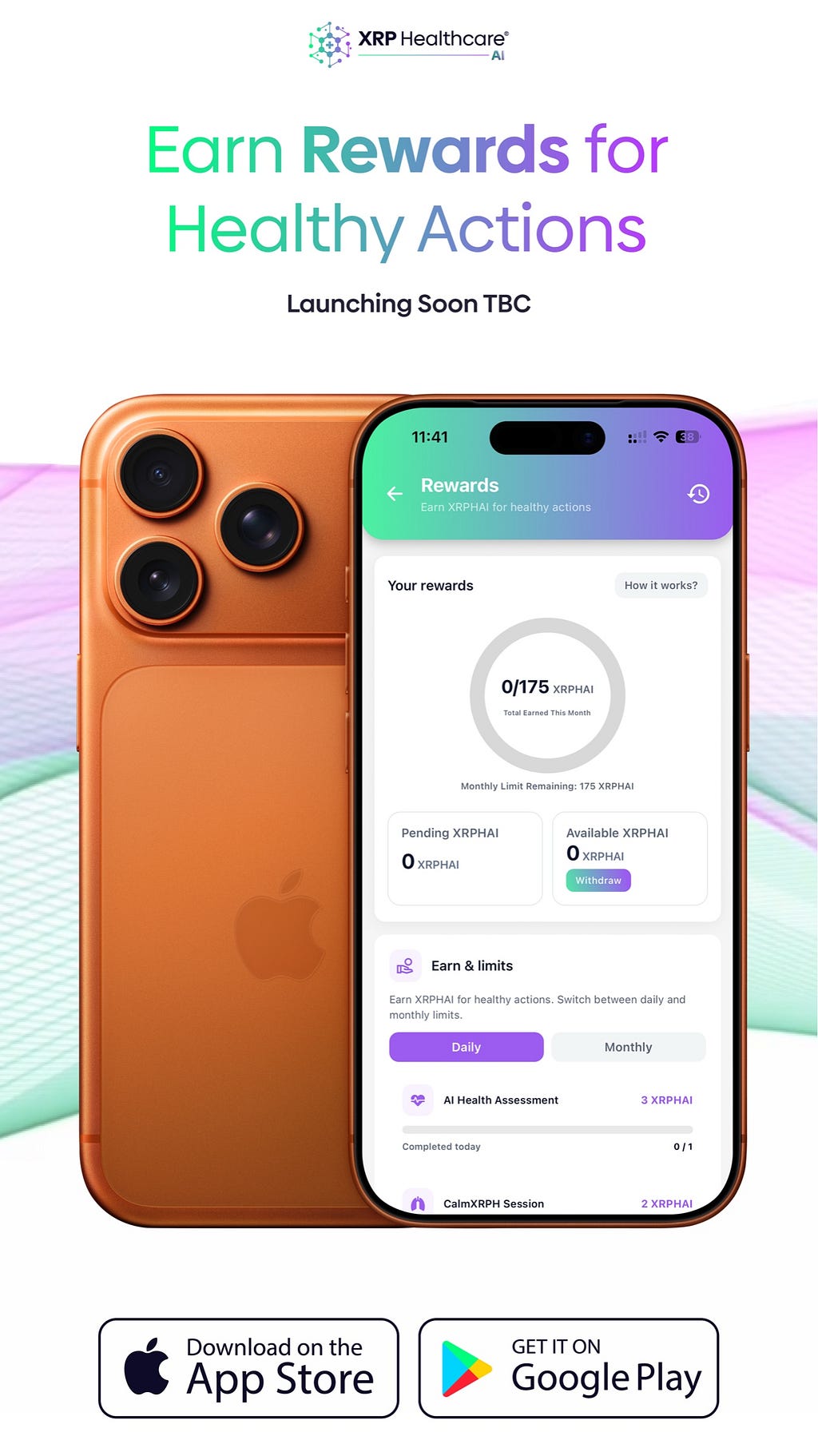
The Proof of Health™ model is designed to reward real health engagement. Rather than being a passive tool, the platform intends to incentivize users for taking verified healthy actions. These rewards are powered by XRPHAI and are designed to turn healthy behaviors into utility, which can eventually be transferred to the XRPH Wallet XRPH Healthcare.
According to the platform’s framework, users will be able to earn rewards through activities such as:
- Engaging with AI healthcare tools and guidance.
- Completing health-related actions within the app.
- Utilizing wellness features like CalmXRPH sessions.
- Reaching specific usage milestones that indicate consistent health management.
This shift from simple access to active participation is significant. By aligning incentives with healthy behavior, the platform moves toward a model of preventative care. When users are rewarded for consistency, the likelihood of long-term habit formation increases, which is the cornerstone of managing chronic conditions and improving general public health.
Scaling Accessibility in Emerging Markets
While the prescription savings card provides immediate value in the U.S. Market, the broader vision for XRPH AI is global. The platform is specifically designed to scale in regions where healthcare access is inconsistent and physical infrastructure is lacking.
The use of the XRP Ledger provides a scalable foundation for these operations, allowing for efficient transactions and data management. This technological choice supports the platform’s expansion into high-growth healthcare markets. Specifically, XRP Healthcare is expanding its footprint in Africa through AI-driven acquisitions, aiming to enhance healthcare access across the continent XRP Healthcare.
The combination of multilingual support, mobile-first accessibility, and AI-driven support allows the platform to function without a total dependency on physical clinics. For a patient in a rural area, having access to AI-powered symptom awareness and the ability to connect with a provider via a smartphone can be the difference between early intervention and a critical health crisis.
Key Components of the XRPH AI Ecosystem
| Feature Category | Specific Tool/Capability | Primary Benefit |
|---|---|---|
| Clinical Support | AI Guidance & Image Upload | Symptom awareness and triage for skin/throat issues. |
| Affordability | Prescription Savings Card | Up to 80% savings at 68,000+ U.S. Pharmacies. |
| Safety | Counterfeit Med Detection | Verification of medication authenticity. |
| Engagement | Proof of Health™ | Rewards for verified healthy actions. |
| Wellness | CalmXRPH & FemCare | Mental wellness and personalized women’s health. |
As the platform continues to evolve, the next major milestone will be the full launch of the in-app rewards and the scalable utility layer. This will transition the app from a resource library into an interactive health ecosystem where user activity is recognized and valued.
The integration of AI into healthcare is no longer a future prospect; it is a present reality. The success of platforms like XRPH AI will likely depend on their ability to maintain high privacy standards while continuing to lower the barriers to entry for the world’s most vulnerable populations. By focusing on real-world usability and tangible incentives, the platform is positioning itself as a practical tool for global health scaling.
For those interested in the intersection of blockchain and medical innovation, the upcoming rollout of the Proof of Health™ rewards will be the key development to watch. We will continue to monitor how these incentives impact user engagement and health outcomes in the coming months.
Do you believe that rewarding healthy actions via digital tokens can effectively improve public health outcomes? We invite our readers to share their perspectives in the comments below.