As the international community grapples with escalating regional tensions and shifting power dynamics, the role of Beijing in global diplomacy has come under renewed scrutiny. Following the recent high-level summit between Chinese President Xi Jinping and U.S. President Donald Trump, analysts are reassessing how major powers can effectively manage conflict in an era where military dominance is increasingly overshadowed by economic and diplomatic connectivity.
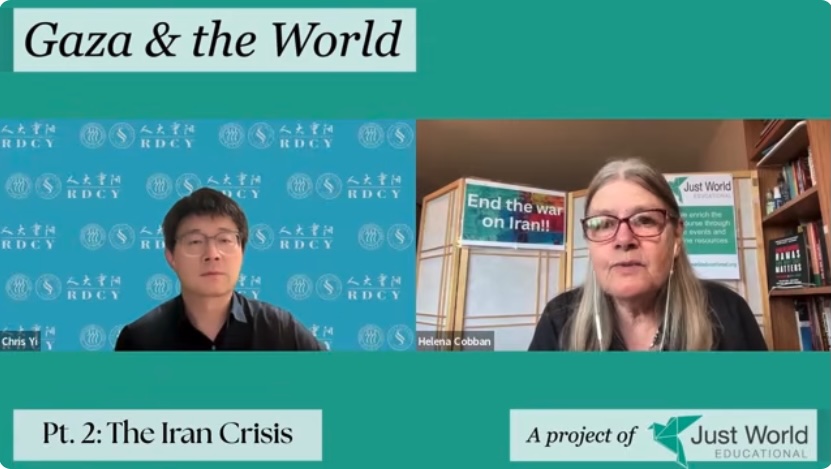
In a recent 80-minute dialogue, Dr. Yingnan (“Chris”) Yi, a Research Fellow at the Chongyang Institute for Financial Studies at Renmin University, offered a nuanced perspective on China’s evolving strategy. The discussion, hosted by Helena Cobban, president of Just World Educational, explored the complexities of U.S.-China relations and the potential for a more stable, albeit competitive, global order. Dr. Yi emphasized that China currently maintains unique, functional channels to Tehran, Gulf Arab nations, and Washington, positioning it as a distinct actor in regional conflict resolution.
The dialogue also addressed the critical need for a holistic approach to Middle Eastern stability. Both participants reached a consensus that sustainable resolutions in the region remain elusive as long as the conflicts in Gaza and southern Lebanon persist. This perspective underscores the interconnected nature of modern geopolitical crises, where local hostilities are inextricably linked to broader international security frameworks.
Beyond Strategic Distrust: The Path to Stability
A central theme of the exchange was the necessity of moving “beyond talking past each other” in U.S.-China relations. Dr. Yi noted that the recent summit provided a meaningful, if limited, step toward “constructive strategic stability.” He specifically highlighted the creation of a joint working group focused on AI safety and military applications as a tangible risk-reduction measure. However, he cautioned that economic deliverables from the summit were thinner than global markets required, and that significant issues, such as the status of Taiwan, remain unresolved in practical terms.
For those interested in the full exchange, the dialogue is available through several platforms:

- Watch the complete discussion on YouTube.
- Listen to the audio version via Apple Podcasts or Spotify.
- Download the transcript for further study.
The conversation highlighted that military confrontation is proving less decisive than diplomacy, economics, and regional connectivity in the current landscape. As Washington navigates its own internal policy debates, Cobban noted that many analysts now recognize that the trajectory of the U.S.-Iran conflict depends more on Tehran’s strategic decisions than on rhetoric emanating from the White House. The difficulty for other nations, she argued, lies in balancing their relationships between Washington and Beijing amid fluctuating tariff policies and unpredictable diplomatic maneuvers.
Economic Integration as a Diplomatic Asset
Dr. Yi identified three distinct assets China brings to the diplomatic table: its reputation as an “honest broker and bridge,” its insistence that settlements be nested within United Nations frameworks, and its capacity to serve as a reconstruction partner for infrastructure and energy projects once active conflict ceases. This approach prioritizes long-term regional integration over zero-sum competition.

Cobban drew a historical parallel to the 14th-century Indian Ocean trading system, suggesting it serves as a model for open commerce and shared prosperity. Both scholars agreed that the goal should be a balanced Asian order—one not dominated by a single supreme power—where trade and infrastructure links act as a buffer against geopolitical instability. Dr. Yi expressed skepticism that the U.S.-China rivalry is inherently existential, pointing to the historical wartime alliance between the two nations as a reminder that direct conflict across the Pacific would be irrational.
Looking Toward 2035
As the discussion neared its conclusion, the focus shifted to long-term strategy and the rise of the Global South. Dr. Yi highlighted the growth of Shenzhen as a high-tech innovation hub, pointing to it as a model for how China intends to navigate the next decade. He posed a forward-looking question: how can China seize strategic opportunities by 2035, and how will the United States respond to the evolving influence of the Global South?

Cobban suggested that China could enhance its global standing by making its diplomatic efforts more publicly visible and by consistently promoting the UN Charter and nonviolent conflict resolution. The dialogue concluded on a cautiously hopeful note, suggesting that the path out of current crises depends on the ability of major powers to support ceasefires, minimize miscalculation, and build durable regional arrangements rooted in international law.
As these conversations continue, observers will be watching for follow-up meetings from the joint working groups established during the summit. Readers are invited to share their perspectives on these developments in the comments section below.
Keep reading