
Historic Moment: Yomif Kejelcha Breaks Two-Hour Marathon Barrier—But Finishes Second
In a landmark achievement for long-distance running, Ethiopia’s Yomif Kejelcha became the second man in history to complete a marathon in under two hours—only to finish second by a razor-thin margin. The 28-year-old crossed the finish line at the 2026 TCS London Marathon in 1:59:41 on April 26, 2026, just 11 seconds behind Kenya’s Sabastian Sawe, who set a new world record with a time of 1:59:30. Kejelcha’s performance, achieved in his debut marathon, has sent shockwaves through the athletics world and redefined the limits of human endurance.
“This represents so crazy,” Kejelcha told NPR in an interview conducted on April 28, 2026. “It’s too hard to believe… I don’t have words for it really.” His disbelief was understandable. Before the race, Kejelcha had dismissed the idea of breaking the two-hour barrier in his first marathon, calling it “not possible.” Yet, he not only achieved the feat but did so with a time that would have shattered the previous world record—had Sawe not run even faster.
The London Marathon, one of the six World Marathon Majors, has long been a proving ground for elite runners. This year’s event, however, transcended its usual significance. The sub-two-hour marathon had been an elusive goal for decades, with athletes and scientists alike debating whether it was physiologically possible. The barrier was first broken in a controlled, non-competitive setting in 2019 by Kenya’s Eliud Kipchoge, who ran 1:59:40 in Vienna as part of the INEOS 1:59 Challenge. However, Kipchoge’s time was not recognized as an official world record due to the use of pacemakers and other non-competitive conditions. Sawe’s and Kejelcha’s times in London are the first to be officially ratified under standard marathon rules.
How the Two-Hour Barrier Fell—Twice
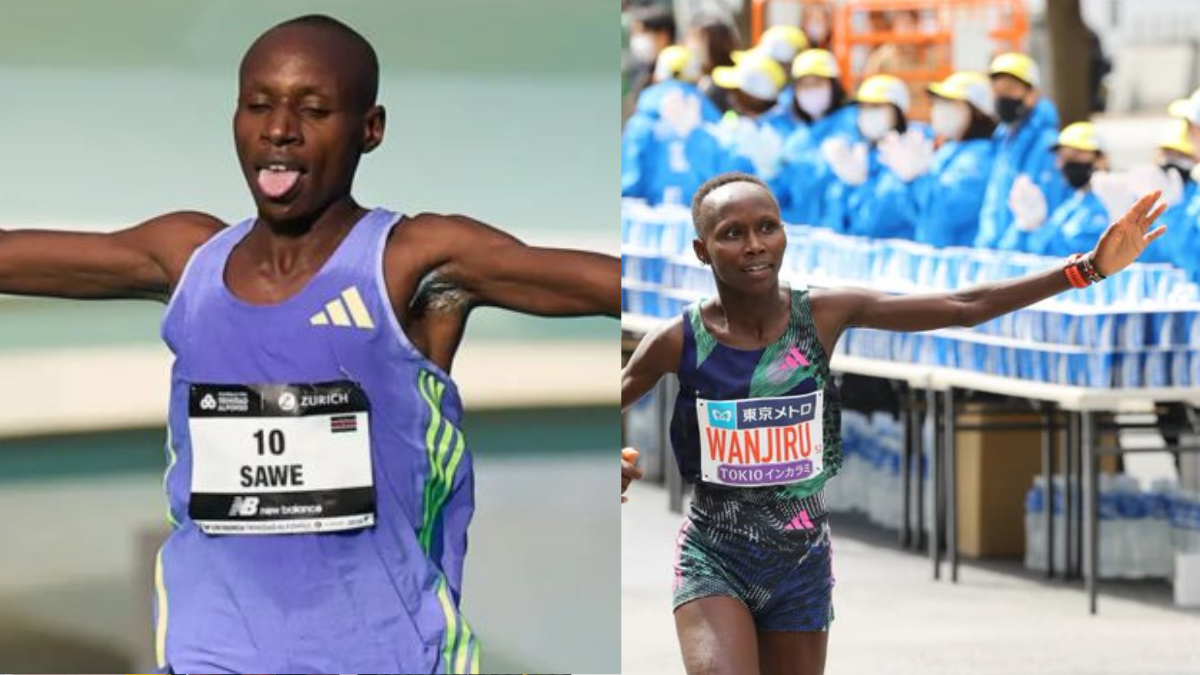
Sabastian Sawe’s victory in London was nothing short of historic. The 31-year-old Kenyan, hailing from the high-altitude running belt of Kapsabet in the Rift Valley, clocked 1:59:30, shattering the previous world record of 2:00:35 set by the late Kelvin Kiptum at the 2023 Chicago Marathon. Sawe’s achievement was met with widespread celebration in Kenya, where President William Ruto hailed him as a national hero. “Your triumph firmly places you among the greats of global athletics and reaffirms Kenya as an enduring force at the pinnacle of distance running,” Ruto wrote on X (formerly Twitter).
Yet, the spotlight on Sawe’s victory has not dimmed the significance of Kejelcha’s performance. Running his first competitive marathon, Kejelcha’s 1:59:41 would have been the fastest debut marathon in history—and the fastest time ever recorded under official conditions—had Sawe not run faster. Uganda’s Jacob Kiplimo too delivered a record-breaking performance, finishing third in 2:00:28, seven seconds faster than Kiptum’s previous world record. The trio’s times have collectively rewritten the record books, proving that the two-hour barrier is not just a one-off achievement but a new benchmark for elite marathoners.
Kejelcha’s journey to London was unconventional. Unlike many elite marathoners who transition from shorter distances, Kejelcha had built his reputation as a dominant force in the 3,000-meter and 5,000-meter events. He won gold in the 3,000 meters at the 2018 World Indoor Championships and silver in the 5,000 meters at the 2019 World Championships. His decision to step up to the marathon distance was met with curiosity—and skepticism—from the running community. “I knew it would be hard, but I didn’t think I could do it in my first race,” Kejelcha admitted. “I was just hoping to run a good time and learn.”
A Friendly Rivalry and the Road Ahead
Despite finishing second, Kejelcha’s reaction to his achievement was one of pure joy. “I’m not upset. I’m not angry. I’m very, very happy because I broke two hours,” he told NPR. The 11-second gap between him and Sawe has only fueled his ambition. “It’s… an 11-second difference, so I think it’s not too far for me to break again,” he said, hinting at his plans to return to London—or another major marathon—with an even faster time in mind. “I hope to run my next marathon a minute faster.”
Kejelcha’s optimism is not unfounded. His transition from the track to the marathon has been remarkably smooth, and his aerobic capacity, honed over years of competing in shorter distances, appears to have given him a unique advantage. Although marathon specialists often focus on endurance over speed, Kejelcha’s background has allowed him to maintain a blistering pace over 26.2 miles. His performance has sparked discussions about whether more track athletes could successfully transition to the marathon, potentially reshaping the sport’s competitive landscape.
The relationship between Kejelcha and Sawe adds a compelling narrative to their rivalry. Kejelcha described their competition as “friendly,” emphasizing mutual respect. “We push each other, but we are also friends,” he said. This camaraderie reflects the broader spirit of East African distance running, where athletes from Kenya, Ethiopia, and Uganda often train together and share insights, even as they compete fiercely on the global stage. The region’s dominance in long-distance running is unparalleled, with East African athletes holding nearly every major marathon record and Olympic medal in recent decades.
The Business of Breaking Barriers
The sub-two-hour marathon is not just a sporting milestone; it is also a commercial and cultural phenomenon. Marathon running has grown into a multi-billion-dollar industry, with major races like London, Boston, and New York attracting elite athletes, corporate sponsors, and millions of viewers worldwide. Breaking the two-hour barrier has been a long-standing marketing goal for brands like Nike, which sponsored Kipchoge’s 2019 attempt, and INEOS, which backed his subsequent efforts. The official recognition of Sawe’s and Kejelcha’s times in a competitive setting is likely to accelerate investment in elite marathon programs, training technologies, and athlete development.
For athletes like Kejelcha, the financial implications are significant. Marathon winners at major races can earn hundreds of thousands of dollars in prize money, appearance fees, and sponsorship deals. While Kejelcha did not accept home the top prize in London, his historic performance has undoubtedly raised his profile. Sponsors are likely to take notice, and his future earnings potential has increased substantially. In an interview with the London Marathon Events organization, Kejelcha reflected on the broader meaning of his achievement. “This is my dream,” he said. “To run under two hours in my first marathon… it’s something I will never forget.”
The ripple effects of this year’s London Marathon extend beyond the athletes themselves. The event has reignited global interest in marathon running, particularly among amateur runners inspired by the idea that human limits are constantly being redefined. Training programs, running clubs, and fitness apps are likely to see a surge in participation as runners seek to emulate the feats of Sawe, Kejelcha, and Kiplimo. For the cities that host major marathons, the economic impact is also substantial, with events generating millions in tourism revenue and local business activity.
What’s Next for Kejelcha and the Marathon World?
Kejelcha’s immediate plans remain focused on recovery and preparation for his next race. While he has not yet announced which marathon he will target next, speculation is already swirling about a potential rematch with Sawe. The Berlin Marathon, known for its swift course and record-breaking history, is a likely candidate. Kejelcha’s goal of running a minute faster—potentially targeting a time under 1:59—would require another monumental effort, but his London performance has proven that he is capable of defying expectations.
For the broader marathon community, the sub-two-hour barrier’s fall raises new questions. Will other athletes now aim for even faster times? Could we see a marathon completed in 1:58 or 1:57 in the coming years? Scientists and coaches are already studying the physiological factors that enabled Sawe and Kejelcha to achieve their times, from altitude training to race-day nutrition and pacing strategies. The role of technology, including advanced footwear and real-time performance analytics, is also under scrutiny. While some purists argue that such innovations blur the line between human achievement and technological assistance, others see them as tools that can assist athletes push the boundaries of what is possible.
One thing is certain: the 2026 London Marathon has entered the history books as a turning point for the sport. For Kejelcha, the journey is just beginning. “I seek to keep running, keep improving,” he said. “This is only the start.”
Key Takeaways
- Historic Achievement: Yomif Kejelcha became the second man to run a marathon in under two hours, finishing the 2026 London Marathon in 1:59:41—just 11 seconds behind Kenya’s Sabastian Sawe, who set a new world record of 1:59:30.
- Debut Marathon Success: Kejelcha’s time is the fastest ever recorded for a debut marathon, surpassing the previous world record set by Kelvin Kiptum in 2023.
- East African Dominance: The top three finishers in London were all from East Africa, with Uganda’s Jacob Kiplimo taking third in 2:00:28, further cementing the region’s status as the epicenter of long-distance running.
- Friendly Rivalry: Kejelcha and Sawe share a respectful competition, with Kejelcha expressing admiration for his rival and setting his sights on future races.
- Commercial Impact: The sub-two-hour barrier’s fall is expected to drive increased investment in marathon running, from sponsorship deals to training technologies and athlete development programs.
- Inspiration for Runners: The performances in London have reignited global interest in marathon running, inspiring both elite and amateur athletes to push their limits.
Looking Ahead
The next major marathon on the calendar is the Berlin Marathon in September 2026, where Kejelcha and Sawe could face off again. With both athletes targeting faster times, the race promises to be another historic moment for the sport. Fans and analysts alike will be watching closely to see if the two-hour barrier can be broken yet again—or if a new benchmark will emerge.
For now, Kejelcha’s achievement stands as a testament to the power of perseverance, ambition, and the relentless pursuit of greatness. As he told NPR, “I’m very happy. This is a dream come true.”
What do you think about the future of marathon running? Will we see even faster times in the coming years? Share your thoughts in the comments below and join the conversation on social media.