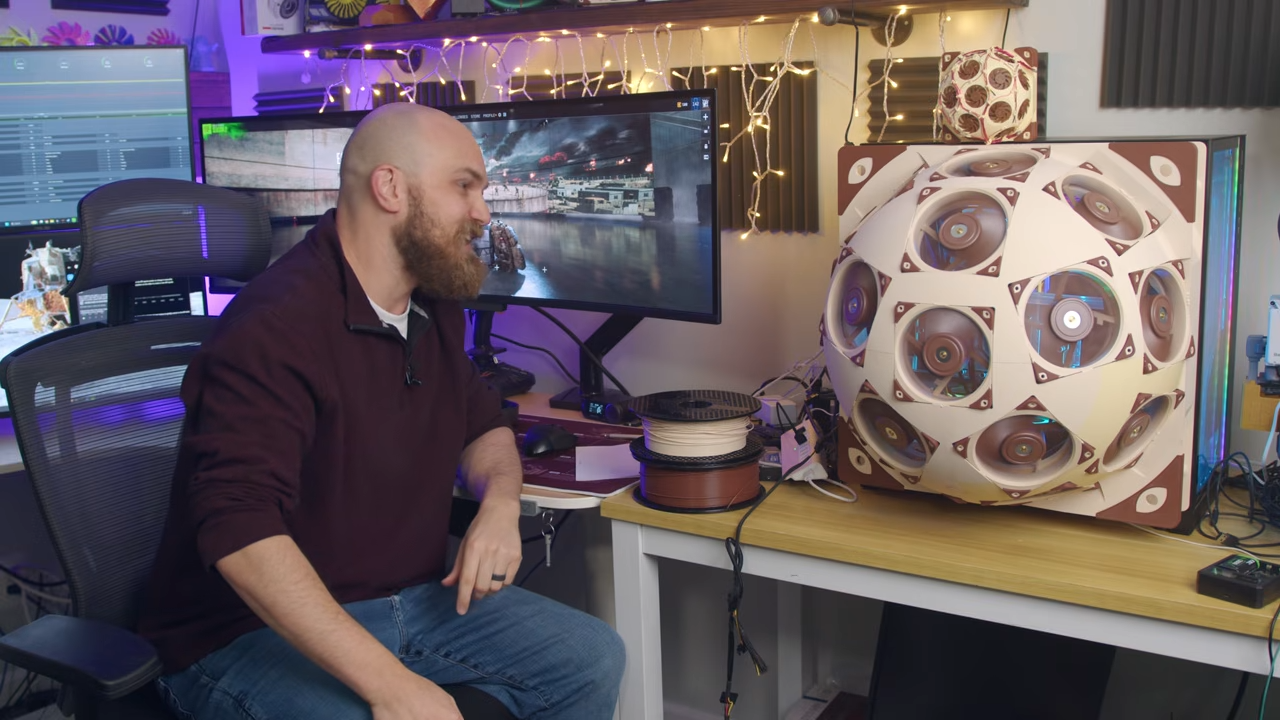
In the world of PC enthusiast modifications, there is a fine line between engineering brilliance and absolute absurdity. YouTuber Major Hardware, known to his community as James, has spent his recent projects dancing right on that line. After gaining attention for a miniature fan experiment, he has now scaled his ambitions upward—quite literally—by replacing a standard PC side panel with a massive, 3D-printed dome housing 15 high-performance fans.
The project, dubbed the “Superdome,” transforms a Lian Li O11 Dynamic XL case into a cooling behemoth. Whereas the concept began as a “meme,” the resulting thermal data suggests that this unconventional approach to airflow provides a significant performance boost, slashing internal temperatures by nearly 20 degrees Celsius during high-intensity gaming.
This ambitious build was not a solo effort. Upon realizing that purchasing 15 premium 120 mm fans would cost over $500, Major Hardware reached out to the manufacturer, Noctua. In a surprising move of corporate support for community creativity, the company provided the necessary fans and 3D printing materials to ensure the Superdome maintained the brand’s signature aesthetic.
From the Fanhattan Project to the Superdome
The Superdome is the spiritual successor to an earlier, smaller-scale experiment known as “The Fanhattan Project.” In that previous venture, Major Hardware attempted to replace a single Noctua NF-A12x25 fan with 15 miniature fans. While that project was primarily an exploration of surface area and noise, it served as the proof-of-concept for the Superdome’s “more is more” philosophy.
According to verified reports on the Fanhattan Project, the miniature fans were inspired by a toy UFO and, while loud, produced surprising airflow . Yet, the Superdome shifts the focus from miniature components to full-sized industrial cooling, utilizing 15 standard 120 mm Noctua fans to create a massive intake wall.
Engineering a Cooling Behemoth
Constructing the Superdome required a blend of digital modeling and physical fabrication. Using a 3D model of the Lian Li case, James designed a large dome structure to house the fans and then 3D printed the chassis. The fans were then slotted into the housing and glued securely into place.
The project was not without its technical hurdles. The most prominent struggle was cable management. Integrating 15 separate fans required a complex web of Y-connectors, which the creator described as “a little bit of a disaster.” Despite the chaotic wiring, the system is surprisingly efficient in terms of noise; James reported that the Superdome is quieter than his computer’s standard desktop idle noise.

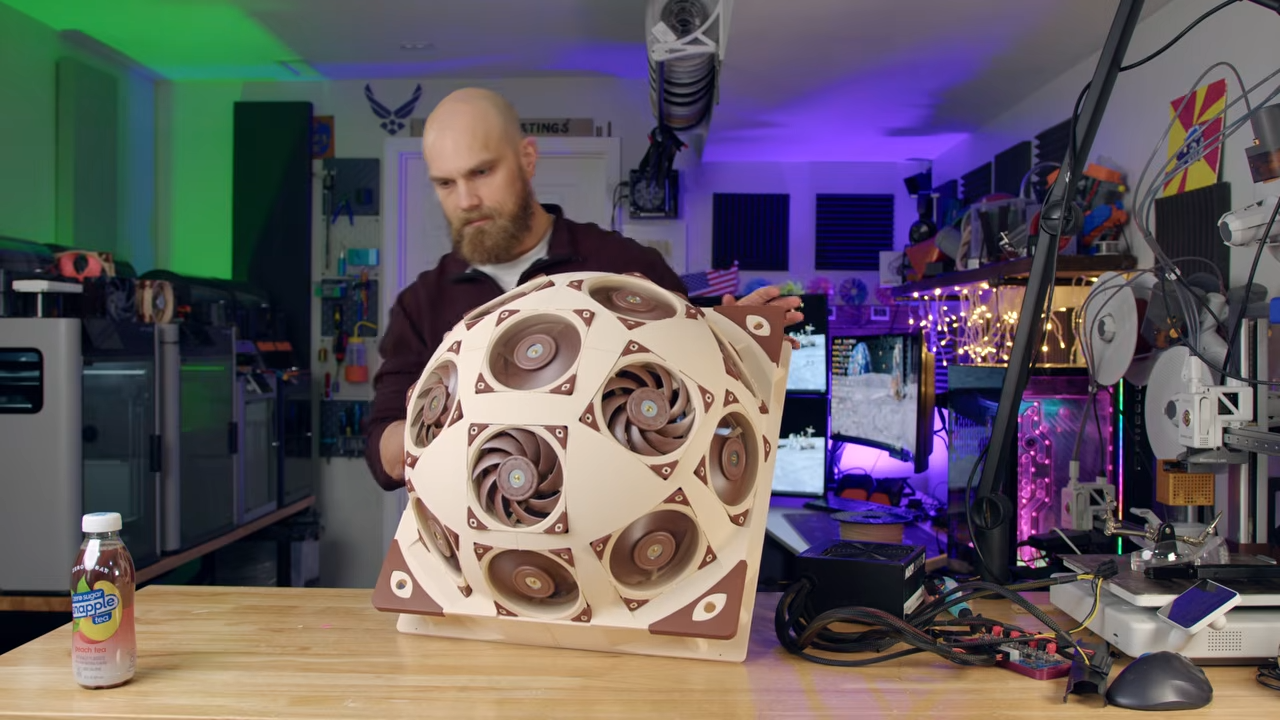
Power consumption also scaled with the size of the project. While a single standard A12X25 fan typically pulls 6.1 watts, the Superdome requires 27.6 watts to operate all 15 units simultaneously.
Thermal Results: Does More Air Mean Better Cooling?
The primary question for any PC modder is whether the visual spectacle translates to actual performance. In this case, the answer is a resounding yes, though the results are influenced by the existing setup of the rig. James noted that his PC’s top and bottom radiators are both set to exhaust to highlight the internal RGB lighting, a configuration that is generally inefficient for airflow and leads to higher internal temperatures.

To test the Superdome’s impact, Major Hardware ran several sessions of Battlefield 6. The results were stark:
- Without Superdome: Internal temperatures averaged around 86.3 °C.
- With Superdome: Temperatures dropped to 66.9 °C.
This represents a temperature reduction of 19.4 °C, a significant margin that could potentially extend the lifespan of the hardware and prevent thermal throttling during intensive gaming sessions.
The Trade-offs: Dust and Maintenance
Despite the thermal gains, the Superdome introduces a significant practical drawback: the lack of dust filtration. Since the dome consists of open fan intakes, room dust has a direct path into the interior of the PC. However, the creator expressed a level of indifference toward this issue, noting that his existing exhaust-heavy configuration already allows a significant amount of dust to enter the system passively.
For those looking to replicate this “meme-turned-solution,” the barrier to entry is relatively high. A successful build requires a Lian Li case, a capable 3D printer, and a significant investment in Noctua fans. To assist the community, James has made the official blueprints available for download via Thingiverse.
The Superdome serves as a fascinating case study in extreme PC cooling. While not a practical solution for the average user, it demonstrates how aggressive airflow modifications can compensate for inefficient case layouts and provide a dramatic drop in operating temperatures.
With the blueprints now public, it remains to be seen if other enthusiasts will adopt the “dome” aesthetic or if the industry will move toward more integrated, filtered versions of such high-volume intake systems. We will continue to monitor community iterations of the design as they appear on 3D printing forums.
Do you suppose the thermal gains justify the “cable disaster” and dust risks? Let us recognize your thoughts in the comments below or share this story with your fellow PC builders.
Keep reading