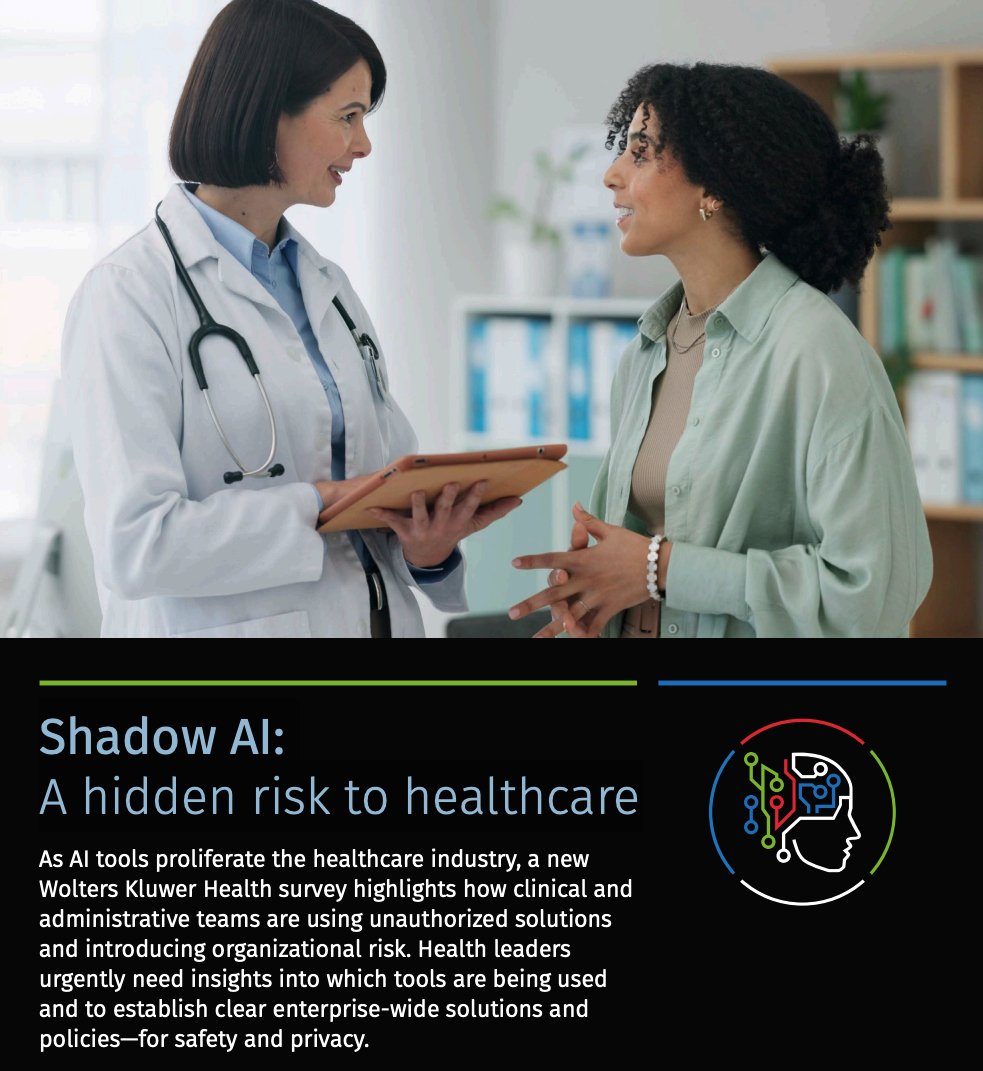
The Rise of ”Shadow AI” in Healthcare: Risks, Reasons, and a Path Forward
The healthcare industry is quietly grappling with a growing phenomenon: the widespread, unauthorized use of Artificial Intelligence (AI) tools by its workforce. A recent report from Wolters Kluwer Health reveals that nearly 20% of healthcare staff are actively using unvetted AI algorithms, while a staggering 40% have encountered them in thier workplaces. This “Shadow AI,” driven not by malicious intent but by clinician burnout and a desperate need for efficiency, presents meaningful risks to data security and patient safety.
The Efficiency Imperative: Why Clinicians Turn to Unsanctioned AI
Healthcare professionals are facing unprecedented demands. The report highlights a critical pressure point: primary care physicians would require 27 hours a day to provide guideline-recommended care. In this environment, readily available AI tools – offering assistance with tasks like drafting appeals or summarizing patient charts - become an attractive solution. Clinicians are prioritizing speed and workflow optimization, often at the expense of adhering to organizational policies. As the report notes,staff want to follow rules,but when approved solutions are lacking,they’re compelled to experiment with readily accessible,generic AI options.
A Governance Gap: Disconnect Between Administrators and Providers
A significant disconnect exists between healthcare administrators and the clinicians on the front lines. While 42% of administrators believe AI policies are clearly communicated, only 30% of providers agree. Furthermore, administrators are three times more likely to be involved in the development of thes AI policies then the providers who are actually utilizing the tools. This “ivory tower” approach creates a perilous blind spot, where administrators perceive a secure environment while providers feel forced to circumvent the system to deliver adequate care.
the high Stakes: Financial and Clinical Risks of Shadow AI
The consequences of this unregulated AI adoption are significant. The average cost of a data breach in the healthcare sector has soared to $7.42 million. Using unapproved AI tools introduces a significant vulnerability, as sensitive patient data can easily be exposed when entered into free, publicly accessible platforms. This compromises patient privacy and violates HIPAA regulations.
Beyond financial repercussions, the potential for clinical errors is a paramount concern. the risk of “hallucinations” – inaccurate or fabricated data generated by AI – could lead to incorrect diagnoses, inappropriate dosages, or other critical medical mistakes. Both administrators and providers identify patient safety as their top concern regarding the use of AI.
Moving Beyond Prohibition: A Shift to Enterprise-Grade Solutions
The initial reaction for many healthcare IT leaders is to block access to popular AI platforms like ChatGPT, claude, and Gemini. However, industry experts argue that a purely prohibitive approach is ineffective. Scott Simeone, CIO at Tufts Medicine, emphasizes that scaling AI’s potential in healthcare hinges less on the technology itself and more on the maturity of organizational governance.
The report advocates for a shift from “ban” to “build” – providing healthcare professionals with enterprise-grade AI solutions that address their workflow challenges safely and efficiently. If clinicians are turning to Shadow AI to solve a problem, health systems must offer a sanctioned alternative that delivers comparable speed and effectiveness while maintaining data security and patient safety.
Alex Tyrrell, CTO of Wolters Kluwer, predicts that 2026 will be a pivotal year for AI governance in healthcare, requiring leaders to rethink their strategies and implement robust guardrails to ensure compliance. The era of ignoring the issue is over, and a proactive, solution-oriented approach is now essential to harness the power of AI responsibly within the healthcare landscape.
Keywords: AI in healthcare, Shadow AI, healthcare data security, HIPAA compliance, AI governance, healthcare technology, clinical decision support, AI risks, healthcare burnout, Wolters Kluwer Health.
Worth a look