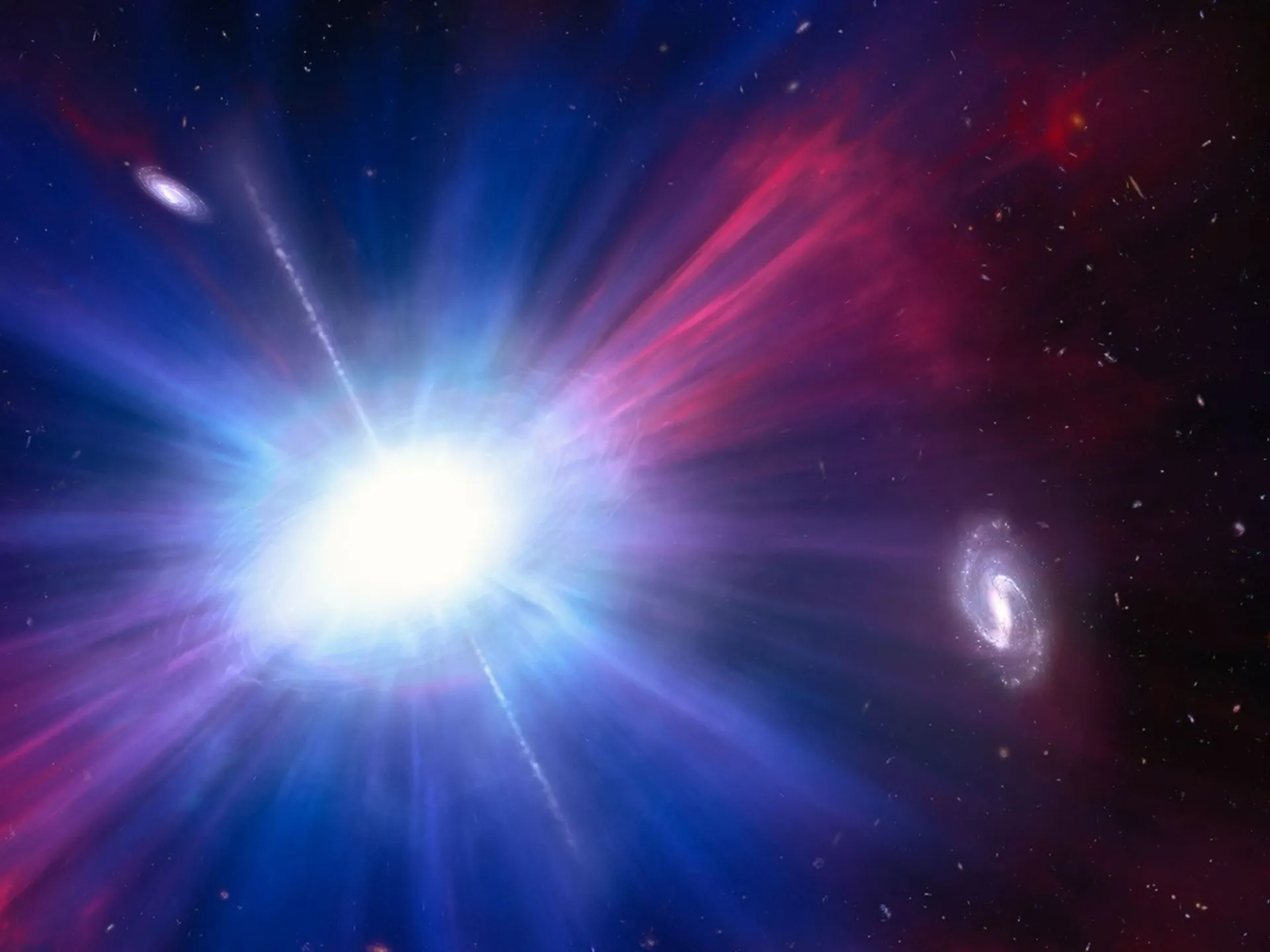
For decades, astronomers have categorized the death of stars with relative predictability. Supernovae, the explosive finales of massive stars, typically brighten over weeks and fade over months, leaving behind a glowing remnant and a wealth of heavy elements. However, a new class of cosmic events is defying these rules, appearing as brilliant, sapphire-hued flashes that ignite and vanish with startling speed.
These phenomena, known as Fast Blue Optical Transients (FBOTs), represent one of the most perplexing mysteries in modern astrophysics. Unlike traditional stellar explosions, FBOTs reach their peak luminosity in a matter of days—sometimes hours—before fading rapidly into the darkness of space. This accelerated timeline suggests a power source far more concentrated and violent than a standard supernova, leading researchers to believe they are witnessing the birth of something far more exotic.
The pursuit to understand FBOTs is not merely a quest for categorization; it is a search for the “central engine” that drives these events. Whether these flashes signal the sudden awakening of a dormant black hole or the collapse of a massive star into a neutron star, the answer could reshape our understanding of how the most compact objects in the universe are formed. As detection technology improves, the scientific community is moving closer to solving the riddle of these celestial anomalies.
The Prototype: How AT2018cow Defined a New Class
The modern fascination with FBOTs began in earnest with the discovery of an event designated AT2018cow. Due to its distinctive characteristics and the speed of its evolution, astronomers affectionately nicknamed the event “The Cow.” This specific transient served as the prototype for the entire class of Fast Blue Optical Transients, providing the first detailed look at how these events differ from known astronomical phenomena.
AT2018cow was characterized by an extraordinary luminosity and a distinct blue color, indicating extremely high temperatures. Most crucially, its light curve—the graph of its brightness over time—showed a rise and fall that was far too rapid for a standard supernova. While a typical supernova might take 20 days to reach peak brightness, AT2018cow evolved on a scale of days. This suggested that the energy was not coming from the radioactive decay of nickel-56, which powers most supernovae, but from a more direct and potent source of energy.
Observations of AT2018cow across multiple wavelengths—including X-ray and radio emissions—revealed a compact, high-energy environment. The presence of X-rays, in particular, suggested a “central engine,” likely a compact object such as a black hole or a magnetar (a highly magnetized neutron star), accreting matter at an incredible rate. This discovery shifted the focus of the astrophysics community from viewing these events as “weird supernovae” to treating them as a distinct physical process.
The Leading Theories: Black Holes and Tidal Disruptions
Because FBOTs evolve so quickly, capturing them in their early stages is a logistical nightmare for astronomers. However, the data gathered from the handful of confirmed events has led to several competing theories regarding their origin. The primary debate centers on whether these flashes are caused by the collapse of a star or the destruction of one.
One of the most prominent theories is the Tidal Disruption Event (TDE). In this scenario, a star wanders too close to a supermassive black hole. The black hole’s immense gravitational tidal forces stretch and eventually rip the star apart—a process known as “spaghettification.” As the stellar debris falls into the black hole, it forms an accretion disk, releasing a massive burst of radiation. While TDEs are well-documented, a specific subset of “fast” TDEs could explain the rapid brightening and blue hue observed in FBOTs, especially if the disruption occurs around a smaller, intermediate-mass black hole.
An alternative theory suggests that FBOTs are “failed supernovae” or “collapsars.” In this model, a massive star collapses directly into a black hole without a traditional supernova explosion. However, if the star is rotating rapidly, a disk of material may form around the newly born black hole, launching powerful jets of plasma that punch through the remaining stellar envelope. This process would create a brilliant, fast-evolving flash of blue light as the shockwave interacts with the surrounding circumstellar material.
Another possibility involves the interaction between a supernova shockwave and a dense shell of gas previously ejected by the star. If a star sheds a significant amount of mass shortly before exploding, the resulting supernova shockwave hits this dense “wall” of gas, converting kinetic energy into a sudden, intense burst of blue light. This theory explains the luminosity and color but struggles to account for the extremely rapid fade-out seen in the most extreme FBOT cases.
The Role of Next-Generation Survey Technology
The rarity of FBOTs is partly a result of their brevity; if a telescope is not looking at the right patch of sky at the right moment, the event is missed entirely. For years, the discovery of these transients relied on serendipity. However, the advent of wide-field digital surveys has transformed the search into a systematic hunt.
The Zwicky Transient Facility (ZTF) has been instrumental in this effort. By scanning the entire northern sky every few nights, ZTF can detect changes in brightness in real-time, allowing astronomers to trigger “follow-up” observations with larger telescopes like the Keck Observatory or the Hubble Space Telescope before the transient fades. This rapid-response pipeline is essential for capturing the early-time data needed to distinguish between a TDE and a collapsar.
Looking forward, the scientific community is anticipating the full operational capacity of the Vera C. Rubin Observatory in Chile. Equipped with a massive camera and a wide field of view, the Rubin Observatory’s Legacy Survey of Space and Time (LSST) is expected to discover thousands of transients per night. This volume of data will allow astronomers to move from studying individual “celebrity” events like AT2018cow to analyzing a statistically significant population of FBOTs. By comparing the environments—such as the types of galaxies where FBOTs occur—researchers can determine if these events prefer young, star-forming galaxies (suggesting massive star collapse) or older galaxies (suggesting black hole interactions).
Why Solving the FBOT Mystery Matters
At first glance, a brief flash of blue light in a distant galaxy may seem like a curiosity of pure science. However, FBOTs provide a unique laboratory for studying the most extreme physics in the universe. They occur at the intersection of general relativity, fluid dynamics, and high-energy particle physics.
If FBOTs are indeed the signatures of newborn black holes, they offer a glimpse into the “birth cries” of these objects. Understanding the mechanism behind the central engine helps scientists refine models of accretion—how matter falls into a black hole—and how jets of energy are launched across interstellar distances. This has direct implications for our understanding of Quasars and Active Galactic Nuclei (AGN), which are the most luminous objects in the known universe and are powered by similar accretion processes on a much larger scale.
the study of FBOTs contributes to the broader field of “multi-messenger astronomy.” While most FBOTs are currently detected via light (photons), some theories suggest they could be associated with gravitational waves or neutrinos. If a future event is detected simultaneously by a gravitational wave observatory (like LIGO) and an optical survey (like ZTF), it would provide an undeniable “smoking gun” for the event’s cause, potentially confirming the merger of compact objects or the collapse of a massive stellar core.
Key Takeaways: Understanding FBOTs
- What they are: Fast Blue Optical Transients (FBOTs) are extremely bright, blue cosmic flashes that brighten and fade much faster than traditional supernovae.
- The Prototype: AT2018cow (“The Cow”) is the most well-studied example, revealing that these events likely possess a “central engine” like a black hole.
- Leading Theories: Possible causes include Tidal Disruption Events (stars ripped apart by black holes) or Collapsars (massive stars collapsing directly into black holes).
- Detection: Wide-field surveys like the Zwicky Transient Facility (ZTF) are critical for finding these events before they disappear.
- Significance: Solving the FBOT mystery helps scientists understand the formation of black holes and the physics of high-energy accretion.
As we enter a new era of astronomical observation, the “blue flash” mystery is moving from the realm of the unexplained toward a concrete physical model. The transition from anecdotal discoveries to population-level data will likely reveal that FBOTs are not a single type of event, but a diverse family of high-energy phenomena.
The next major milestone in this research will be the integration of data from the Vera Rubin Observatory, which is expected to provide an unprecedented census of the transient sky. Until then, astronomers remain vigilant, scanning the depths of the cosmos for the next “Cow” that might finally reveal the secrets of the universe’s fastest flashes.
Do you think we are on the verge of a major breakthrough in astrophysics? Share your thoughts in the comments below or share this article with fellow space enthusiasts.
Keep reading