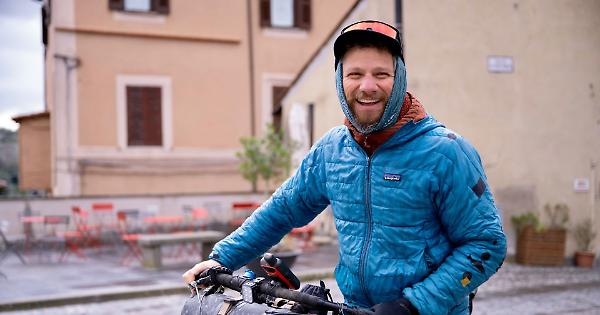
A 13,000-Kilometer Journey by Bicycle: From Beijing to Venice, Following the Silk Road
Montodine, Italy – For five months, Matteo Stella pedaled across continents, traversing 13,000 kilometers from Beijing to Venice. His journey, a zig-zag across the map, took him through deserts, over mountains, and across forgotten borders, filled with encounters that will undoubtedly stay with him forever. The Italian cyclist, a mountain bike and trekking guide from the Aosta Valley, made a poignant stop in Montodine, a small town where his girlfriend, Naomi, resides, nestled at the confluence of the Adda and Serio rivers.
Stella’s inspiration stemmed from a fascination with the history of silk. “It all started with a story I read about silk,” he explained, as reported by La Provincia di Cremona. “For centuries, no one really knew how it reached Rome. It was a mystery. The silk route was so long that its path was lost.” This ancient trade route, while, connected distant worlds long before modern globalization. “At Pompeii, there’s a mosaic depicting women dancing draped in silk veils. Virgil wrote that it perhaps came from a down that grew on trees, others believed it came from a sheep in Anatolia. One thing is certain: that route connected far more than we imagine today.”
The Silk Road, Stella emphasizes, was far more than a simple commercial exchange. “Everything passed along that road: goods, of course, but also philosophies, knowledge, and religions. The heart of this world was Samarkand, the capital of Tamerlane’s empire. I’ve always imagined it as a great open-air university. That’s why Samarkand was a mandatory stop.”
Across Asia and Back: A Route Through Diverse Landscapes
Stella’s route took him through China, Mongolia, Kazakhstan, Kyrgyzstan, Tajikistan, Uzbekistan, and Afghanistan before returning to Italy via Turkey, Greece, and Albania. His journey through Afghanistan proved particularly memorable. “I was in the desert, a strong wind was blowing, and I had nowhere to sleep. I saw a two-story building in the middle of nowhere and asked for hospitality. It turned out to be a Taliban checkpoint,” he recounted. He described the encounter as surprisingly cordial, noting that while the Taliban’s treatment of women and children is widely condemned, he, as a foreign man, was treated with respect and offered food and drink.
The situation took a surreal turn when the Taliban leader received a phone call. “He was told that intelligence was coming to get him. They really did arrive. They just wanted to introduce themselves and take me to a safe place. They took me to a hotel where I slept… on the floor.”
Challenges were plentiful. “The hardest moment was in the Altai Mountains in Mongolia. One of the most remote areas on the planet. I cycled for weeks without meeting anyone, crossing mountains where there isn’t even a road.” There, the journey became a test of endurance against the elements. “I encountered snow, freezing winds from Siberia, temperatures below minus thirty degrees Celsius. Even the army couldn’t give me directions on how to cross that range.”
Amidst the arduous journey, love provided a powerful anchor. “I saw Naomi again at the airport in Bishkek. We hugged for ten minutes. Then we both cried before I departed for Afghanistan.” Bishkek is the capital and largest city of Kyrgyzstan, according to the Britannica.
A Return to Roots: The Via Francigena and a Rediscovery of Faith
Stella’s return to Italy wasn’t a direct route, but another journey in itself. “I traveled the Via Francigena,” he said. “I am deeply Catholic, and along that road, I rediscovered the beauty of Italy and the hospitality towards pilgrims. It’s a tradition we are losing.” The Via Francigena is an ancient road and pilgrimage route to Rome, with origins dating back to the Middle Ages.
“Do I wish to abandon again right away? Not for now. I want to distill what I’ve learned. Great adventures serve this purpose: to bring something into everyday life.”
The Enduring Legacy of the Silk Road
Stella’s journey is a modern echo of the ancient Silk Road, a network of trade routes that for centuries connected the East and West. While the original Silk Road facilitated the exchange of goods like silk, spices, and precious stones, it also fostered the transmission of ideas, religions, and cultures. The historical Silk Road wasn’t a single route, but rather a complex web of pathways, both overland and maritime, stretching from East Asia to the Mediterranean Sea. Samarkand, Uzbekistan, a key city on Stella’s route, served as a vital crossroads for centuries, a center of learning and commerce under the rule of Tamerlane (Timur) in the 14th century.
The challenges Stella faced – harsh weather, remote landscapes, and navigating complex political situations – mirror the difficulties faced by merchants and travelers along the original Silk Road. His encounter with the Taliban, while surprising, highlights the ongoing complexities of the region and the risks faced by those who venture into it. The Taliban, an Islamic fundamentalist political movement, regained control of Afghanistan in 2021, imposing strict interpretations of Islamic law and curtailing many freedoms, particularly for women, as reported by Human Rights Watch.
Stella’s journey also underscores the enduring power of human connection. His reunion with his girlfriend, Naomi, in Bishkek, Kyrgyzstan, serves as a reminder of the personal motivations that drive such ambitious undertakings. The Via Francigena, the ancient pilgrimage route he followed upon his return to Italy, further emphasizes the importance of faith and community in shaping human experience.
As Stella reflects on his experiences, he hopes to share the lessons he’s learned with others. His journey is a testament to the human spirit’s capacity for resilience, adventure, and the pursuit of understanding in a world that remains deeply interconnected.
Matteo Stella is currently back in the Aosta Valley, Italy, and plans to spend time processing his experiences before considering future expeditions. Readers interested in following his story or learning more about the Silk Road can find additional resources through historical societies and travel blogs dedicated to the region. Share your thoughts on Stella’s incredible journey in the comments below, and consider sharing this article with others who might be inspired by his story.