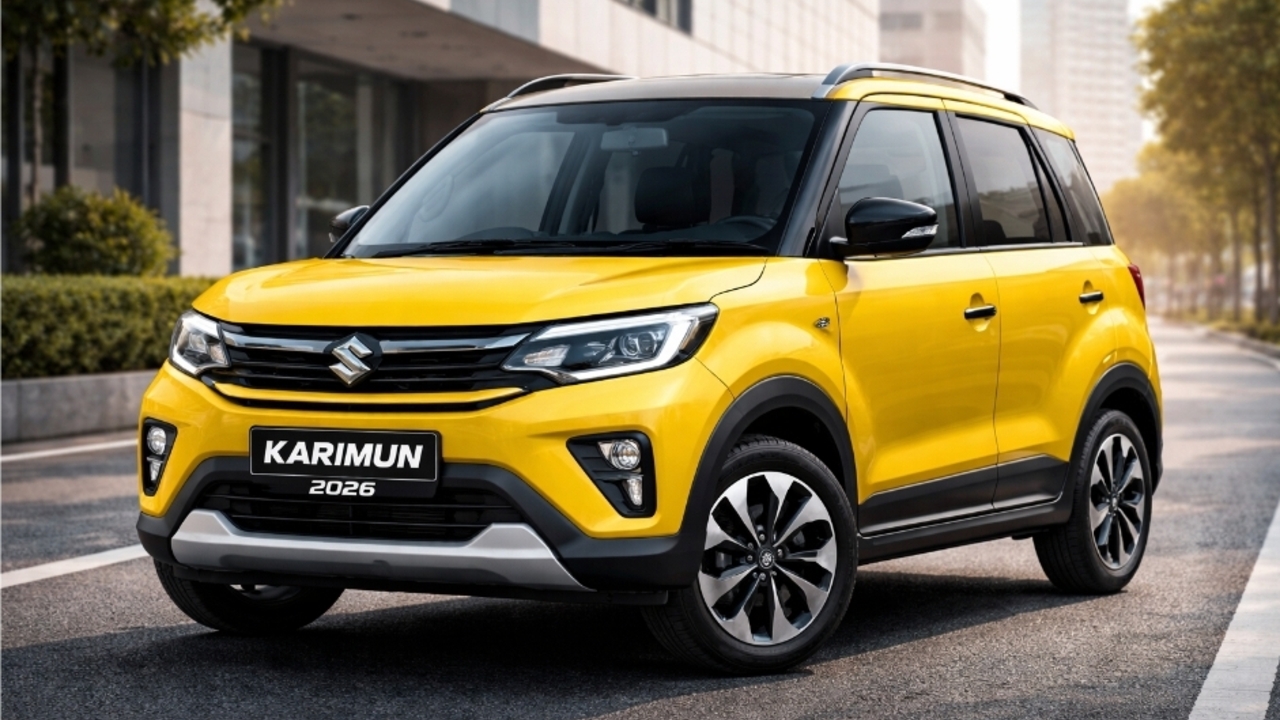
The Suzuki Karimun has long been a familiar sight on Indonesian roads, valued for its compact footprint, affordability, and reliability in urban environments. As the automotive landscape evolves with rising fuel costs and stricter emissions standards, the 2026 iteration of this city car aims to redefine expectations in the low-cost green car (LCGC) segment. Far from being merely a budget option, the redesigned Karimun promises unexpected strengths that could challenge established rivals like the Toyota Agya and Honda Brio.
Industry analysts note that Suzuki’s approach with the 2026 Karimun reflects a broader strategy to enhance value without compromising the model’s core appeal to first-time buyers and urban commuters. While official specifications remain pending confirmation from Suzuki Indonesia, early indications suggest a focus on improved fuel efficiency, updated safety features, and a more modern interior—elements increasingly important to cost-conscious consumers navigating economic uncertainty.
What sets this update apart is not just incremental refinement but a deliberate effort to address longstanding criticisms of entry-level vehicles: perceived fragility, sparse equipment, and underwhelming driving dynamics. By targeting a claimed fuel economy of up to 25 km/liter under optimal conditions, the Karimun 2026 seeks to deliver tangible running cost savings—a critical factor for households where transportation expenses directly impact monthly budgets.
Design and Interior Updates: Function Meets Modernity
Exterior revisions for the 2026 Karimun include a redesigned front fascia with sharper headlights and a more pronounced grille, giving the vehicle a more assertive presence despite its diminutive size. These changes align with Suzuki’s global design language seen in newer models like the Swift and Baleno, suggesting a concerted effort to elevate the Karimun’s aesthetic appeal beyond mere functionality.
Inside, the cabin reportedly features upgraded materials with soft-touch surfaces on the dashboard and door panels, a departure from the hard plastics common in its class. A new touchscreen infotainment system supports smartphone integration via Apple CarPlay and Android Auto, addressing a growing consumer expectation for connectivity even in entry-level vehicles. While rear legroom remains constrained due to the car’s overall dimensions, Suzuki claims improved seat ergonomics and increased headroom in the front seats enhance comfort during daily commutes.
These interior enhancements respond directly to user feedback gathered from Indonesian market studies, where buyers expressed willingness to pay slightly more for better perceived quality and modern conveniences—provided the vehicle retains its low running costs. This shift indicates Suzuki’s recognition that today’s LCGC buyers are not solely focused on upfront price but also on long-term satisfaction and usability.
Powertrain and Efficiency: The 25 km/Liter Claim
At the heart of the 2026 Karimun’s appeal is its revised 1.0-liter three-cylinder petrol engine, now equipped with dual variable valve timing (DVVT) and an optimized combustion cycle. Suzuki states that these modifications improve thermal efficiency, contributing to the advertised fuel economy figure of up to 25 km/liter—a significant increase over the previous generation’s official rating of approximately 21 km/liter under the same testing conditions.
such figures are typically achieved under controlled laboratory environments using the Indonesian LCGC test cycle, which may not fully reflect real-world driving patterns involving frequent stops, air conditioning use, and varying loads. Independent testing by automotive publications will be necessary to verify actual on-road consumption, particularly in congested urban settings like Jakarta or Surabaya where stop-and-go traffic can substantially reduce efficiency.
Nevertheless, even a modest improvement in real-world fuel economy could translate to meaningful savings over time. For a driver covering 15,000 kilometers annually, an increase from 20 km/liter to 23 km/liter would save roughly 160 liters of fuel per year—equivalent to several months’ worth of fuel costs for many Indonesian households.
Safety and Technology: Closing the Gap
One of the most notable advancements in the 2026 Karimun is the inclusion of dual front airbags as standard across all variants, a feature that was previously limited to higher trims or absent entirely in some LCGC models. Anti-lock braking system (ABS) with electronic brakeforce distribution (EBD) is also now standard, improving stability during emergency stops—particularly valuable in wet conditions common during Indonesia’s rainy season.
While the Karimun 2026 does not yet offer advanced driver-assistance systems (ADAS) such as lane departure warning or autonomous emergency braking—features still rare in this price bracket—it does include ISOFIX child seat anchors and a tire pressure monitoring system (TPMS), enhancing passive and active safety respectively. These updates bring the vehicle closer to regional safety benchmarks, though it still falls short of the full suite of electronic aids found in competing models like the Honda Brio Satya.
Industry observers suggest that Suzuki’s incremental approach to safety reflects a balance between meeting regulatory expectations and maintaining affordability. As ASEAN nations move toward harmonized vehicle safety standards under the ASEAN NCAP framework, future iterations of the Karimun may need to incorporate additional technologies to remain competitive.
Market Position and Competitive Context
The Indonesian LCGC segment remains highly competitive, with models like the Toyota Agya, Honda Brio, and Daihatsu Ayla dominating sales due to their strong brand recognition and extensive dealer networks. The Suzuki Karimun, while historically popular, has faced challenges in recent years as competitors introduced more frequent updates and aggressive pricing strategies.
By focusing on tangible improvements in efficiency, safety, and cabin quality—rather than relying solely on price cuts—the 2026 Karimun aims to differentiate itself through overall value proposition. This strategy could resonate with buyers who prioritize long-term ownership costs and daily usability over initial sticker price, particularly in secondary cities where brand loyalty is less pronounced and practical considerations weigh more heavily.
Suzuki Indonesia has not yet announced an official launch date or pricing for the 2026 Karimun, though industry sources indicate a release is expected in the second half of 2025, potentially coinciding with the Jakarta Fair or other major automotive events. Prospective buyers are advised to monitor Suzuki Indonesia’s official website and authorized dealerships for confirmed specifications and pre-order details.
What This Means for Indonesian Consumers
For urban drivers seeking an affordable, efficient, and increasingly well-equipped city car, the Suzuki Karimun 2026 represents a noteworthy evolution in a segment often criticized for stagnation. Its potential to deliver better fuel economy without sacrificing basic reliability could make it a smart choice for cost-sensitive households, ride-hailing drivers, and first-time car buyers navigating Indonesia’s complex transportation landscape.
As with any vehicle purchase, prospective owners should consider their specific needs—including typical driving conditions, passenger and cargo requirements, and long-term maintenance costs—when evaluating the Karimun against alternatives. Test drives and comparisons with rival models will be essential to assess real-world comfort, visibility, and handling characteristics that specifications alone cannot convey.
The true measure of the Karimun 2026’s success will lie not in showroom specifications but in owner satisfaction over time. If Suzuki delivers on its promises of improved efficiency and enhanced usability while maintaining the model’s reputation for low-cost ownership, it could reclaim relevance in a fiercely contested market where perception often lags behind reality.
Stay tuned for official updates from Suzuki Indonesia as the launch approaches. Share your thoughts on what you expect from the next generation of Indonesia’s favorite city car—comment below and join the conversation.
Keep reading