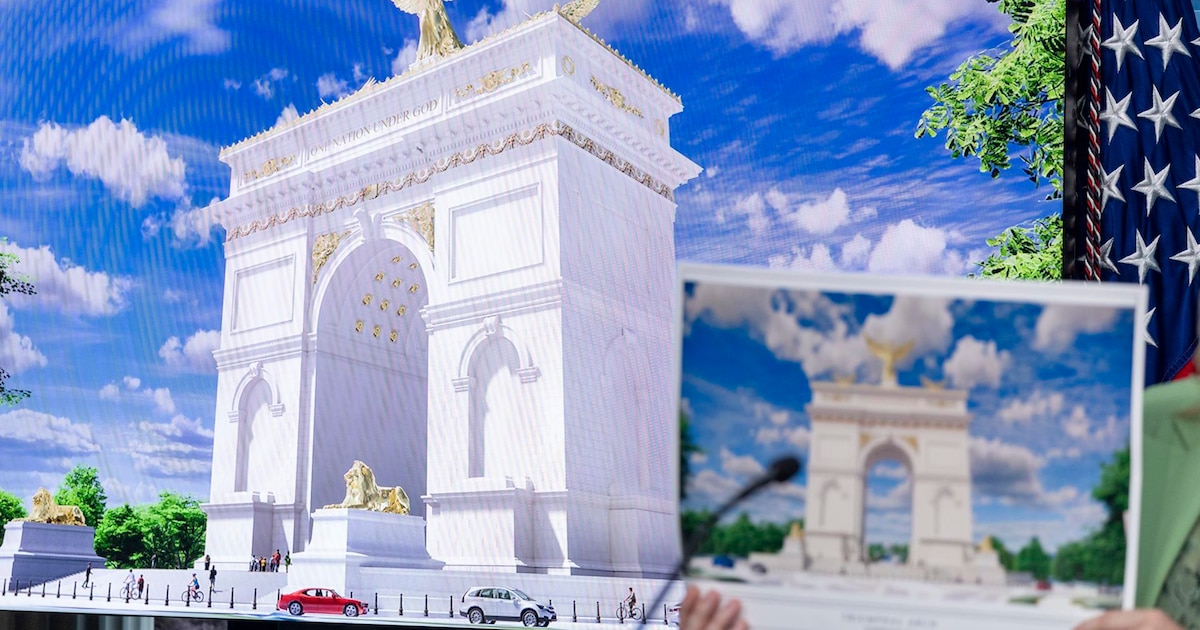
On Wednesday, April 15, 2026, the White House officially unveiled plans for a monumental triumphal arch in Washington, D.C., proposed by President Donald Trump to commemorate the 250th anniversary of American independence. The announcement was made during the administration’s weekly press briefing in the James S. Brady Press Briefing Room, where White House Press Secretary Karoline Leavitt presented a rendered image of the proposed structure to reporters.
The proposed monument, dubbed the “Arch of Independence,” would stand 250 feet tall — approximately 76.2 meters — with each foot representing one year of U.S. History since the Declaration of Independence in 1776. According to Leavitt, the arch would be crowned by a winged figure of victory holding a torch, flanked by golden eagles and guarded at its base by four golden lions. The design was described by the administration as an “architectural masterpiece” intended to inspire future generations and serve as a lasting symbol of national pride.
The structure is slated for placement in Memorial Circle, a traffic rotary located between the Lincoln Memorial and Arlington National Cemetery — one of the primary ceremonial entrances to the nation’s capital. This location situates the arch between two of the country’s most significant memorials: the tribute to Abraham Lincoln and the final resting place of over 400,000 military personnel and their families.
Leavitt emphasized that the project would be a collaborative effort between the White House and the U.S. Department of the Interior, framing it as a non-partisan tribute to American history. “Long after everyone in this room is gone, our children and grandchildren will continue to be inspired by this national monument,” she stated during the briefing, echoing a sentiment expressed in multiple official summaries of the event.
The announcement comes amid a broader wave of commemorative initiatives planned for the semiquincentennial of U.S. Independence, including exhibitions, educational programs, and infrastructure projects across federal agencies. Though, the triumphal arch proposal has already drawn attention from urban planners, historians, and architectural critics who have questioned its scale, symbolism, and potential impact on the carefully planned monumental core of Washington, D.C.
Officials noted that the project would undergo review by relevant federal agencies, including the National Capital Planning Commission and the Commission of Fine Arts, both of which have jurisdiction over alterations to the city’s monumental landscape. As of the announcement date, no formal application for construction approval had been submitted, and timelines for groundbreaking or completion remain unspecified.
While the administration has framed the arch as a unifying national symbol, some observers have interpreted the initiative through a political lens, noting its alignment with Trump’s broader emphasis on legacy-building projects during his second term. Others have pointed to historical precedents for such monuments, including the Arc de Triomphe in Paris and the Victory Gate in Berlin, though the U.S. Proposal distinguishes itself through its explicit numerical symbolism and proposed iconography.
The White House has not released detailed cost estimates, architectural blueprints, or contractor information for the project. No public comment period or environmental review process has been announced, though such steps would likely be required under the National Environmental Policy Act (NEPA) and the National Historic Preservation Act for any federal action affecting public land in the District of Columbia.
Supporters of the proposal have cited the need for bold, visible commemorations of American ideals, particularly in advance of the 250th anniversary celebrations scheduled to culminate on July 4, 2026. They argue that the arch would serve as a destination for education and reflection, similar to how the Gateway Arch in St. Louis or the Washington Monument functions today.
As the nation approaches the semiquincentennial milestone, the triumphal arch remains one of the most visually ambitious proposals under consideration. Its fate will depend on regulatory review, public consultation, and the resolution of ongoing debates about how best to honor historical milestones in a evolving democratic society.
For updates on the federal review process, members of the public can monitor the Federal Register or visit the official websites of the National Park Service and the U.S. Department of the Interior, which oversee many of the commemorative activities tied to the 250th anniversary of independence.
If you have thoughts on this proposed monument or other plans for the nation’s 250th anniversary, we invite you to share your perspective in the comments below and help spread informed discussion by sharing this article with your network.