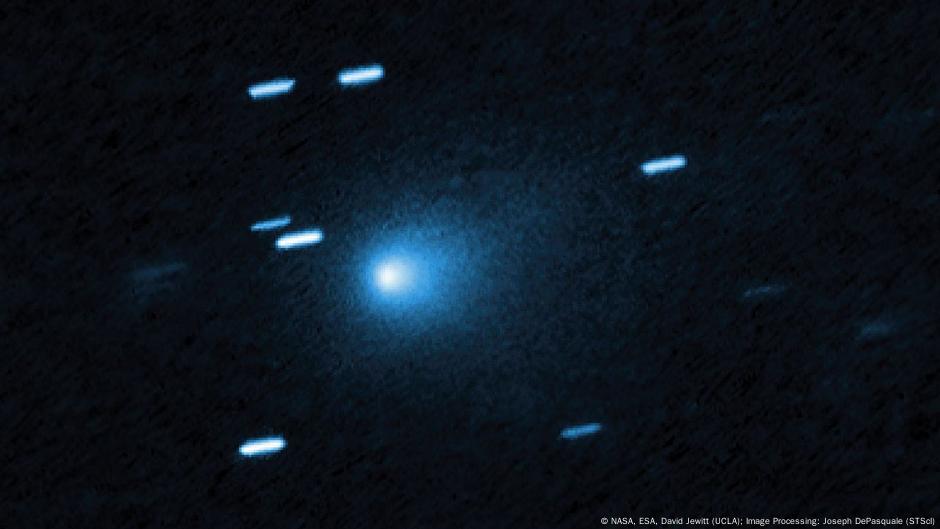
In April 2026, astronomers made a significant discovery about the interstellar comet 3I/ATLAS, revealing new clues about its origins beyond our solar system. Using the Atacama Large Millimeter/submillimeter Array (ALMA) in Chile, researchers detected heavy water—deuterium oxide (HDO)—in the comet’s coma, marking the first time this molecule has been identified in an object originating from outside the Sun’s gravitational influence. The finding, published in Nature Astronomy, suggests that 3I/ATLAS formed in an environment far colder and less irradiated than that of our solar system, offering rare insight into the conditions of a distant planetary system.
The detection was led by Chilean astronomer Tere Paneque, who worked alongside Luis Salazar Manzano, a doctoral student at the University of Michigan. Paneque, known for her expertise in astrochemistry, oversaw the observational planning, data reduction and analysis from ALMA’s 66-antenna array located in the Atacama Desert. Speaking to BioBioChile, she emphasized the uncertainty surrounding the observation: “We had no idea what we were going to find,” reflecting the exploratory nature of studying interstellar objects. This candid admission underscored the significance of the discovery, as no prior detection of heavy water in an extrasolar cometary body had ever been made.
According to the study’s findings, the deuterium-to-hydrogen (D/H) ratio in water within 3I/ATLAS exceeds 6.6 × 10⁻³, a value that indicates substantial enrichment in deuterium, a heavier isotope of hydrogen. This level is more than 40 times higher than the D/H ratio found in Earth’s oceans and over 30 times greater than that typically observed in comets originating from our solar system. Such extreme enrichment implies that the water in 3I/ATLAS formed under extremely cold conditions—likely below 20 Kelvin—and in a region shielded from intense stellar radiation, consistent with the outer reaches of a protoplanetary disk around a young star unlike our Sun.
These conditions point to a formation environment vastly different from that of our solar system, where cometary ice typically forms at slightly higher temperatures and undergoes more thermal processing. The presence of such pristine, deuterium-rich ice suggests that 3I/ATLAS preserved material from the earliest stages of its parent system’s evolution, untouched by significant heating or chemical alteration. As noted in the Nature Astronomy paper, this makes the comet a valuable tracer of the physical and chemical conditions present during the birth of its host star system, offering a rare opportunity to compare planetary formation processes across the galaxy.
The discovery also highlights the critical role of ALMA in enabling such detections. Operating at millimeter wavelengths, the telescope is uniquely suited to identify molecular signatures in cold, distant objects. Its high sensitivity and resolution allowed scientists to isolate the faint emission lines of HDO amid the complex chemical signature of the comet’s outgassing. Without ALMA’s capabilities, particularly its location in one of the driest and most stable atmospheric regions on Earth, this level of molecular detail would not have been discernible from ground-based observatories.
While 3I/ATLAS was first detected in 2022 as it passed through the inner solar system, its interstellar origin was confirmed through its hyperbolic trajectory—indicating We see not bound to the Sun’s gravity and is merely passing through. Unlike ‘Oumuamua or 2I/Borisov, which showed limited cometary activity, 3I/ATLAS displayed detectable outgassing, enabling spectroscopic analysis of its composition. This made it an ideal candidate for studying volatile compounds like water and its isotopologues.
The implications extend beyond understanding a single comet. By measuring the D/H ratio in water from another planetary system, scientists gain a direct chemical probe into the environment where that system’s planets and icy bodies formed. Such comparisons help refine models of how planetary systems evolve under varying stellar masses, radiation levels, and disk compositions. If other interstellar objects show similar or differing D/H signatures, it could reveal a diversity of formation pathways across the Milky Way.
As of now, no follow-up observations of 3I/ATLAS are possible, as the comet has moved beyond the detectable range of current telescopes. However, the data collected during its brief passage remain available for further analysis. Researchers continue to study the ALMA datasets for additional molecular traces, such as methanol or formaldehyde, which could further characterize the chemical richness of its origin environment.
For the scientific community, the detection of heavy water in 3I/ATLAS represents more than a technical achievement—it is a step toward understanding whether the processes that shaped our solar system are common or exceptional in the universe. As Paneque noted in her interview, the surprise was not just in the abundance of HDO, but in what it implies: that other planetary systems may form under conditions we are only beginning to imagine.
Those interested in tracking developments in interstellar object research can follow updates from major observatories such as ALMA and the James Webb Space Telescope, both of which contribute to advancing our understanding of cosmic origins. Peer-reviewed findings are regularly published in journals like Nature Astronomy and The Astrophysical Journal Letters.
What does this discovery suggest about how common or unique our solar system’s formation might be? Share your thoughts in the comments below, and consider sharing this article to help others explore the growing field of interstellar science.