
Maintaining lower back strength after age 60 is a critical component of healthy aging, serving as a primary defense against spinal degeneration, loss of core stability, and increased fall risk. Research published by the National Institute on Aging highlights that regular physical activity, including targeted resistance training, is essential for preserving the functional independence required for daily tasks such as rising from a chair, lifting groceries, and maintaining postural balance. While many older adults believe that building strength requires expensive gym memberships or complex machinery, medical evidence suggests that effective, safe, and accessible strengthening can be achieved through chair-based exercises performed at home.
As a physician, I have observed that the chair is an ideal tool for older adults because it provides a stable base that minimizes the risk of falls during exercise. By removing the need for balance on unstable surfaces, these movements allow for a concentrated focus on recruiting specific muscle groups, such as the erector spinae and glutes, which are vital for spinal health. According to guidelines from the American College of Sports Medicine, consistency in resistance training—aiming for two to three sessions per week—is the most reliable predictor of long-term functional improvement in older populations.
The Seated Hip Hinge: Foundation for Spinal Health
The seated hip hinge, often referred to in clinical settings as a “seated good morning,” is a foundational movement for restoring lower back strength. This exercise teaches the neuromuscular system how to properly engage the glutes and erector spinae while maintaining a neutral spine, which is a critical skill for preventing lumbar strain. By controlling the torso against gravity, the movement builds the postural control necessary for everyday functional tasks, such as standing up from a seated position or lifting objects from a low surface.
To perform the movement correctly, sit toward the front edge of a sturdy, non-wheeled chair with feet shoulder-width apart. Keep your chest tall and shoulders relaxed. Slowly lean your torso forward by pushing your hips backward, ensuring the back remains straight rather than rounded. Lean until you feel the muscles in your lower back and hips engage, then return to an upright position by consciously squeezing your glutes. Aim for 2 to 3 sets of 10 to 15 repetitions. A helpful form cue is to imagine balancing a glass of water on your lower back; the movement must originate from the hips, not the spine itself.
Building Stability with Seated Marches
The seated march is an effective exercise for strengthening the hip flexors and deep core muscles that stabilize the lower back during gait. By improving the strength of these stabilizers, individuals often report reduced fatigue during prolonged standing and improved balance, which is a key factor in fall prevention as identified by the Centers for Disease Control and Prevention. This exercise is particularly useful for those who find traditional standing marches too taxing or unsteady.

Sit tall with both feet flat on the floor to begin. Lift one knee toward your chest, then slowly lower the foot back to the floor before alternating to the opposite side. It is essential to maintain an upright posture throughout the movement; avoid the common mistake of rocking backward, which shifts the workload away from the core. Perform 2 to 3 sets of 10 to 15 repetitions per leg, maintaining a slow, controlled pace to maximize muscle activation.
Pelvic Tilts and Back Extensions
Pelvic tilts and back extensions target the deep core and erector spinae, the muscles responsible for holding the spine in an upright position. Pelvic tilts are particularly effective for teaching the lower abdominals and back muscles to work in tandem. To execute, sit upright with feet flat and place your hands on your hips to monitor the movement. Draw your belly button toward your spine and gently tuck your tailbone under, moving through a small, controlled range of motion. This is not a large movement; the focus remains on subtle, precise control.
For seated back extensions, cross your arms over your chest while sitting tall. Extend your upper body backward slightly, then return to the starting position. This movement helps counteract the tendency toward slouching, which can contribute to chronic back pain in older adults. Limit this to a small range of motion to avoid stressing the neck or lumbar spine. Aim for 2 to 3 sets of 8 to 12 repetitions, ensuring the core remains engaged throughout the entire extension.
The Seated Arm and Leg Reach
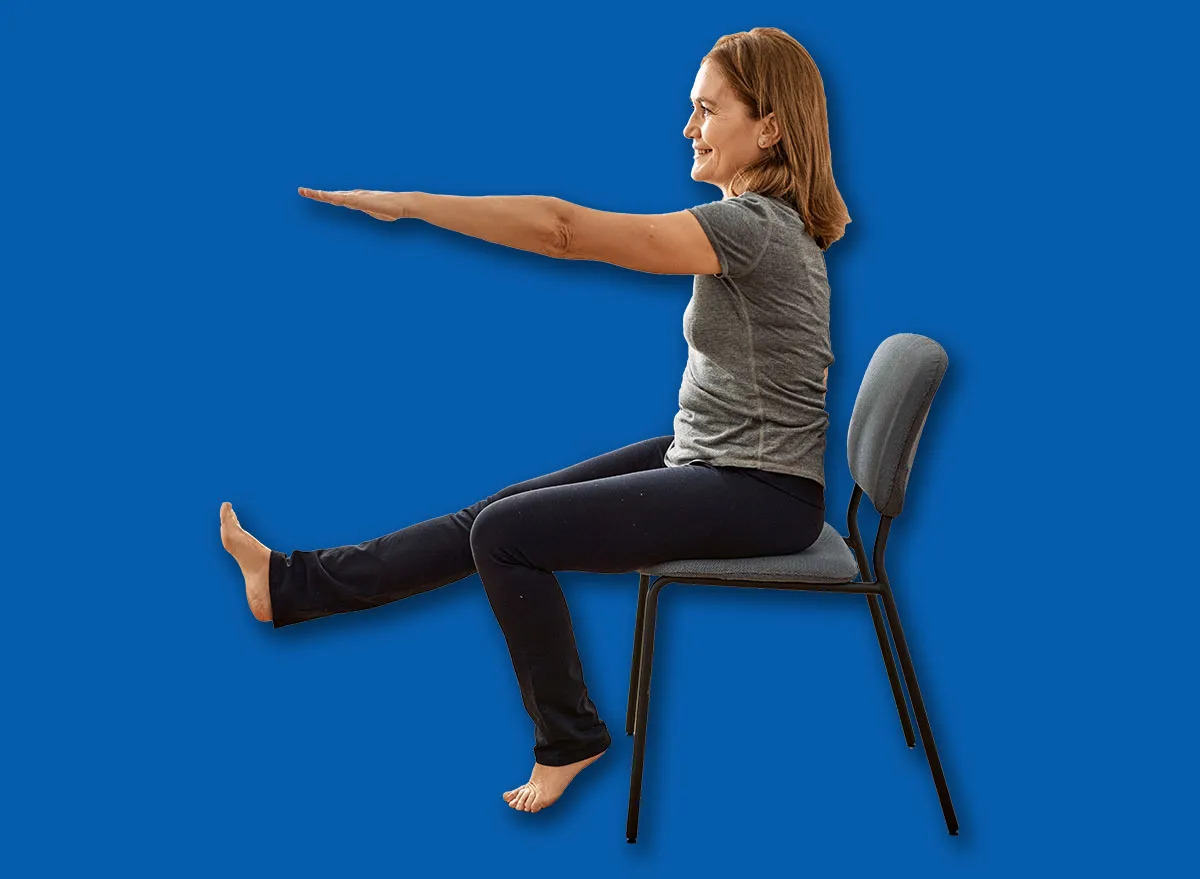
The seated arm and leg reach is a compound movement that challenges core stability while the limbs are in motion. By extending the right arm forward simultaneously with the left leg, you force the stabilizing muscles of the spine to compensate for the shift in center of gravity. This exercise, which should be performed for 2 sets of 8 to 10 repetitions, is excellent for improving coordination and balance. Always maintain an upright posture and avoid leaning or compensating to one side, as this minimizes the intended strengthening effect on the core.
When incorporating these movements, it is important to remember that physiological adaptation takes time. Most individuals can expect to see improvements in functional strength and energy levels within 2 to 4 weeks of consistent, twice-weekly training. More profound improvements in stability and muscle tone typically manifest between weeks 6 and 12. Beyond exercise, ensuring adequate protein intake is vital for muscle protein synthesis, as noted by the International Society of Sports Nutrition in their guidelines regarding protein requirements for older adults. If you experience sharp or shooting pain during any of these movements, stop immediately and consult with a healthcare professional to ensure the exercises are appropriate for your specific spinal health needs.