
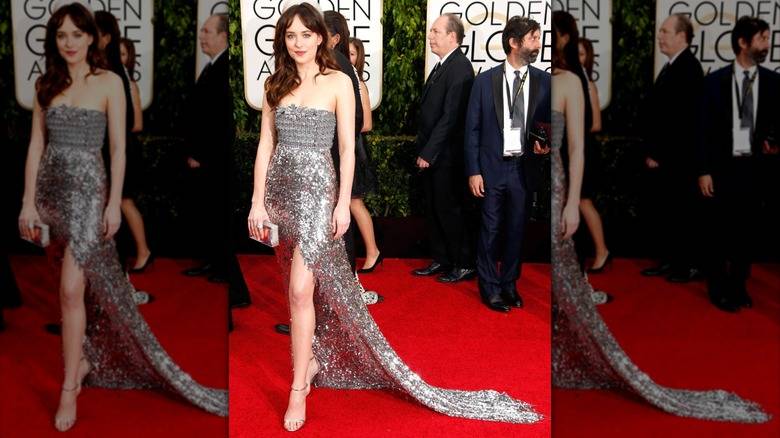
Dakota Johnson has long been recognized for her thoughtful approach to fashion, often using clothing as a quiet but powerful form of self-expression. Over the years, observers have noted a pattern in her public appearances following personal milestones—particularly the end of significant relationships—where her style choices appear deliberate, confident, and sometimes daring. These moments, informally dubbed “revenge dress” instances by fans and media alike, are less about retaliation and more about reclaiming visibility on her own terms. While Johnson has never publicly labeled any outfit as such, the timing and tone of certain looks have sparked conversation about how fashion can communicate resilience without a single word.
The concept of a revenge dress typically refers to an outfit worn after a breakup or public scrutiny that signals strength, independence, or emotional closure. In Johnson’s case, these moments have unfolded gradually, becoming part of how audiences interpret her presence on red carpets and in candid street style. Rather than engaging with speculation about her private life, she has consistently chosen to let her appearance speak—sometimes boldly, sometimes subtly—but always with a sense of intention. This approach reflects a broader cultural shift in how celebrities navigate personal narratives in the public eye, using style not as a shield, but as a statement.
To understand the significance of these moments, it helps to look at Johnson’s background and public journey. Born in 1989 to actors Don Johnson and Melanie Griffith, she grew up in the spotlight but has often spoken about seeking privacy and authenticity in her career. She gained international recognition for her role as Anastasia Steele in the Fifty Shades film series, a role that brought both fame and intense public scrutiny. Since then, she has balanced mainstream projects with independent films, often choosing roles that explore complex emotional landscapes. Off-screen, her relationships—particularly her long-term partnership with Coldplay frontman Chris Martin—have drawn media attention, though she has rarely addressed them directly in interviews.
One of the earliest cited examples of Johnson’s fashion-forward responses came in 2015, following reports of a split with musician Matthew Hitt. She attended the 72nd Golden Globe Awards wearing a shimmering Chanel gown featuring a high thigh slit—a choice noted by several style commentators for its confidence and modernity. While the outfit was praised for its elegance, some observers pointed to the timing as potentially meaningful. However, Johnson and Hitt were later seen together again, leading to speculation about the nature of their relationship at the time. Without confirmed statements from either party, the exact status of their relationship in early 2015 remains unverified, and any interpretation of the gown as a reactive statement should be viewed as interpretive rather than factual.
Years later, after her relationship with Chris Martin ended in 2025—confirmed by multiple reputable entertainment outlets including Variety and The Hollywood Reporter—Johnson made a notable appearance the very next day in New York City. She was photographed wearing a sheer black mesh dress layered over a vibrant red slip, a look that combined transparency with bold color contrast. The ensemble, attributed to a custom design, was widely discussed in fashion circles for its balance of daring construction and poised presentation. Unlike more provocative interpretations of sheer dressing, Johnson’s version maintained structural integrity through strategic layering, avoiding any sense of accident or overexposure.
What stood out to stylists and commentators was not just the aesthetic, but the composure with which she carried herself. Paparazzi photos from that day show her walking through SoHo with a relaxed posture, engaging briefly with fans, and appearing unfazed by the attention. This sense of ease—rather than defiance or anger—became a recurring theme in her subsequent appearances. A few days later, she attended the premiere of Materialists, a film in which she starred, wearing a black Gucci dress with intricate cutouts along the sides. The design, while minimalist in silhouette, revealed significant amounts of skin through strategic openings. Yet Johnson posed confidently on the red carpet, laughing with co-stars including Chris Evans and Ana de Armas, and adjusting her stance with deliberate grace rather than discomfort.
By September 2025, her fashion choices had evolved into what some described as a sustained exploration of sheer fabrics and avant-garde tailoring. At a gala supporting women’s health initiatives, she wore a full-length black lace Gucci gown that, while completely transparent in parts, was structured with internal boning and strategic lining to maintain modesty and shape. The dress, described by Gucci as part of their Autumn/Winter 2025 couture exploration, was praised by Vogue for its technical precision and emotional resonance. Critics noted that the dress did not rely on shock value but instead demonstrated mastery of textile engineering—a metaphor some applied to her personal journey: strength revealed through delicacy, not despite it.
Shortly after, at the Zurich Film Festival, Johnson appeared in another sheer black ensemble, this time a long-sleeved mesh dress with no visible undergarments. The look, while minimal, was not chaotic; it flowed with movement and was accessorized with simple black heels and minimal jewelry. Fashion editors at WWD observed that the outfit felt intentional, almost sculptural, and reflected a growing confidence in her ability to wear challenging designs without appearing to perform for the camera. The absence of visible foundations was not framed as provocative by most commentators, but rather as a continuation of her preference for clean lines and uncluttered aesthetics.
In October 2025, Johnson attended the Los Angeles premiere of her film Daddio in a soft pink Valentino gown. The dress featured a plunging neckline and sheer panels along the sides and back, balanced by a full skirt and structured bodice. While the color and fabric evoked softness, the cut introduced an element of modernity and edge. Some outlets noted the timing—coming shortly after unverified rumors linked Martin to actress Sophie Turner—but Johnson did not address the speculation. Instead, she spoke in interviews about the film’s themes of connection and communication, redirecting focus to her work. Representatives for both Johnson and Martin have consistently declined to comment on personal matters, and no credible evidence has emerged to confirm the nature of Martin’s post-breakup relationships.
What ties these moments together is not a narrative of retaliation, but one of agency. Johnson has repeatedly demonstrated a preference for expressing herself through action rather than explanation. She rarely engages with tabloid rumors, does not confirm or deny relationship statuses in interviews, and maintains a consistent presence at industry events regardless of personal circumstances. Her fashion choices, can be seen as extensions of this philosophy: not reactive, but reflective of a mindset that values self-possession.
This approach aligns with broader trends in celebrity culture, where public figures are increasingly using style to assert control over their narratives. Unlike the early 2000s, when a “revenge dress” often implied a literal message to an ex-partner (think Elizabeth Hurley’s Versace safety-pin dress after Hugh Grant’s scandal), today’s iterations tend to be more nuanced. They may signal self-renewal, artistic exploration, or simply the refusal to disappear from public view after a personal change. In Johnson’s case, her evolution reflects a shift from being defined by relationships to being recognized for her craft, her taste, and her quiet consistency.
Stylists who have worked with Johnson describe her as deeply involved in the creative process, often collaborating with designers to achieve a specific mood rather than simply wearing what is offered. Her long-standing relationship with Gucci’s creative team, for instance, has resulted in several custom pieces that blend the house’s aesthetic with her personal sensibility—favoring clean lines, monochromatic palettes, and unexpected textures. This level of collaboration suggests that her fashion moments are not impulsive, but the result of thoughtful dialogue between artist and artisan.
her choices often intersect with larger conversations about body autonomy and female expression. By wearing sheer fabrics or bold cuts without apology, Johnson participates in a quiet reclamation of the female form—not as object, but as subject. She does not invite commentary; she simply exists in the space she occupies. This distinction is critical: a true statement does not seek approval, nor does it rely on provocation for impact. It merely is.
As of mid-2025, Johnson continues to balance film promotions with selective public appearances. She has several projects in post-production, including a drama directed by Joanna Hogg and a thriller set for release in late 2026. While she remains active in the industry, she has not announced any plans to discuss her personal life in greater detail. For now, her public presence remains defined by her work, her style, and the quiet confidence with which she navigates both.
Those interested in following her career can look to official channels such as her verified Instagram account (@dakotajohnson) for project updates, or rely on reputable entertainment news sources for verified reporting. Speculation will likely continue to surround her appearances, but as history has shown, the most enduring aspect of her presence is not what she wears—but the sense that she wears it on her own terms.