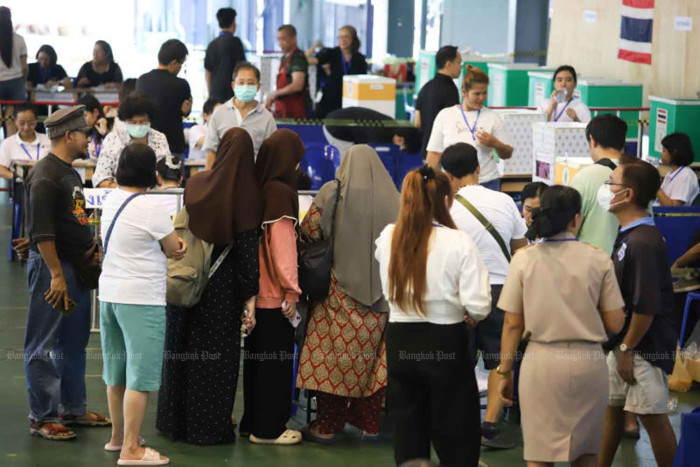
Bangkok, Thailand – A recent survey conducted by the King Prajadhipok’s Institute (KPI) reveals significant public acceptance of the possibility of a new election in Thailand, should a “political accident” – defined as the unseating of a government following an election due to controversy – occur. The findings, released on March 15, 2026, indicate that approximately 74.4% of Thai respondents would support a return to the polls under such circumstances, signaling a notable willingness to embrace political renewal even amidst instability. This level of acceptance underscores a complex interplay of factors within the Thai electorate, including a desire for accountability and a potential frustration with the status quo.
The KPI survey, carried out between February 27 and March 2, 2026, provides a snapshot of public sentiment at a potentially pivotal moment for Thai politics. While Thailand has experienced periods of political turbulence in recent decades, including military coups and prolonged protests, the survey suggests a growing acceptance of democratic processes, even if those processes are disrupted. The willingness to accept a new election, despite the inherent uncertainty it entails, could be interpreted as a sign of maturing political consciousness among Thai citizens. The survey’s findings are particularly relevant given the ongoing scrutiny of the current government and the potential for challenges to its legitimacy.
The survey’s results are not uniform across all regions of Thailand. The southern region demonstrated the highest level of acceptance, with 75.7% of respondents indicating their support for a new election. This contrasts with the central region, where a slight majority – 56.3% – expressed opposition to the idea. Acceptance rates were also high in the Northeast (72.2%) and North (68%), while Bangkok registered a 66.3% acceptance rate, and the Eastern region showed 64.4% acceptance. These regional variations likely reflect differing socio-economic conditions, political affiliations, and historical experiences. Understanding these nuances is crucial for interpreting the overall findings and anticipating potential responses to future political developments.
Regional Variations in Support for New Elections
The geographical breakdown of the survey data reveals a clear pattern of support for new elections, albeit with significant regional differences. The southern region’s strong endorsement – 75.7% – may be attributed to a number of factors, including a historically conservative political culture and a strong sense of regional identity. Conversely, the central region’s opposition – 56.3% – could stem from a greater degree of political stability and a stronger attachment to the existing power structures. The Northeast, traditionally a stronghold of the Pheu Thai Party, showed strong support for a new election, potentially reflecting a desire for political change. The Bangkok Post provides further details on these regional variations.
The survey also highlighted generational differences in priorities for the next cabinet. While respondents aged 28-43, 44-59, and over 60 prioritized short-term economic solutions and increasing incomes – with approximately 25.8% selecting this as the most urgent issue – younger voters, aged 18-27, placed greater emphasis on long-term economic reforms and improving the country’s competitiveness (21.7%). This divergence in priorities underscores the evolving needs and expectations of different demographic groups within Thai society. The younger generation’s focus on long-term economic development suggests a growing awareness of the challenges posed by globalization and technological disruption.
Economic Concerns Dominate Policy Priorities
Beyond the question of a potential new election, the KPI survey also shed light on the key issues that Thai citizens want the next cabinet to address. The overwhelming majority of respondents identified economic concerns as the most pressing priority. The desire for short-term economic relief, particularly among older demographics, reflects the immediate challenges faced by many Thai families, including rising living costs and income inequality. But, the younger generation’s emphasis on long-term economic development highlights a broader concern about the country’s future competitiveness and its ability to attract investment and create sustainable jobs. This generational divide in priorities presents a challenge for policymakers, who must balance the need for immediate relief with the imperative of long-term economic planning.
The King Prajadhipok’s Institute (KPI) plays a crucial role in shaping public discourse and informing policy decisions in Thailand. Established to promote democracy, good governance, and peace, the KPI conducts research, provides training, and disseminates information on a wide range of political and social issues. According to the KPI’s official website, the institute aims to be a “thought leader” and contribute to the development of a more just and equitable society. The recent survey on public acceptance of new elections is just one example of the KPI’s ongoing efforts to monitor public opinion and provide insights into the evolving political landscape of Thailand.
The KPI’s work is increasingly focused on community-participatory public policies. In April 2024, the institute signed a memorandum of understanding with the National Science and Technology Development Agency (NXPO) to collaborate on designing policies for sustainable community development. The NXPO reported that this partnership will leverage the expertise of both organizations to address local needs and promote inclusive growth. This collaboration reflects a growing recognition of the importance of engaging communities in the policymaking process and ensuring that policies are responsive to the needs of those they are intended to serve.
Understanding the “Political Accident” Scenario
The KPI survey specifically asked respondents about their willingness to accept a new election in the event of a “political accident.” This term refers to the unseating of a government after an election due to a political controversy, such as a constitutional crisis, a major scandal, or a loss of confidence in parliament. While the survey does not specify the nature of the potential “political accident,” it suggests that a significant portion of the Thai public is prepared to embrace a fresh start if the current government is unable to maintain its legitimacy. This willingness to accept a new election, even under challenging circumstances, is a testament to the resilience of democratic values in Thailand.
The survey’s findings have implications for the future of Thai politics. While the current government enjoys a degree of stability, the possibility of a “political accident” cannot be ruled out. The high level of public acceptance of a new election suggests that the government would likely face limited resistance if forced to call for fresh polls. However, the regional variations in support for a new election also indicate that any such decision would need to be carefully considered, taking into account the specific concerns and priorities of different communities. The survey serves as a reminder that public opinion is a dynamic force that can shape the course of political events.
Looking ahead, the KPI is expected to continue monitoring public opinion and providing insights into the evolving political landscape of Thailand. The institute’s research will be crucial for informing policy decisions and promoting a more inclusive and democratic society. The next major checkpoint will be the release of the KPI’s annual report on political trends, scheduled for December 2026. This report is expected to provide a comprehensive analysis of the key challenges and opportunities facing Thailand, as well as recommendations for addressing them. Stay informed on the KPI’s website for updates and further analysis.
The survey results offer a valuable glimpse into the mindset of the Thai electorate. The willingness to consider a new election, coupled with the clear priorities for economic improvement, suggests a population engaged with the political process and focused on securing a better future. We encourage readers to share their perspectives on these findings and engage in constructive dialogue about the future of Thailand.
- Police Hunt Suspect After Mayor Condemns Attack on Free Society
- Pernyataan Keluarga soal Kematian Jubir Otorita IKN di Rusun ASN – detikNews
- DHHS Reveals Supplemental Nutrition Assistance Program Performance Metrics (archyde.com)
- Data Centers Spur Economic Growth, But Who Reaps the Benefits? (world-today-news.com)