Galactic Giants: Unveiling the Largest Gas Bridge between Galaxies Ever Discovered
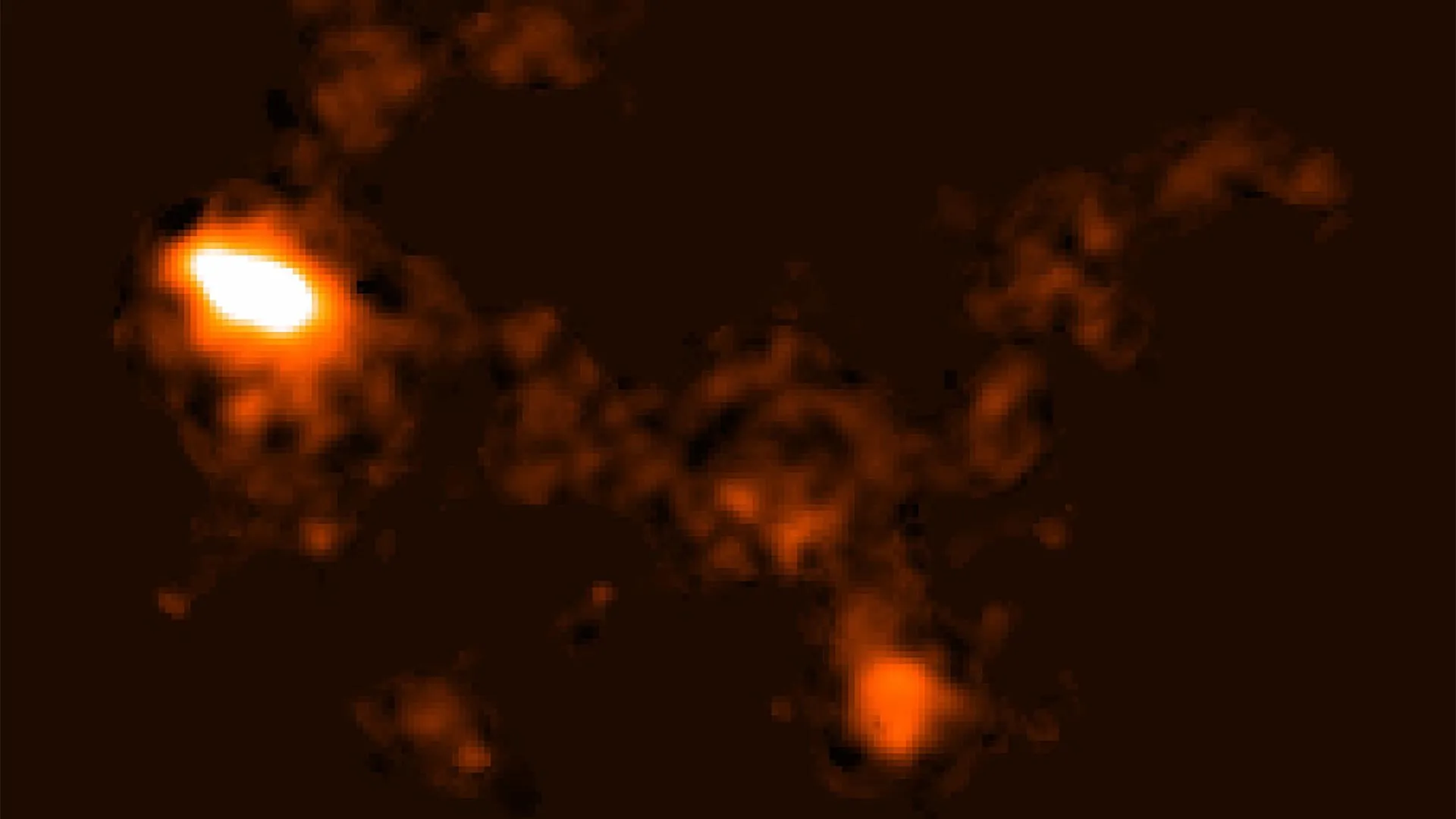
Have you ever wondered how galaxies interact and shape each other over billions of years? recent discoveries are revealing the dramatic processes at play, and a groundbreaking find by researchers at the International Center for Radio astronomy Research (ICRAR) at The University of Western Australia is rewriting our understanding of galactic evolution. A colossal structure – a gas bridge stretching an astounding 185,000 light-years – has been detected connecting the galaxies NGC 4532 and DDO 137, located 53 million light-years from Earth. But this isn’t just a bridge; it’s accompanied by a gas tail extending a further 1.6 million light-years, making it the largest such feature ever observed. What does this mean for our understanding of the universe? Let’s dive in.
A Cosmic Connection: The Finding of a Massive Gas Bridge
The research, published in the Monthly Notices of the Royal Astronomical Society, details the observation of this immense structure. This isn’t a visual spectacle easily captured by conventional telescopes; it’s a detection of neutral hydrogen gas, a crucial component for star formation, revealed through sensitive radio astronomy. The sheer scale of this gas bridge is breathtaking, dwarfing our own Milky Way and offering a unique window into the complex interactions between galaxies.
https://academic.oup.com/mnras – Monthly Notices of the Royal Astronomical Society official website.
Lead researcher Professor Lister Staveley-Smith from ICRAR UWA explains that the discovery provides vital new insights into how galaxies influence each other’s evolution. “Our modeling showed that the tidal forces acting between these galaxies, alongside their proximity to the massive Virgo cluster of galaxies, played a crucial role in the gas dynamics we observed,” he stated.
The Forces at Play: Ram Pressure and Tidal Interactions
So, how did this enormous structure come to be? The answer lies in a combination of gravitational forces and environmental pressures. The galaxies NGC 4532 and DDO 137 aren’t isolated; they’re engaged in a cosmic dance, orbiting each other while concurrently being drawn towards the Virgo Cluster – a massive collection of galaxies.
As they move through the superheated gas surrounding the Virgo Cluster (reaching temperatures 200 times hotter than the Sun’s surface), they experience what’s known as “ram pressure.” Imagine a car driving into a strong headwind – the air pushes against it. Similarly, the hot gas of the virgo Cluster pushes against the galaxies, stripping away their gas and heating it up.
Professor Staveley-Smith draws a compelling analogy: “The process is akin to atmospheric burn-up when a satellite re-enters the Earth’s upper atmosphere, but has extended over a period of a billion years.” The density of electrons and the galaxies’ velocity are sufficient to explain the substantial gas displacement, resulting in the observed bridge and surrounding gas distribution. Tidal forces, the gravitational pull exerted by each galaxy on the other, also contribute to the stretching and distortion of the gas.
WALLABY: the Survey Enabling Breakthroughs
this remarkable discovery wouldn’t have been possible without the Widefield ASKAP L-band Legacy All-sky Survey (WALLABY). This ambitious project utilizes the ASKAP radio telescope, operated by CSIRO, Australia’s national science agency, to map hydrogen gas across the entire sky.
https://www.csiro.au/en/research/astronomy/askap – CSIRO’s ASKAP telescope information.
WALLABY’s high-resolution observations of neutral hydrogen are key to identifying these vast gas structures, which are otherwise invisible to optical telescopes. By mapping the distribution of this crucial star-forming material, WALLABY is revolutionizing our understanding of galactic interactions and evolution.
Why This Matters: Parallels to Our Own Galactic Neighborhood
the meaning of this discovery extends beyond the specific galaxies involved. Co-author Professor Kenji Bekki of ICRAR UWA highlights the importance of neutral hydrogen: “Neutral hydrogen plays a crucial role in the formation of stars, making this finding fundamental to understanding how galaxies interact and evolve, notably in dense environments.”
Interestingly, the NGC 4532/DDO 137 system bears striking similarities to our own Milky Way and the magellanic System - the two dwarf galaxies orbiting our own. This provides a unique chance to study galactic interactions in detail, offering insights into the future evolution of our own galactic neighborhood.
professor Staveley-Smith emphasizes the broader implications: “Understanding these
Worth a look