Understanding the Potential Impact of Public Charge Policies on Healthcare Coverage
Public charge policies, which can deny legal residency to immigrants deemed likely to become dependent on government assistance, are a significant concern for millions of families. These policies create fear and uncertainty, potentially leading individuals to forgo vital healthcare coverage.This article breaks down how experts are estimating the potential impact of these policies on enrollment in programs like Medicaid and CHIP, and how these estimates differ from those used by the Department of Homeland Security (DHS).
Estimating Coverage Loss: A Range of Possibilities
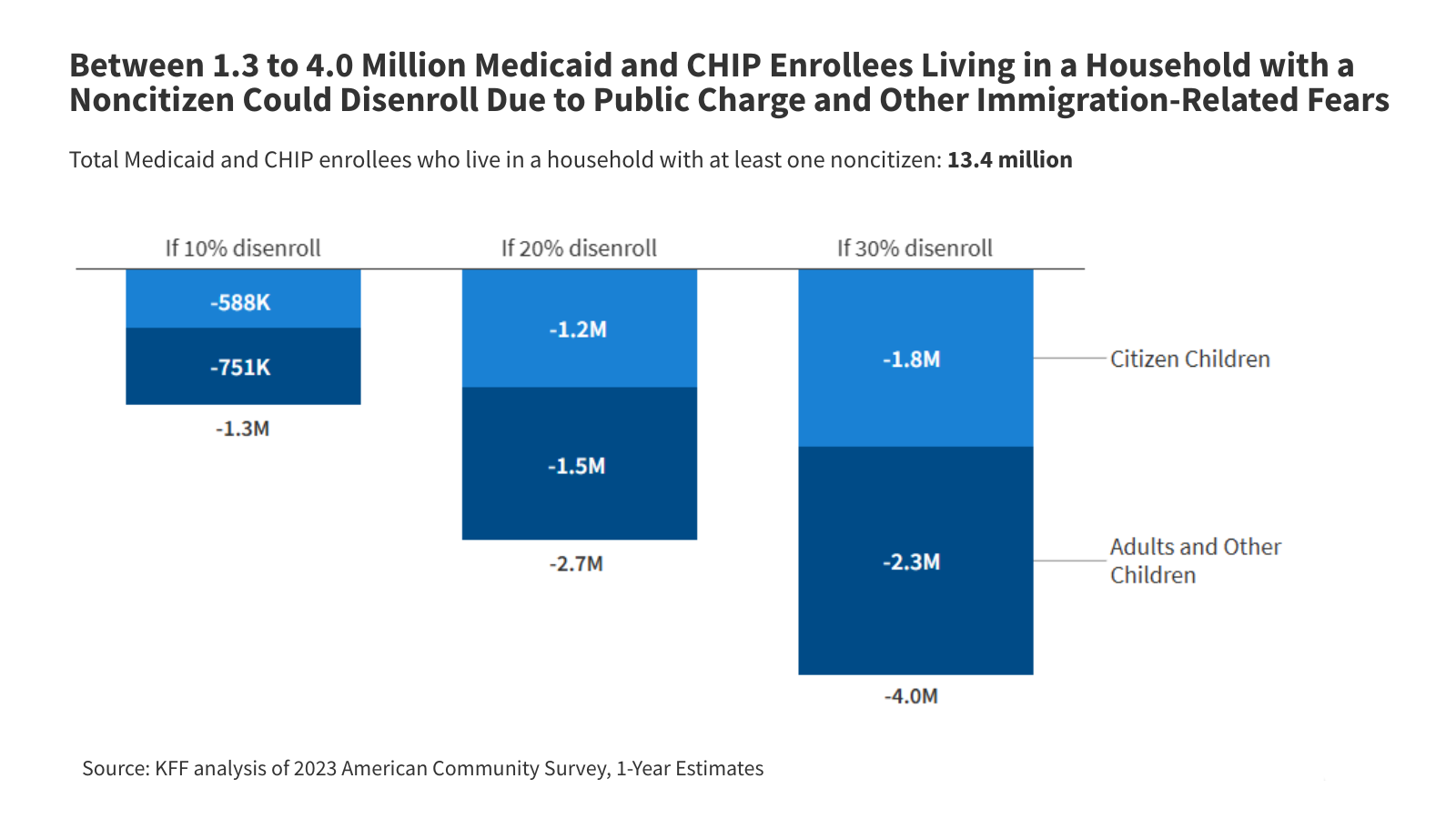
To understand the potential scale of coverage changes, the Kaiser Family Foundation (KFF) modeled different scenarios based on disenrollment and forgone enrollment rates. They considered rates of 10%, 20%, and 30% – representing a range of possible responses to public charge concerns.
These estimates were broken down by age and citizenship status, recognizing that the impact may vary across different groups. Children (under 18) were specifically identified as a key demographic.
the 20% midpoint estimate is grounded in real-world data from the KFF/New York Times 2025 Survey of Immigrants. This survey revealed that roughly 20% of adults in households with non-citizens had stopped using programs providing assistance with food, healthcare, or housing due to fear of immigration consequences. Similar rates were observed for those avoiding applying for these programs in the first place.
However, KFF also acknowledges the potential for even greater impact. The 10% lower bound reflects DHS’s own conservative estimates. The 30% upper bound accounts for factors that have emerged since the survey was conducted, including:
* New policy proposals, like the recent public charge rule.
* Plans by the Centers for Medicare & Medicaid Services (CMS) to share Medicaid data with Immigration and Customs Enforcement (ICE).
* Increased public enforcement activity, which can further discourage participation in vital programs.
How KFF’s Approach Differs from DHS
It’s significant to understand that KFF’s methodology differs from that used by DHS in its proposed 2025 public charge rule. DHS estimates that approximately 4.1 million Medicaid and CHIP enrollees live in households with at least one non-citizen. They project around 400,000 Medicaid and 60,000 CHIP enrollees will disenroll or avoid enrolling due to public charge fears.
Here’s a breakdown of the steps DHS took to arrive at these figures:
- Average Enrollment: DHS calculated average annual Medicaid (adults onyl) and CHIP enrollment from FY 2019-2024.
- Household Estimation: They estimated the number of households with Medicaid/CHIP enrollees by dividing average enrollment by the average U.S. household size (2.54).
- Non-Citizen Household Identification: DHS multiplied the percentage of the U.S. population that is foreign-born (6.61%) by the estimated number of households with Medicaid/CHIP enrollees.
- enrollee Calculation: They multiplied these households by the average size of foreign-born households (3.12) to estimate the total number of enrollees living with a non-citizen.
- Disenrollment Rate: DHS applied a 10.3% disenrollment/forgone enrollment rate to these estimated enrollees.
What This Means for You and Your Family
If you or someone you know is an immigrant, understanding these potential impacts is crucial. Public charge policies can create a difficult choice: accessing necessary healthcare versus potentially jeopardizing immigration status.
Here’s what you shoudl remember:
* Coverage is vital. Don’t let fear prevent you from accessing healthcare for yourself and your family.
* There are resources available. Numerous organizations offer assistance navigating these complex policies. (See resources below).
* Stay informed. Keep up-to-date on policy changes and their potential impact.
Resources:
* kaiser Family Foundation (KFF): https://www.kff.org/
* National Immigration Law Center (NILC): https://www.nilc.org/
Related reading