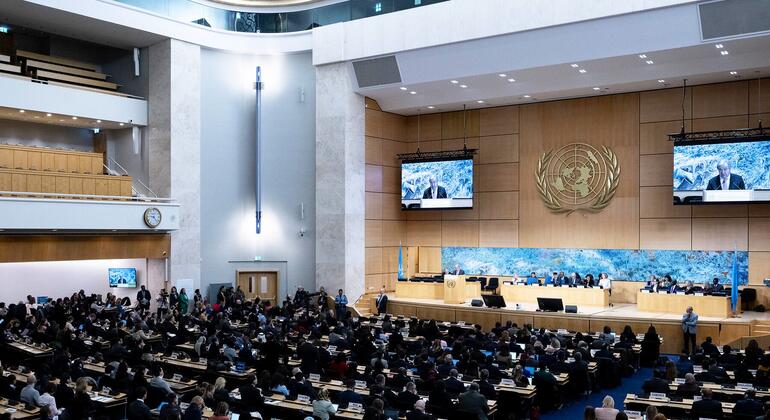
Geneva, Switzerland – As the world grapples with escalating conflicts and a rising tide of authoritarianism, the defense of human rights is no longer a passive endeavor, but a critical and urgent responsibility, United Nations officials warned this week. Speaking at the opening of the 55th session of the Human Rights Council in Geneva on Monday, Secretary-General António Guterres delivered a stark assessment of the global landscape, characterizing the current moment as one where fundamental rights are under “full-scale attack…often led by those who hold the greatest power.” The remarks came on the eve of the fourth anniversary of Russia’s full-scale invasion of Ukraine, a conflict that has tragically claimed the lives of over 15,000 civilians, according to verified reports.
Guterres’s address, delivered February 23rd, underscored a growing concern that international law and established norms are being eroded, with devastating consequences for vulnerable populations worldwide. He specifically highlighted the ongoing crises in Gaza, Myanmar, Sudan, and Ukraine, emphasizing the urgent demand for accountability and a renewed commitment to the principles enshrined in the UN Charter. The Secretary-General’s message resonated with the President of the UN General Assembly, Annalena Baerbock, who powerfully asserted that human rights are “not a spectator sport,” demanding active engagement from all stakeholders – Council members, ambassadors, ministers, and UN officials alike.
The Erosion of Rights and the Cost of Silence
Baerbock’s impassioned plea centered on the historical lesson that systems of protection rarely collapse dramatically, but rather through a gradual erosion of rules, commitments, and, crucially, the willingness to speak out against injustice. “History teaches us that large systems rarely collapse in one dramatic moment; they erode slowly, rule by rule, commitment by commitment, with those who should defend them rather staying silent,” she stated. This sentiment was echoed by UN High Commissioner for Human Rights, Volker Türk, who called for a focus on rights and justice as central tenets of any future ceasefire or peace agreement, particularly in Ukraine. Türk is set to launch the Office’s Global Alliance for Human Rights, aiming to bring together diverse stakeholders to bolster the defense of human rights globally.
The plight of Afghan women under the Taliban regime served as a particularly harrowing example of this erosion. Recent edicts, reportedly allowing husbands to beat their wives without leaving visible marks, have drawn widespread condemnation. The UN has consistently documented severe restrictions on women’s rights in Afghanistan since the Taliban takeover in August 2021, including limitations on education, employment, and freedom of movement. The Office of the High Commissioner for Human Rights (OHCHR) provides ongoing monitoring and reporting on the human rights situation in Afghanistan.
Ukraine: Four Years of Conflict and the Crime of Child Abduction
As February 24th marks the fourth anniversary of Russia’s full-scale invasion of Ukraine, the human cost of the conflict remains staggering. The UN Human Rights Monitoring Mission in Ukraine (HRMMU) has verified over 10,810 civilian deaths as of February 15, 2026, though the actual number is believed to be considerably higher. The OHCHR’s Ukraine page provides regularly updated casualty figures and reports on human rights violations.
Beyond the immediate loss of life, the conflict has been marked by widespread allegations of war crimes, including the forced transfer and deportation of Ukrainian children to Russia and Russian-occupied territories. Both the UN and international legal bodies are investigating these allegations, which are considered a grave violation of international law. President Baerbock specifically appealed for a “clear commitment from every Member State that the abduction of Ukrainian children is a war crime,” emphasizing the need for accountability for those responsible. The International Criminal Court (ICC) issued arrest warrants in March 2023 for Russian President Vladimir Putin and Maria Lvova-Belova, Russia’s Commissioner for Children’s Rights, over the alleged unlawful deportation of children.
The Two-State Solution and the West Bank
The deteriorating situation in the occupied West Bank also drew sharp criticism from Secretary-General Guterres, who warned that the prospect of a two-State solution is being “stripped away in broad daylight.” Accelerating Israeli settler expansion, deemed illegal under international law, continues to undermine the viability of a future Palestinian state. According to data from the UN Office for the Coordination of Humanitarian Affairs (OCHA), settlement activity in the West Bank has increased significantly in recent years, displacing Palestinian communities and exacerbating tensions. OCHA’s website provides detailed information on the humanitarian situation in the occupied Palestinian territory.
AI and the Future of Human Rights
Guterres also addressed the emerging challenges posed by artificial intelligence (AI), warning that the technology is increasingly being used to suppress rights, deepen inequality, and discriminate against marginalized communities. He urged a renewed commitment to the values of multilateral solidarity, as outlined in the UN Charter, to ensure that AI is developed and deployed in a manner that respects human rights and promotes the common good. The UN has been actively exploring the ethical and legal implications of AI, with ongoing discussions on the need for international regulations, and standards.
The Secretary-General’s final address to the Council before the end of his second five-year term on December 31st served as a sobering reminder of the interconnected challenges facing the world today. He reiterated his concerns about the drivers of insecurity and inequality, including the plight of migrants and refugees, the rise of xenophobia and discrimination against LGBTQI+ communities, and the escalating climate crisis. He emphasized that “countries are drowning in debt and despair, climate chaos is accelerating,” particularly impacting small and vulnerable nations.
Key Takeaways
- Human rights are under attack globally: Secretary-General Guterres warned of a “full-scale attack” on human rights, often perpetrated by powerful actors.
- Silence is complicity: President Baerbock stressed that inaction in the face of human rights violations has dire consequences.
- Ukraine remains a focal point: The fourth anniversary of the Russian invasion underscores the urgent need for peace and accountability, including addressing the alleged abduction of Ukrainian children.
- The two-State solution is at risk: Continued Israeli settlement expansion threatens the viability of a future Palestinian state.
- AI presents new challenges: The use of artificial intelligence raises concerns about the suppression of rights and the exacerbation of inequalities.
The call to action from both Guterres and Türk is clear: defending human rights requires a collective and unwavering commitment. As the international community navigates an increasingly complex and turbulent world, upholding the principles of the UN Charter and prioritizing the protection of vulnerable populations is more critical than ever. The upcoming launch of the OHCHR’s Global Alliance for Human Rights represents a significant step towards fostering greater collaboration and strengthening the global human rights framework.
The Human Rights Council is scheduled to continue its 55th session through March 22, 2026, with a focus on thematic issues and country-specific situations. Updates on the Council’s proceedings and reports can be found on the OHCHR website. We encourage readers to engage in the conversation and share their perspectives on the challenges and opportunities facing the global human rights movement.