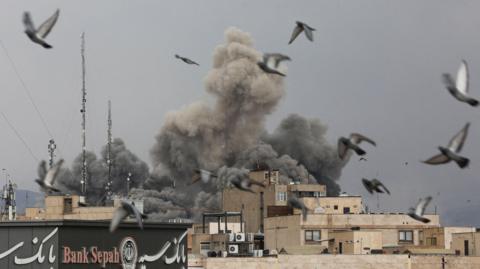
Sofia, Bulgaria – The death of Iran’s Supreme Leader, Ayatollah Ali Khamenei, in a joint U.S.-Israeli strike on Saturday has sent shockwaves through the Middle East, and beyond. The unprecedented attack, confirmed by Iranian state media, has triggered a period of national mourning and raised critical questions about the future of the Islamic Republic and the potential for further escalation in the region. While details surrounding the operation remain closely guarded, the event marks a significant turning point in decades-long tensions between Iran and the West, and specifically, Israel.
The loss of Khamenei, who had held the position of Supreme Leader since 1989, leaves a power vacuum at the apex of Iran’s complex political system. For many Iranians, particularly those who came of age after the 1979 revolution, Khamenei represented the continuity of the Islamic Republic. His decades-long leadership shaped both domestic policy and Iran’s assertive foreign policy, including its support for regional proxies and its controversial nuclear program. The immediate aftermath has seen widespread displays of grief, alongside reports of celebratory gatherings in some areas, signaling a deeply fractured public response. The question of succession, and who will ultimately wield the immense power once held by Khamenei, is now paramount.
Former U.S. President Donald Trump, speaking shortly after the news broke, indicated that this strike was only the beginning. He stated that a “big wave” of attacks against Iran has yet to be launched. This statement, coupled with the uncertainty surrounding the succession process, has fueled anxieties about a wider conflict. Meanwhile, Ali Larijani, a prominent Iranian political figure, asserted that Iran “has prepared itself for a long war, unlike the United States,” suggesting a resolve to withstand further pressure. This declaration underscores the potential for a protracted and destabilizing confrontation.
A Life Shaped by Revolution and Authority
Ayatollah Ali Khamenei’s life story is inextricably linked to the tumultuous history of modern Iran. Born in 1939 in the holy city of Mashhad, as confirmed by both the BBC Arabic and Al Arabiya, he grew up in a family of religious scholars. His early life was marked by opposition to the Shah’s regime, a stance that would define his political trajectory. He actively participated in the 1979 Islamic Revolution, which overthrew the Pahlavi dynasty and established the Islamic Republic.
Khamenei’s rise to power was gradual but strategic. Following the death of Ayatollah Ruhollah Khomeini, the founder of the Islamic Republic, in 1989, he was selected as the new Supreme Leader. This transition, as noted by the BBC, solidified his position as the ultimate authority in Iran, granting him control over the military, judiciary, and key political institutions. He wielded the power of veto over policy and played a crucial role in selecting candidates for public office. His authority extended to the Islamic Revolutionary Guard Corps (IRGC), a powerful military force with significant influence both domestically and regionally.
Immediate Aftermath and Public Response
Following the announcement of Khamenei’s death, Iranian state television broadcast images of mourning processions taking place in cities across the country, including Mashhad, his birthplace. State media reported that 22 locations in the capital, Tehran, were designated for gatherings to commemorate the Supreme Leader. Videos circulating online showed crowds chanting slogans such as “Death to Israel” and “Death to America.”
However, the public response has been far from monolithic. Reports, including those cited by the BBC, indicate that Iranian authorities sent text messages warning citizens against taking to the streets to protest. Simultaneously, the BBC verified videos showing celebratory gatherings in several cities, alongside demonstrations denouncing Khamenei’s death and vowing retaliation. This duality highlights the deep divisions within Iranian society and the potential for unrest in the wake of his passing.
The Succession Question and Potential Scenarios
The most pressing question now is who will succeed Khamenei as Supreme Leader. The process is determined by the Assembly of Experts, a body of 88 clerics responsible for selecting and overseeing the Supreme Leader. The Assembly, as outlined by Iranian constitutional law, will convene to choose a successor. Several names have been floated as potential candidates, but the outcome remains highly uncertain.
Among those frequently mentioned is Ebrahim Raisi, the current President of Iran. His hardline stance and close ties to the IRGC make him a strong contender. However, his controversial past, including alleged involvement in the 1988 mass executions of political prisoners, could prove divisive. Another potential candidate is Mojtaba Khamenei, the Supreme Leader’s son, though his lack of formal religious credentials may be a hindrance. Other figures, such as Ali Larijani, a former speaker of parliament and a seasoned political operator, are also being considered. The selection process is likely to be fraught with internal power struggles and competing interests, potentially leading to a prolonged period of uncertainty.
Regional and International Implications
Khamenei’s death has profound implications for the broader Middle East region. Iran’s influence extends to numerous countries through its support for proxy groups, including Hezbollah in Lebanon, Hamas in Palestine, and Houthi rebels in Yemen. The removal of a key figure like Khamenei could disrupt these relationships and alter the regional balance of power. The potential for increased instability is particularly acute in countries already grappling with conflict and political turmoil.
Internationally, the event has prompted a flurry of diplomatic activity. The United States and Israel have remained largely silent, beyond Trump’s aforementioned statement, while European powers have called for restraint and a de-escalation of tensions. The future of the Iran nuclear deal, formally known as the Joint Comprehensive Plan of Action (JCPOA), is also uncertain. Khamenei was a staunch defender of Iran’s nuclear program, and his death could open the door to renewed negotiations, although the prospects for a breakthrough remain slim given the current geopolitical climate.
The Role of the Islamic Revolutionary Guard Corps
The Islamic Revolutionary Guard Corps (IRGC) is a critical component of Iran’s power structure. Established after the 1979 revolution, the IRGC operates independently of the regular armed forces and wields significant economic and political influence. Khamenei, as Supreme Leader, had direct control over the IRGC, and its loyalty to him was unwavering. The IRGC’s role in the succession process and its potential influence on the selection of the next Supreme Leader are significant factors to watch. The IRGC’s continued dominance could solidify a hardline stance and further exacerbate tensions with the West.
Looking Ahead: A Period of Uncertainty
The death of Ayatollah Ali Khamenei marks the end of an era in Iranian history. His decades-long leadership shaped the Islamic Republic and its role in the world. The coming weeks and months will be critical as Iran navigates a period of political transition and grapples with the challenges of succession. The potential for both internal unrest and external conflict remains high. The international community will be closely monitoring developments, seeking to prevent further escalation and promote stability in the region.
The immediate focus will be on the Assembly of Experts’ deliberations and the selection of a new Supreme Leader. The outcome of this process will have far-reaching consequences for Iran and the wider Middle East. The world awaits with bated breath, hoping for a peaceful transition and a resolution to the escalating tensions. The next confirmed checkpoint will be the announcement of the new Supreme Leader by the Assembly of Experts, a date which has not yet been set.
We encourage readers to share their thoughts and perspectives on this developing story in the comments below. Your insights are valuable as we continue to follow this critical event.
Keep reading