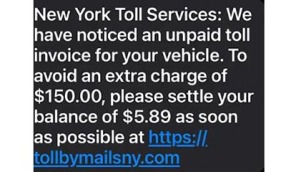
New York and New Jersey drivers are facing a surge in sophisticated text message scams designed to steal money by falsely claiming unpaid tolls. The Port Authority of New York and New Jersey has issued urgent warnings about these fraudulent schemes, which impersonate “New York Toll Services” and attempt to trick recipients into clicking malicious links. This latest wave of scams underscores the growing threat of digital fraud targeting everyday commuters and highlights the importance of vigilance when dealing with unsolicited communications.
The scam operates by sending text messages that allege unpaid toll fees and threaten fines if immediate payment isn’t made. These messages contain a link that, if clicked, could lead to the compromise of personal and financial information. Authorities emphasize that the Port Authority itself never requests payment or demands urgent action via text message. The Port Authority’s official stance, as of March 6, 2026, is to only communicate with drivers who have specifically registered for text notification services. This scam is particularly concerning given the recent implementation of new toll rates on January 4, 2026, at 12:01 AM, as reported by the Port Authority, which may create confusion and increase the likelihood of individuals falling victim to these deceptive practices. Current toll rates can be found on the Port Authority’s website.
The Rise of Toll Scams and Impersonation Tactics
This “New York Toll Services” scheme is not an isolated incident. It represents a broader trend of fraudsters impersonating government agencies, vehicle registration authorities, and even legitimate toll payment services like E-ZPass. The International Bridge and Tunnel Tollway Association (IBTTA) has warned that similar scams are occurring in at least 19 states across the United States, indicating a widespread and coordinated effort to defraud drivers. The IBTTA’s concerns reflect a growing sophistication in these schemes, as scammers increasingly leverage the credibility of official-sounding names and urgent messaging to manipulate victims.
The Port Authority is actively working to combat these scams through public awareness campaigns and collaboration with law enforcement. They are utilizing social media platforms to disseminate warnings and educate drivers about the risks. Though, officials acknowledge that staying ahead of these evolving tactics requires constant vigilance and a proactive approach to cybersecurity. The agency’s warning comes just four days after reports surfaced about the scam, as noted by NJ.com, demonstrating the rapid spread of this fraudulent activity.
Protecting Yourself from Toll Payment Scams
Drivers can take several steps to protect themselves from falling victim to these scams. The most crucial advice is to never click on links contained within unsolicited text messages. Legitimate toll collection agencies will not request payment or sensitive information via text. Instead, individuals should directly contact the Port Authority or access the official website to verify any outstanding tolls. For E-ZPass users, the Port Authority offers a Green Pass Discount Plan, with rates of $16.79 per peak trip and $11.29 per off-peak trip (plus a $13.80 fee for each trip), as of March 6, 2026, for eligible Class 1 vehicles. More information about E-ZPass and the Green Pass Discount Plan is available on the Port Authority website.
The IBTTA recommends the following preventative measures:
- Do not click on any links included in text messages.
- Never provide personal or financial information through text messages.
- Contact toll collection agencies directly or access their official websites to check for unpaid tolls.
Reporting fraudulent text messages is also essential. The Federal Trade Commission (FTC) provides a platform for reporting fraud at ReportFraud.ftc.gov. By reporting these incidents, individuals can contribute to the broader effort to track and disrupt these criminal activities.
Understanding the E-ZPass System and Toll Payment Options
The E-ZPass system is a widely used electronic toll collection system throughout the New York and New Jersey region. It allows drivers to pay tolls automatically without stopping at toll booths. While E-ZPass offers convenience and potential discounts, it also presents an opportunity for scammers to exploit the system’s familiarity. Drivers should be aware that the Port Authority will not request E-ZPass account information via text message or email. Any such requests should be treated as suspicious and reported immediately.
Beyond E-ZPass, drivers have other options for paying tolls, including Toll-by-Mail and Video Tolling. However, these methods also carry the risk of being targeted by scammers. The Port Authority advises drivers to regularly check their toll accounts and report any discrepancies or unauthorized charges. Staying informed about the various toll payment options and associated security measures is crucial for protecting oneself from fraud.
What Happens Next?
The Port Authority continues to monitor the situation and collaborate with law enforcement agencies to identify and prosecute those responsible for these scams. They are also working to enhance their public awareness campaigns and improve their communication channels to ensure that drivers receive accurate and timely information. The next update from the Port Authority regarding this issue is expected within the next two weeks, as they assess the effectiveness of their current countermeasures and adapt their strategies to address emerging threats. Drivers are encouraged to stay informed by regularly visiting the Port Authority’s website and following their official social media channels.
This ongoing battle against toll scams underscores the importance of digital literacy and critical thinking in today’s interconnected world. By remaining vigilant, educating themselves about common fraud tactics, and reporting suspicious activity, drivers can protect themselves and contribute to a safer online environment. The Port Authority’s commitment to combating these scams, coupled with the proactive measures taken by drivers, will be essential in mitigating the risks and ensuring the integrity of the region’s toll collection system.
What are your thoughts on this growing scam? Share your experiences and tips in the comments below. And please, share this article with your friends and family to help spread awareness and protect others from falling victim to these fraudulent schemes.
Keep reading