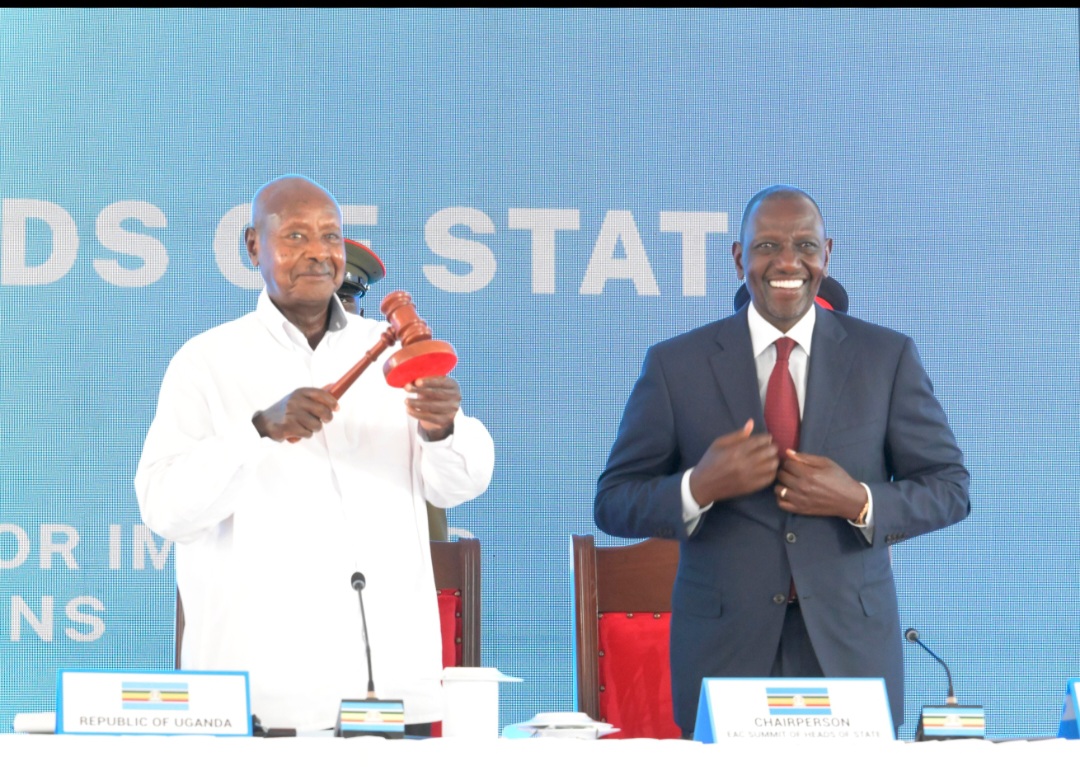
Arusha, Tanzania – President Yoweri Museveni of Uganda has assumed the chairmanship of the East African Community (EAC) Summit, taking the reins from outgoing chair President William Ruto of Kenya. The handover took place at the conclusion of the EAC Heads of State Summit held at the Arusha International Conference Centre on Saturday, March 2, 2026. This transition comes at a pivotal moment for the regional bloc, as it navigates challenges to deeper integration and economic stability. The appointment of a fresh Secretary General, Ambassador Stephen Patrick Mbundi of Tanzania, also signals a commitment to fresh leadership within the EAC.
Museveni’s appointment is viewed as a critical step in revitalizing the EAC, which has faced headwinds in recent years. The community, comprised of eight nations – Burundi, the Democratic Republic of the Congo, Kenya, Rwanda, Somalia, South Sudan, Tanzania, and Uganda – represents a significant economic and political force in East Africa, with a combined population estimated at over 343 million people in 2024, according to the East African Community website. However, realizing the full potential of this integration requires addressing persistent obstacles, including trade barriers, political tensions, and infrastructure deficits. The EAC’s combined GDP (PPP) was estimated at Int$1,027.067 billion in 2024, highlighting the economic weight of the region, but also the need for sustained growth and equitable distribution of wealth.
A Call for Unity and Strategic Security
In his inaugural address as EAC chair, President Museveni emphasized the importance of unity and strategic security for the region’s progress. He invoked the concept of “Okukonesa,” a local metaphor for improperly cooked food, to illustrate the dangers of incomplete or half-hearted efforts towards African transformation. Museveni cautioned against repeating historical mistakes that led to colonization and underdevelopment, pinpointing weak leadership, disunity, and a lack of scientific and technological advancement as key contributing factors. He recalled the historical context of the late 19th and early 20th centuries, when divisions among African societies facilitated colonial rule, and stressed the resilience of the African people in overcoming these challenges.
Museveni articulated a four-pronged vision for the African liberation struggle: liberation, modernization, prosperity, and strategic security. He underscored that the foundation for achieving these goals lies in “Uhuru na Umoja” – Freedom and Unity. While acknowledging that political independence has largely been achieved, he emphasized that economic integration remains an unfinished task. He argued that production alone is insufficient for wealth creation without access to large, integrated markets, drawing parallels with the successful economic models of China, India, and South Korea, which leveraged large domestic markets to drive industrialization and growth. The East African Community aims to create such a market for its member states.
New Leadership at the EAC Secretariat
Alongside the change in chairmanship, the summit also approved the appointment of Ambassador Stephen Patrick Mbundi of Tanzania as the new Secretary General of the East African Community. This appointment is expected to bring a fresh perspective to the EAC Secretariat, the administrative arm of the community. The Secretary General plays a crucial role in implementing the policies and programs of the EAC, coordinating regional initiatives, and fostering cooperation among member states. Mbundi’s experience and leadership will be vital in navigating the complex challenges facing the EAC and advancing its integration agenda.
Addressing Regional Challenges and Opportunities
The East African Community faces a complex array of challenges, ranging from infrastructure deficits and non-tariff barriers to trade, to political instability and security concerns. The recent conflicts in the Democratic Republic of Congo and South Sudan, for example, have underscored the need for enhanced regional security cooperation. Climate change poses a significant threat to the region’s agricultural sector and overall economic development. However, the EAC also possesses significant opportunities for growth and development, including its abundant natural resources, a young and growing population, and increasing regional integration.
The launch of the 7th EAC Development Strategy (2026/27–2030/31) during the summit signals a commitment to addressing these challenges and capitalizing on these opportunities. The strategy is expected to focus on key areas such as infrastructure development, industrialization, trade facilitation, and climate change adaptation. The launch of the EAC Customs Bond, aimed at streamlining trade procedures and reducing transaction costs, is another positive step towards enhancing regional economic integration. The EAC is also actively promoting investment in key sectors such as agriculture, tourism, and energy, with the goal of creating jobs and boosting economic growth.
Museveni’s Vision for a Prosperous East Africa
President Museveni’s vision for the EAC centers on building a productive, integrated, and secure region. He called on the youth of East Africa to focus on building productive economies, strengthening regional integration, and avoiding distractions that could undermine long-term development. He also emphasized the importance of strategic security, noting that modern states must be capable of defending themselves across all domains – land, air, sea, and space – while working together to safeguard regional stability. Museveni paid tribute to the historical leaders who championed African unity and liberation, including Mwalimu Julius Nyerere, Sheikh Abeid Amani Karume, Kwame Nkrumah, Ahmed Sékou Touré, and Modibo Keïta, recognizing their enduring legacy and relevance to the current challenges facing the region.
Museveni’s emphasis on strategic security is particularly noteworthy given the evolving geopolitical landscape in East Africa. The region has become increasingly vulnerable to transnational threats such as terrorism, piracy, and cybercrime. Strengthening regional security cooperation is therefore essential for protecting the EAC’s economic interests and ensuring the safety and well-being of its citizens. The EAC is also working to promote peace and reconciliation in conflict-affected areas, such as the Democratic Republic of Congo and South Sudan, through mediation efforts and the deployment of peacekeeping forces.
The summit also recognized regional youth excellence through the awarding of winners of the 2024 EAC Essay Writing Competition, highlighting the importance of engaging young people in the EAC integration process. The competition provided a platform for young people to share their ideas and perspectives on the challenges and opportunities facing the region. The EAC recognizes that the youth are the future of the community and that their participation is essential for achieving sustainable development and prosperity.
The handover of the EAC chairmanship from President Ruto to President Museveni marks a new chapter in the history of the regional bloc. Under Museveni’s leadership, the East African Community is expected to deepen regional integration, strengthen economic cooperation, and advance the collective prosperity and security of the region’s more than 300 million citizens. The success of this endeavor will depend on the commitment of all member states to work together towards a common vision of a united, prosperous, and secure East Africa.
The next key milestone for the EAC will be the implementation of the 7th EAC Development Strategy (2026/27–2030/31), with progress reports expected to be presented at the next Heads of State Summit in 2027. Readers interested in learning more about the EAC and its initiatives are encouraged to visit the official website at www.eac.int. We invite you to share your thoughts on the future of the East African Community in the comments below.
Keep reading