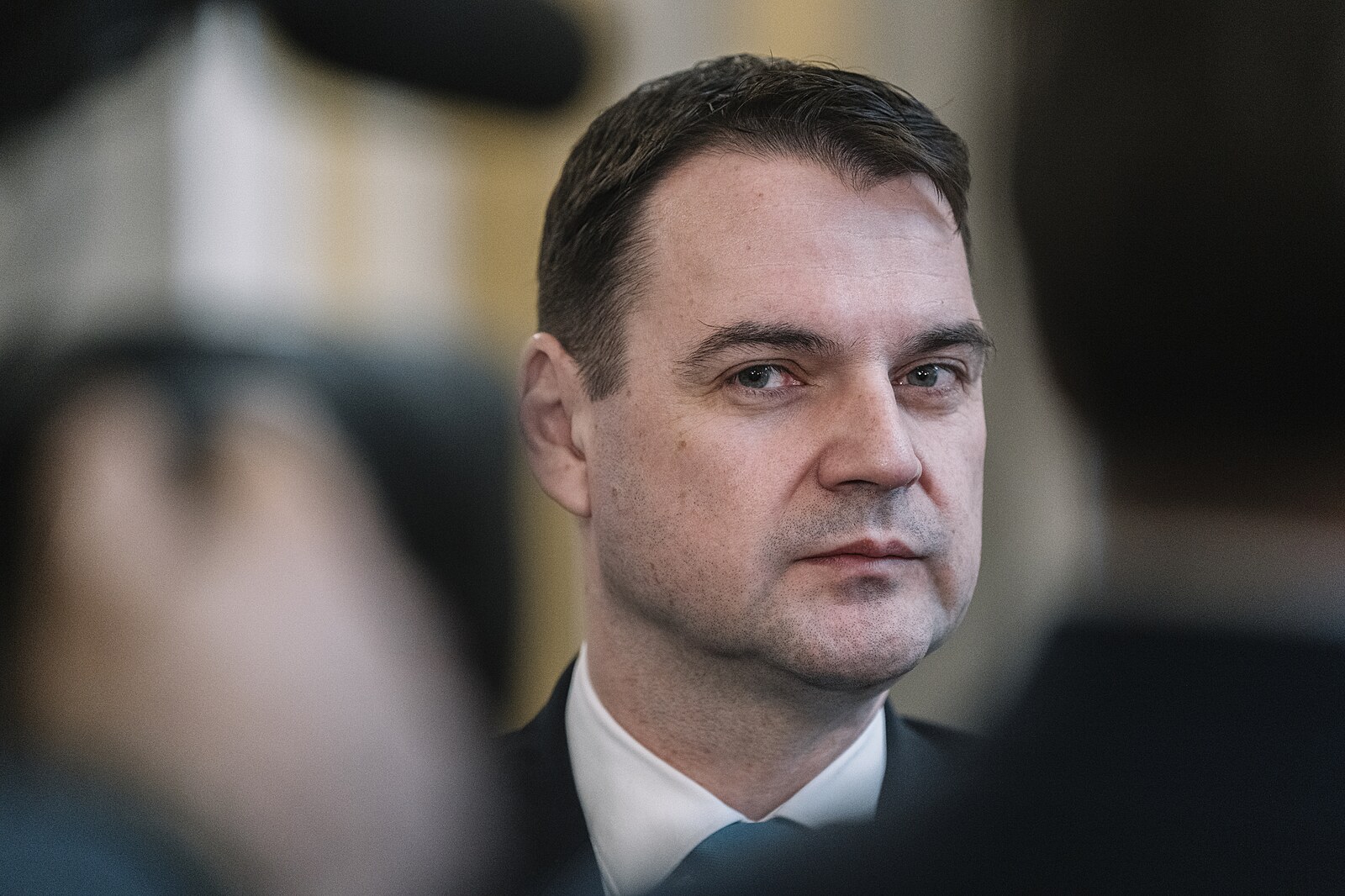
Prague – The Czech political landscape is undergoing a notable shift, with the relatively new party Motorists for Themselves, led by Deputy Prime Minister Petr Macinka, gaining traction while the former governing coalition, Spolu, struggles to regain its footing. Recent polling data suggests a growing disconnect between traditional political forces and a segment of the Czech electorate increasingly receptive to Macinka’s populist messaging. This comes as Macinka continues to navigate a complex political role, simultaneously serving as Deputy Prime Minister and Minister of Foreign Affairs.
Macinka’s rise is particularly striking given the party’s origins. Motorists for Themselves, rebranded in 2022, has successfully tapped into voter frustrations with established parties, focusing on issues like fuel prices and transportation concerns. The party’s recent performance, bolstered by Macinka’s visibility on the international stage – including a speech at the United Nations – has defied expectations and unsettled the established political order. The current government, the third cabinet led by Andrej Babiš, relies on Macinka’s party for support, adding another layer of complexity to Czech politics.
Macinka’s Ascent and the Decline of Spolu
Petr Macinka, born in 1978, has rapidly become a prominent figure in Czech politics. His background includes a long association with former President Václav Klaus, serving as a spokesman at the Václav Klaus Institute and as deputy director of the Presidential Press Department. He studied political science and international relations at CEVRO University, earning a master’s degree in 2013. His political career gained momentum with the rebranding of Motorists for Themselves in 2022, and his election to the Chamber of Deputies in 2025 solidified his position as a key player.
The contrasting trajectory of the Spolu coalition – comprised of the Civic Democratic Party (ODS), KDU-ČSL, and TOP 09 – highlights the changing dynamics. Recent polls indicate a decline in support for Spolu, with internal divisions and a perceived lack of responsiveness to voter concerns contributing to their struggles. The ODS, in particular, faces challenges as voters appear to be gravitating towards alternative options, including Macinka’s Motorists for Themselves. According to data from XTV.cz, ANO currently leads with over 36 percent support, while Motorists for Themselves have reached 7.1 percent, signaling a significant shift in voter preferences.
Polling Data and Voter Sentiment
Several recent polls confirm the growing support for Motorists for Themselves. A survey conducted by Novinky revealed a boost in support following Macinka’s address to the United Nations. Seznam Zprávy reported that support for Motorists for Themselves has surpassed seven percent, while support for the Kubovo hnutí (likely referring to a separate political movement) has declined. Deník N also noted the challenges facing the ODS, with Kubovo hnutí continuing to perform well in recent polls. These findings collectively paint a picture of a fragmented political landscape where traditional allegiances are weakening and new forces are emerging.
The shift in voter sentiment appears to be driven by a combination of factors, including economic anxieties, dissatisfaction with mainstream political parties, and a desire for alternative solutions. Macinka’s focus on issues directly affecting everyday citizens, such as fuel prices and transportation costs, has resonated with a significant portion of the electorate. His populist rhetoric, while controversial to some, has proven effective in mobilizing support and challenging the established political narrative.
Macinka’s Current Roles and Responsibilities
As of December 15, 2025, Petr Macinka holds the positions of Deputy Prime Minister and Minister of Foreign Affairs in the third cabinet of Andrej Babiš. He briefly served as Acting Minister of the Environment from December 15, 2025, to February 23, 2026, before Igor Červený assumed the role. This dual role places Macinka at the center of both domestic and international policy-making, giving him significant influence within the Czech government. His ability to navigate these complex responsibilities will be crucial in shaping the future direction of the country.
Macinka’s appointment as Minister of Foreign Affairs is particularly noteworthy, given his previous experience as a presidential spokesperson and his close ties to Václav Klaus. This background suggests a potential shift in Czech foreign policy, potentially prioritizing national interests and a more assertive stance on the international stage. However, the extent of this shift remains to be seen, as Macinka also operates within the framework of the Babiš government’s broader policy objectives.
The Future of Czech Politics
The current political climate in the Czech Republic is characterized by uncertainty and volatility. The decline of the Spolu coalition, coupled with the rise of Motorists for Themselves, suggests a realignment of political forces is underway. The upcoming months will be critical in determining whether Macinka’s party can sustain its momentum and become a major force in Czech politics. The performance of ANO, currently leading in the polls, will also be a key factor in shaping the political landscape.
The challenges facing the Czech Republic are numerous, including economic pressures, social divisions, and geopolitical uncertainties. The ability of the government to address these challenges effectively will depend on its ability to forge consensus and build broad-based support. Macinka’s role as Deputy Prime Minister and Minister of Foreign Affairs will be crucial in navigating these challenges and shaping the future of the country. The political situation remains fluid, and further shifts in voter sentiment are likely as the Czech Republic approaches future elections.
The political landscape is further complicated by the diminishing support for other parties, such as Přísaha and the Green Party, which have largely disappeared from the polls. STAN (Starostové a nezávislí) may emerge as a significant force in the opposition, according to Classicřich Zajíc of XTV.cz, potentially playing a key role in shaping the political debate and holding the government accountable.
As the Czech Republic navigates these turbulent political waters, the actions of key figures like Petr Macinka will be closely watched. His ability to capitalize on the current momentum and translate it into lasting political influence will be a defining factor in the country’s future.
The next key event to watch will be the ongoing parliamentary sessions and any potential shifts in government policy as a result of the changing political dynamics. Further polling data will also provide valuable insights into evolving voter sentiment.
What are your thoughts on the rise of Petr Macinka and the challenges facing the Czech political system? Share your comments below and join the discussion.
Related reading