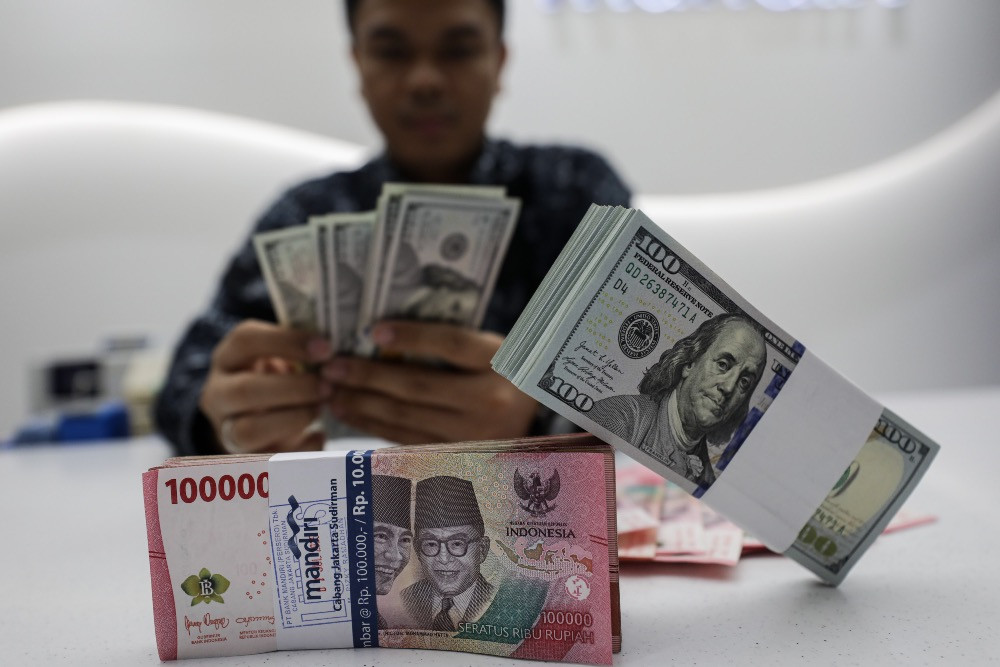
Jakarta, Indonesia – The Indonesian Rupiah experienced a weakening trend against the US dollar throughout Friday, March 13, 2026, as global market sentiment continued to exert influence. Throughout the day, exchange rates at several Indonesian banks fluctuated between Rp16,829 and Rp17,045 per US dollar. This follows a period of volatility influenced by geopolitical factors and broader economic trends. Understanding the rupiah’s performance requires a look at intraday movements, expert analysis, and the broader Asian currency landscape.
The day began with Bank Rakyat Indonesia (BRI) reporting a buying rate of Rp16,829 and a selling rate of Rp16,959 for the rupiah against the dollar as of 7:52 AM Western Indonesian Time (WIB). The dollar was trading at Rp17,045 for sales and Rp16,745 for purchases at BRI’s currency counters. Similar trends were observed at Bank Negara Indonesia (BNI), with a buying rate of Rp16,895 and a selling rate of Rp16,915 on its special rate product as of 8:05 AM WIB. BNI’s counter rates were set at Rp16,760 for buying and Rp17,060 for selling. These initial rates set the stage for a day of fluctuating values, reflecting the dynamic nature of the foreign exchange market.
Rupiah’s Midday and Closing Performance
By midday, the rupiah continued its downward trajectory. According to Bloomberg data, at 1:40 PM WIB, the exchange rate stood at Rp16.953 per US dollar, representing a 0.36% decline from the previous day’s close. Later in the trading day, at 6:32 PM WIB, the rupiah closed at Rp16.958, a 0.38% weakening against the dollar. The index dollar, meanwhile, strengthened to 100.18. This closing rate reflects the cumulative impact of market forces throughout the day, influenced by both domestic and international factors.
Lukman Leon, an analyst at Doo Financial Futures, anticipates that the rupiah’s movement will continue to be dictated by prevailing global sentiment. He predicts the rupiah will likely trade within a range of Rp16,850 to Rp16,950 in the near term. “The rupiah’s future movements will still be dictated by overall global sentiment, which continues to change,” Leon stated. This assessment suggests a cautious outlook, acknowledging the ongoing uncertainties in the global economic landscape.
Broader Asian Currency Trends
The rupiah’s weakening was not an isolated event. Most Asian currencies also experienced declines against the US dollar on Friday, March 13, 2026. The Philippine Peso suffered the largest correction, falling 0.44%, followed by the Malaysian Ringgit, which weakened by 0.24%. The Indian Rupee decreased by 0.20%, while the Singapore Dollar saw a slight decline of 0.04%. The Taiwanese Dollar and Chinese Yuan also experienced modest depreciations, falling by 0.10% and 0.01%, respectively. University of Illinois Athletics reported on related market activity.
However, not all Asian currencies weakened. The Japanese Yen saw a slight appreciation of 0.19%, and the Thai Baht gained 0.09%. The South Korean Won remained relatively stable against the dollar. These divergent trends highlight the varying economic conditions and policy responses across the region.
Factors Influencing the Rupiah’s Performance
The rupiah’s recent performance is influenced by a complex interplay of factors. Geopolitical tensions, particularly in the Middle East, continue to cast a shadow over global markets, contributing to risk aversion and a strengthening of the US dollar as a safe-haven asset. The dollar’s strength puts downward pressure on emerging market currencies like the rupiah. Global economic growth prospects and US monetary policy decisions play a significant role in shaping investor sentiment and capital flows.
The US Federal Reserve’s stance on interest rates is a key factor to watch. Any signals of a more hawkish approach – indicating a potential for further rate hikes – could further strengthen the dollar and put additional pressure on the rupiah. Conversely, a more dovish stance – suggesting a pause or even a cut in interest rates – could provide some relief for the rupiah. Monitoring these policy signals is crucial for understanding the rupiah’s future trajectory.
Impact of Global Economic Conditions
Broader global economic conditions also play a role. Slowing growth in major economies like China and Europe could dampen demand for Indonesian exports, potentially weakening the rupiah. Conversely, strong economic performance in these regions could boost demand for Indonesian goods and support the rupiah. Indonesia’s trade balance – the difference between its exports and imports – is a key indicator of its economic health and a significant driver of the rupiah’s value.
Looking Ahead: Key Considerations
Looking ahead, several factors will be critical in determining the rupiah’s performance. The ongoing situation in the Middle East remains a major source of uncertainty. Any escalation of tensions could trigger a flight to safety, further strengthening the dollar and weakening the rupiah. Monitoring geopolitical developments closely is essential.
Indonesia’s domestic economic policies will play a crucial role. The government’s efforts to control inflation, maintain fiscal stability, and promote economic growth will all influence investor confidence and the rupiah’s value. The central bank, Bank Indonesia (BI), will also be closely watched for its monetary policy decisions. BI’s interventions in the foreign exchange market can help to stabilize the rupiah, but their effectiveness is limited by broader global forces.
The next key data release to watch will be Indonesia’s inflation figures for March, scheduled to be published in early April. These figures will provide insights into the effectiveness of the government’s efforts to control price pressures and will likely influence BI’s monetary policy decisions. Investors will also be closely monitoring Indonesia’s trade balance data for February, which will be released in mid-March, for indications of the country’s export performance.
Key Takeaways:
- The Indonesian Rupiah weakened against the US dollar on Friday, March 13, 2026, closing at Rp16.958.
- Most Asian currencies also experienced declines against the dollar, influenced by geopolitical tensions and global economic uncertainty.
- Analyst Lukman Leon predicts the rupiah will trade between Rp16,850 and Rp16,950 in the near term.
- Indonesia’s inflation figures and trade balance data will be key indicators to watch in the coming weeks.
The rupiah’s performance remains sensitive to global events and domestic economic conditions. Investors and businesses operating in Indonesia should closely monitor these factors to assess the potential risks and opportunities. The next significant update regarding Indonesia’s economic performance will be the release of the March inflation data in early April. Stay informed and adapt your strategies accordingly.
Keep reading