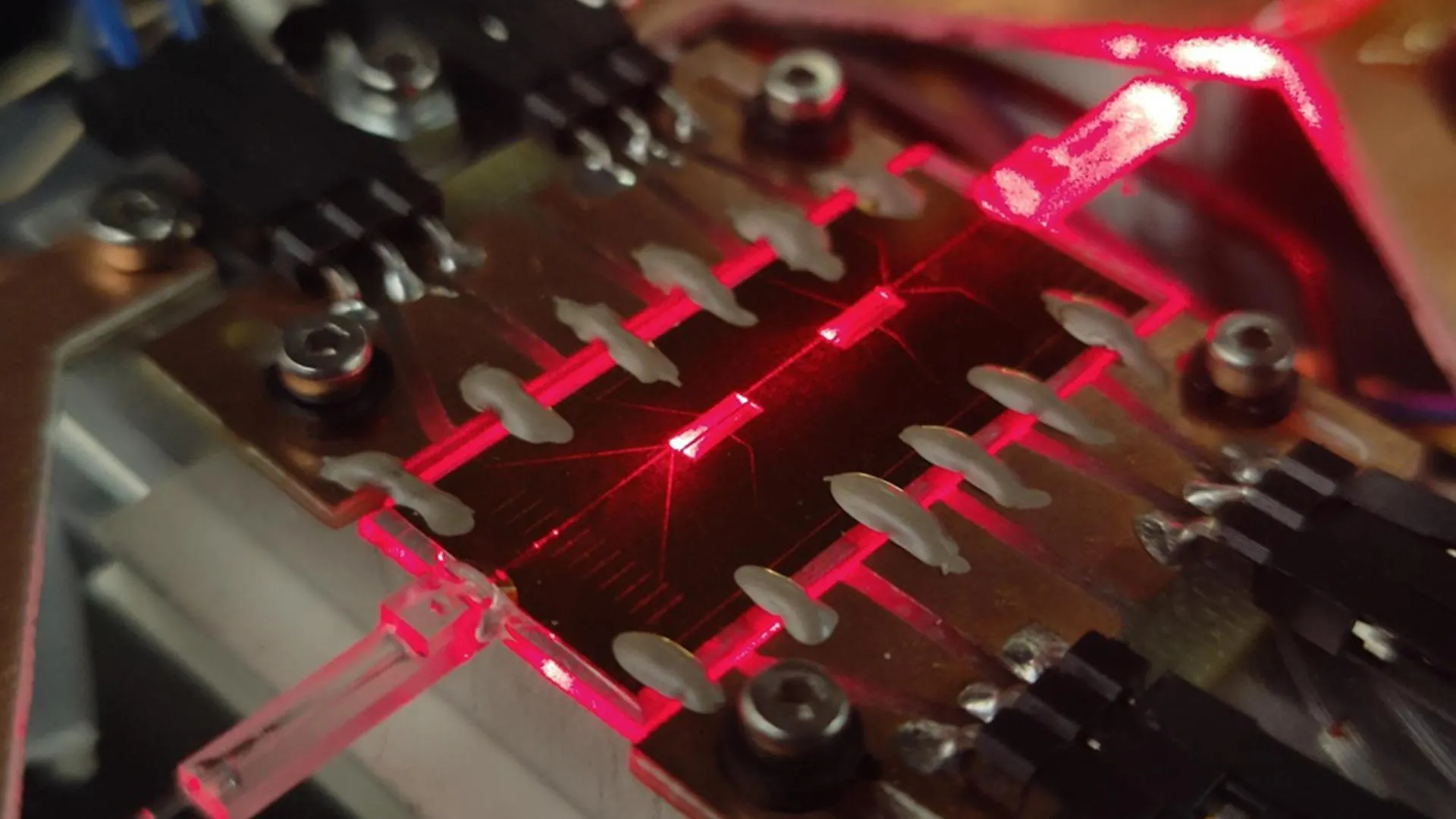
For decades, glass has been the silent backbone of our digital age, serving as the primary medium for the fiber-optic cables that carry the world’s data. Now, physicists have found a way to move beyond using glass as a mere conduit, transforming the material itself into a sophisticated quantum security device capable of protecting sensitive information from the looming threat of quantum computing.
Researchers from the University of Padua, Politecnico di Milano, and the CNR Institute for Photonics and Nanotechnologies have developed a laser-written glass chip that could fundamentally change how we secure data. By utilizing borosilicate glass, the team has created a high-performance quantum coherent receiver that integrates both ultra-secure encryption and high-speed random number generation into a single, compact system.
The breakthrough, reported in the journal Advanced Photonics, addresses a critical vulnerability in modern cybersecurity. As quantum computers grow more powerful, traditional encryption methods—which rely on the mathematical complexity of factoring large numbers—could eventually be cracked. Quantum cryptography offers a solution by relying on the laws of physics rather than math, ensuring that any attempt to intercept data is immediately detectable.
However, transitioning this technology from a controlled laboratory setting to the real world has long been hindered by the need for stable, compact devices that can read fragile quantum signals without disturbing them. This new glass-based platform appears to bridge that gap, offering a path toward practical, deployable quantum network infrastructure according to reports from SPIE.
The Science of Femtosecond Laser Writing
The core of this innovation lies in the use of borosilicate glass and a precision manufacturing technique known as femtosecond laser writing. Unlike traditional chip fabrication, which often involves etching materials on a surface, this method allows researchers to write the photonic circuits directly inside the glass.
This approach provides several distinct advantages over previous methods. As the components are embedded within the glass, the resulting chip is inherently stable and resistant to harsh environmental conditions. The process results in low optical loss, meaning the delicate quantum signals carried by light can travel through the device with minimal degradation.
One of the most significant hurdles in quantum communication is the need for a coherent receiver. In continuous-variable (CV) quantum information processing, the system must measure the amplitude and phase of light waves. This requires combining a weak quantum signal with a stronger reference beam to analyze their interference. While most integrated receivers have historically been built using silicon, the use of glass provides a more versatile and stable alternative for these precise measurements.
Unlocking QKD and QRNG
The versatility of the laser-written glass chip allows it to handle two primary functions essential for quantum security: Quantum Key Distribution (QKD) and Quantum Random Number Generation (QRNG).
- Quantum Key Distribution (QKD): This process allows two parties to produce a shared random secret key known only to them, which can then be used to encrypt and decrypt messages. Because it is based on quantum mechanics, any attempt by an eavesdropper to intercept the key would alter the quantum state of the photons, alerting the users to the breach.
- Quantum Random Number Generation (QRNG): True randomness is the bedrock of strong encryption. Unlike software-based “pseudo-random” numbers, QRNG uses the inherent unpredictability of quantum physics to generate numbers that are impossible to predict or replicate.
By combining these two capabilities into one compact system, the researchers have created a device that is not only prompt and secure but also highly versatile. This integration is a key step in reducing the footprint of quantum security hardware, making it more feasible to integrate into existing data centers and communication hubs as detailed by Science Daily.
Why Glass Outperforms Traditional Platforms
The shift toward borosilicate glass is not incidental. The material is inert, stable, and cost-effective, which makes it an ideal candidate for scaling technology beyond the lab. When compared to silicon-based receivers, the glass platform offers polarization independence and full tunability, which are essential for maintaining the integrity of quantum states over long distances.
Perhaps most importantly, the glass chip is broadly compatible with existing fiber-optic infrastructure. Since the world’s current internet is already built on glass fibers, a quantum device made from similar materials can be integrated more seamlessly than devices requiring entirely new transmission mediums.
Comparison of Quantum Receiver Platforms
| Feature | Silicon-Based | Laser-Written Glass |
|---|---|---|
| Environmental Stability | Moderate | High (Inert/Stable) |
| Optical Loss | Variable | Low |
| Integration | Requires specific interfaces | Compatible with fiber-optics |
| Fabrication | Surface etching/Lithography | Internal femtosecond writing |
The Path Toward a Quantum Internet
While this development is a significant milestone, the road to a fully realized “quantum internet” involves more than just a single chip. It requires the deployment of quantum repeaters and a global network of compatible receivers and transmitters. However, the ability to manufacture these devices using cost-effective, durable materials like glass removes one of the primary barriers to entry.
The perform conducted by the University of Padua, Politecnico di Milano, and the CNR Institute for Photonics and Nanotechnologies demonstrates that the materials we already use for communication can be repurposed to protect that communication. As quantum computing capabilities advance, the transition to physics-based security will likely move from a theoretical luxury to a practical necessity.
For those following the development of quantum networking, this research highlights a shift toward “practical deployment”—moving away from fragile laboratory prototypes and toward ruggedized, scalable hardware according to Phys.org.
The next phase for this technology will likely involve testing these chips in larger, real-world fiber-optic networks to determine how they perform over hundreds of kilometers of existing infrastructure. While a specific date for commercial availability has not been announced, the successful demonstration of the coherent receiver in Advanced Photonics marks a critical checkpoint in the timeline of quantum security.
What are your thoughts on the shift toward quantum-resistant encryption? Do you believe the infrastructure is ready for this transition? Let us know in the comments below.
Related reading