
Designing broadband antennas that maintain consistent performance across wide frequency ranges remains a critical challenge in modern communications engineering. Log-periodic dipole array (LPDA) fed parabolic reflector antennas have emerged as a powerful solution for applications requiring high gain and stable impedance matching from 100 MHz to 1 GHz. These systems combine the broadband characteristics of LPDAs with the focusing ability of parabolic reflectors, making them ideal for radar, satellite communications, and electromagnetic compatibility testing.
Recent advances in electromagnetic simulation software now enable engineers to model these complex multiscale structures with unprecedented accuracy. According to verified technical documentation, WIPL-D’s 3D Method of Moments (MoM) solver supports the simulation of electrically large antenna systems by leveraging higher-order basis functions, quadrilateral meshing, and GPU parallelization. This capability allows designers to analyze structures that would be computationally prohibitive using traditional methods, reducing reliance on physical prototyping.
The design process for LPDA-fed reflector antennas follows a systematic three-step workflow validated through industry practice. First, engineers optimize the standalone LPDA element for voltage standing wave ratio (VSWR) and gain across the target bandwidth. Second, the optimized LPDA is integrated with the parabolic reflector, accounting for mutual coupling effects. Finally, geometric and parametric tuning adjusts the system to meet all performance specifications, including impedance matching and radiation pattern requirements.
Key Technical Considerations in LPDA-Reflector System Design
Bandwidth ratio stands as a fundamental specification when defining design requirements for these antennas. For systems operating from 100 MHz to 1 GHz, the bandwidth ratio reaches 10:1, demanding careful attention to frequency scaling principles inherent in LPDA geometry. Gain targets typically range between 15 to 25 dBi depending on reflector size and illumination efficiency, even as VSWR must remain below 2:1 across the entire band to ensure efficient power transfer from feed lines.
Advanced 3D EM solvers overcome traditional limitations through several technical enhancements. Higher-order basis functions improve current representation accuracy on curved surfaces, reducing the number of unknowns needed for convergence. Quadrilateral meshing conforms better to antenna geometries than triangular elements, particularly for wire-to-solid transitions in LPDA arms. Geometrical symmetry exploitation cuts computational resources by modeling only symmetric sections, and CPU/GPU parallelization distributes matrix filling and solving tasks across multiple cores.
Parametric computer-aided design (CAD) modeling significantly accelerates optimization cycles for these antennas. Self-scaling geometry features allow engineers to define LPDA element dimensions using mathematical ratios rather than fixed values, enabling instant regeneration of entire arrays when scaling factors change. Automated wire-to-solid conversion transforms thin-wire approximations into realistic tubular conductors for accurate surface current modeling. Multiple-copy-with-scaling functions replicate structural elements while applying progressive size reductions, essential for creating the logarithmic progression of dipole lengths in LPDAs.
Simulation-Driven Workflow Advantages
Using full-wave simulation early in the design cycle identifies potential issues before hardware fabrication. Engineers can visualize near-field distributions to detect unwanted coupling between the LPDA feed and reflector rim, predict cross-polarization levels, and assess sensitivity to manufacturing tolerances. Frequency sweeps across the 100 MHz to 1 GHz range reveal impedance trends and guide matching network design without building numerous physical prototypes.

The integration phase requires particular attention to the feed point’s location relative to the reflector’s focal point. Simulations reveal that even modest displacements can significantly affect aperture efficiency and sidelobe levels. Parametric studies allow rapid evaluation of dozens of configurations—varying reflector f/D ratio, LPDA boom taper rate, and ground plane dimensions—to find optimal trade-offs between gain, bandwidth, and physical size.
Practical Applications and Industry Impact
LPDA-fed reflector antennas serve critical roles in defense and aerospace sectors where broadband signal interception and transmission are essential. Electronic warfare systems use them for direction-finding across wide spectrums, while radio astronomy observatories employ similar concepts for continuum observations. In commercial electromagnetic testing, these antennas facilitate immunity and emissions testing per IEC and CISPR standards by providing consistent illumination over decades of frequency.
Educational institutions and research laboratories benefit from simulation accessibility when studying antenna theory. Students can experiment with parametric variations in LPDA design—such as tau (scale factor) and sigma (spacing factor)—and immediately observe impacts on VSWR and radiation patterns. This hands-on computational approach bridges theoretical concepts with practical engineering outcomes.
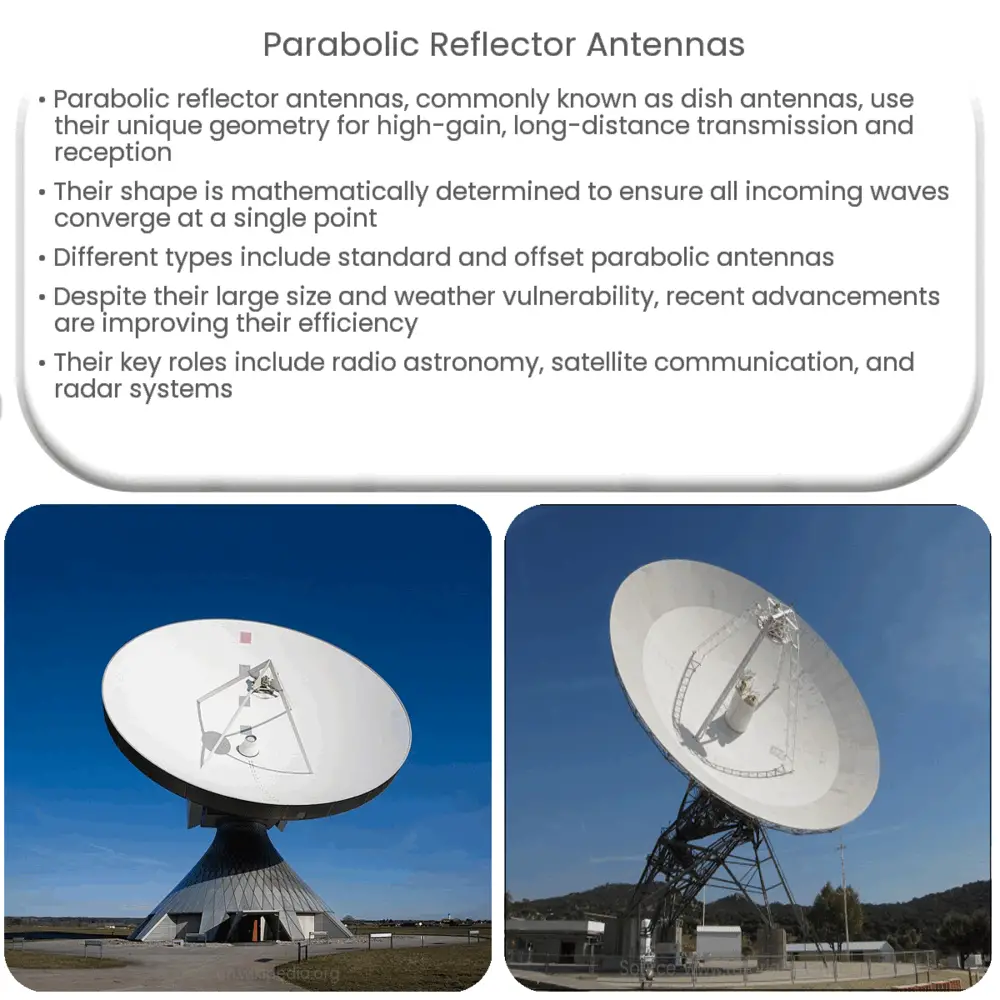
As communication systems push toward wider bandwidths for 6G and advanced radar, the demand for verified simulation tools in antenna design continues to grow. Engineers seeking to implement LPDA-fed reflector systems can access validated workflows through peer-reviewed technical literature and software-specific documentation, ensuring their designs meet rigorous performance benchmarks before entering production.
For professionals looking to deepen their understanding of broadband antenna design using full-wave EM simulation, authoritative resources remain available through established engineering publishers and simulation software vendors. Continued advancements in solver technology promise even greater accuracy for electrically large, multiscale antenna systems in future development cycles.
Related reading