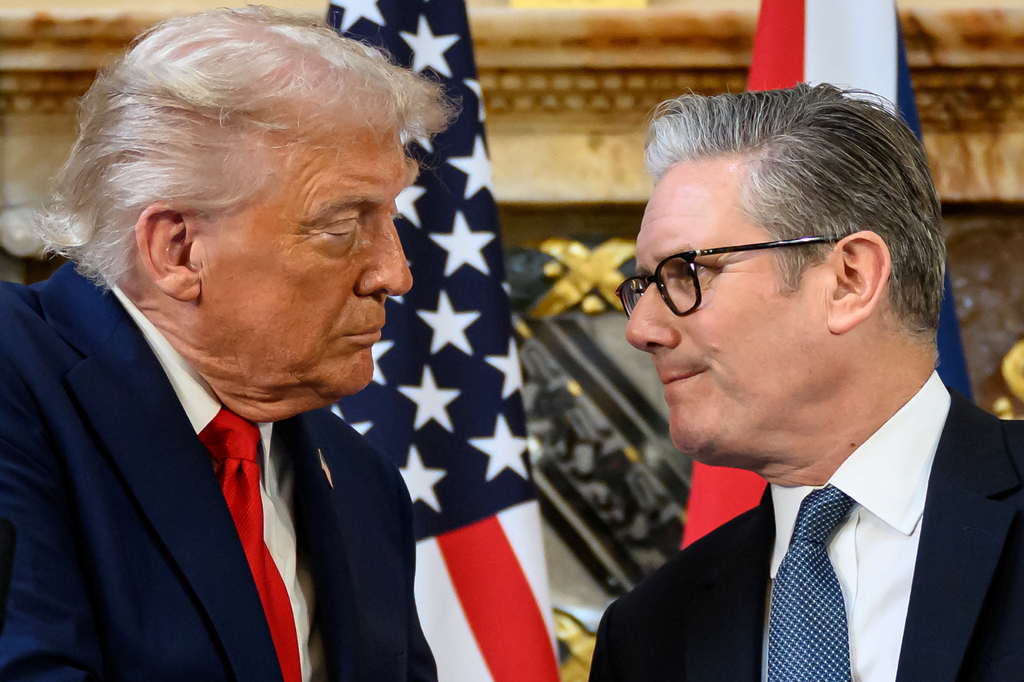
For decades, the United Kingdom has balanced its geopolitical identity between two pillars: the “Special Relationship” with the United States and its deep-rooted economic and cultural ties to continental Europe. However, as the world enters a period of heightened volatility, that balance is shifting. Under the leadership of Prime Minister Keir Starmer, the UK is navigating a precarious path, attempting to stabilize a domestic economy battered by Brexit while managing the unpredictable return of Donald Trump to the White House.
The core of the current tension lies in a perceived “America-drift.” While the UK has traditionally viewed the U.S. As its primary security and intelligence partner, the “America First” agenda—characterized by threats of universal tariffs and a transactional approach to NATO—is forcing London to reconsider its strategic dependencies. For the Starmer administration, the question is no longer just about the legacy of the 2016 referendum, but about survival in an era of protectionism. The result is a cautious but visible strategic pivot toward the European Union.
This shift is not a sudden leap back into full EU membership—a move that remains politically radioactive within the Labour Party—but rather a calculated “reset.” By seeking closer alignment with the EU’s regulatory frameworks and trade standards, the UK hopes to insulate itself from potential economic shocks emanating from Washington and regain a level of stability that has eluded the country since leaving the Single Market.
The Trump Variable: A Strain on the ‘Special Relationship’
The return of Donald Trump to the U.S. Presidency has introduced a level of uncertainty that the UK government is struggling to quantify. Central to this anxiety is the prospect of sweeping trade barriers. During his campaign, Trump proposed a baseline universal tariff on most foreign imports, a move that could severely disrupt the UK’s export economy. Given that the UK has yet to secure a comprehensive free trade agreement (FTA) with the U.S.—a goal that remained elusive throughout the post-Brexit era—London finds itself vulnerable.
Beyond trade, the security architecture of the West is under pressure. Trump’s historical skepticism regarding NATO’s collective defense obligations creates a vacuum in European security. For a UK government that views itself as a “bridge” between the U.S. And Europe, the possibility of a diminished American commitment to the continent makes the EU a more reliable, if more demanding, partner. The strategic imperative is now to ensure that the UK is not left isolated if the U.S. Pivots further toward isolationism.
the diplomatic friction is not merely economic. The divergence in approach toward global conflicts and climate goals suggests that the “Special Relationship” may be becoming more of a transactional arrangement than a shared ideological partnership. This realization is driving the Starmer administration to diversify its geopolitical portfolio, ensuring that the UK’s security and economic interests are not overly dependent on a single, volatile ally.
The Economic Imperative: Why Europe Matters Again
The economic argument for a pivot toward the EU is grounded in stark data. Since the implementation of the Trade and Cooperation Agreement (TCA), the UK has faced significant non-tariff barriers that have hampered small and medium-sized enterprises. According to analysis by the Office for National Statistics (ONS), trade frictions have contributed to a persistent drag on GDP growth compared to pre-Brexit projections.
The EU remains the UK’s largest trading partner and the cost of divergence is becoming increasingly apparent. From veterinary checks on food imports to the complexities of professional qualifications, the “red tape” of Brexit has acted as a tax on British industry. By pursuing a “reset,” Starmer is targeting specific areas of alignment—such as mutual recognition of professional qualifications and a veterinary agreement—that could reduce these frictions without requiring a return to the Customs Union.
The goal is to achieve “frictionless trade” in key sectors. If the U.S. Implements tariffs, the relative importance of the European Single Market increases. The UK cannot afford a trade war with the U.S. While simultaneously maintaining a cold relationship with its nearest neighbors. The economic logic is pushing the UK toward a model of “regulatory alignment,” where London adopts EU standards to ensure its goods can move more freely across the English Channel.
Starmer’s Strategic Reset: Pragmatism over Ideology
Prime Minister Keir Starmer has been careful to avoid the word “rejoin,” knowing that the ghost of the 2016 vote still haunts British politics. However, his approach is one of extreme pragmatism. The Labour government’s strategy is to improve the *quality* of the relationship with Brussels without reopening the *terms* of the exit. This involves a shift from the confrontational tone of previous administrations to one of cooperation and shared interest.
The “reset” is manifesting in several key areas:
- Security Pacts: Renewing and deepening security cooperation to combat irregular migration and organized crime.
- Regulatory Convergence: Exploring ways to align standards in chemicals, pharmaceuticals, and aviation to reduce business costs.
- Diplomatic Re-engagement: Re-establishing the UK as a constructive partner in EU-led initiatives on climate change and global health.
By framing these moves as “economic growth” initiatives rather than “pro-EU” political statements, Starmer is attempting to bypass the Brexit culture war. He is betting that the British public, weary of economic stagnation, will prioritize prosperity over the purity of “sovereignty.” Recent polling suggests this gamble may be paying off, as a growing percentage of the electorate now views the Brexit process as a failure, though this has not yet translated into a mandate for full membership.
The Domestic Hurdle: The Ghost of 2016
Despite the geopolitical and economic pressures, the path toward the EU is blocked by a formidable domestic barrier. The UK’s political landscape remains deeply polarized. Any move that is perceived as “Brexit in reverse” could trigger a backlash from the “Red Wall” seats—the former industrial heartlands that shifted toward the Conservatives in 2019 and which Labour needs to retain for long-term stability.
The risk for Starmer is that by moving too close to the EU, he may be accused of betraying the democratic will of the 2016 referendum. This creates a paradox: the very actions needed to save the UK economy from “America-drift” could potentially destabilize his government domestically. To manage this, the government is focusing on “incrementalism”—small, technical wins that improve trade but do not change the UK’s legal status as a non-member state.
However, the “Trump factor” may provide the necessary political cover. If the U.S. Becomes an overtly hostile trade partner, the narrative can shift from “rejoining the EU” to “protecting Britain from external shocks.” In this scenario, the EU is no longer viewed as a political entity to be feared, but as an economic shield against global volatility.
Comparison: The Two Pillars of UK Foreign Policy
| Feature | Relationship with the USA | Relationship with the EU |
|---|---|---|
| Primary Value | Intelligence & Global Security | Trade & Economic Stability |
| Current Risk | Tariffs & Unpredictability | Regulatory Divergence |
| Starmer’s Goal | Damage Limitation | Strategic Reset / Alignment |
| Political Sensitivity | Low (Generally bipartisan) | High (Brexit legacy) |
What Happens Next?
The trajectory of the UK’s relationship with the EU will likely be determined by the outcome of the first few months of the Trump administration’s trade policy. If the threatened universal tariffs materialize, the pressure on Starmer to accelerate alignment with the EU will become irresistible. We can expect to see an increase in bilateral meetings between London and Brussels focused on specific “carve-outs” for UK goods.

The next critical checkpoint will be the upcoming bilateral trade reviews and the scheduled summits between the UK Prime Minister and EU Commission leadership. These meetings will reveal whether the “reset” is merely rhetorical or if the UK is prepared to accept a degree of EU rule-making in exchange for market access.
the UK is learning a hard lesson about the nature of power in the 21st century: in a world of competing blocs, isolation is an expensive luxury. Whether through a gradual slide back toward the Single Market or a series of strategic pacts, the UK is rediscovering that its future is inextricably linked to the European continent.
Do you believe the UK should pursue full EU membership to protect its economy, or should it maintain its independence despite the risks? Let us know your thoughts in the comments below and share this article to join the conversation.
Worth a look